

Vertebral compression fractures can be miserably painful. They are also getting more common as the population ages. When someone presents with a painful compression fracture, doctors want to do something. That something is often balloon kyphoplasty (BK). They recommend BK even though they don’t know if it works.
The story of BK begins with vertebroplasty. When Vinay and I wrote Ending Medical Reversal, we were obsessed with vertebroplasty. From the index:
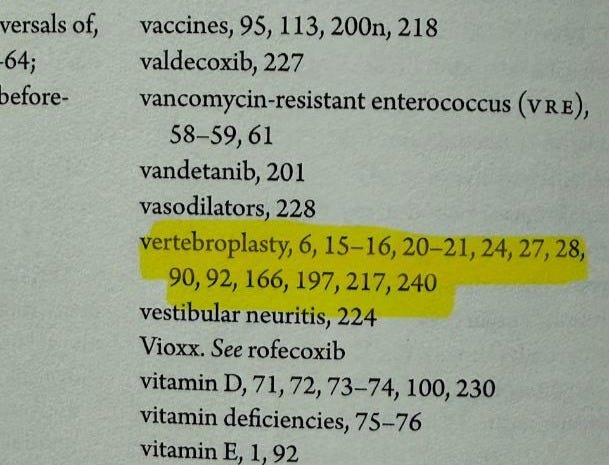
We were obsessed with vertebroplasty because it was a perfect example of a medical reversal. The procedure, injecting medical cement into a fractured vertebral body, was adopted because it made physiologic sense and was supported by obviously flawed data. In the aughts, it was also making people a lot of money. Then, in 2009, the New England Journal of Medicine published two randomized, sham-controlled trials of vertebroplasty.1 Both studies showed that vertebroplasty was no better than placebo. F/U studies bore out these results (more or less).2
Researchers went back to the drawing board to develop a better procedure and came up with balloon kyphoplasty. BK adds a step to vertebroplasty. In vertebroplasty, the proceduralist (usually a radiologist) places a needle into the fractured vertebral body and injects medical cement. In kyphoplasty, before the cement goes in, a balloon is inflated inside the vertebral body to create a cavity. The balloon is then removed, and the cavity is filled with cement. The thinking was that restoring some vertebral height and injecting cement at lower pressure (you’re filling a hole rather than injecting into collapsed bone) would improve outcomes and reduce risks.
You’d assume that after the vertebroplasty debacle, and the millions of copies that Ending Medical Reversal sold3, someone would test kyphoplasty in a sham-controlled trial.
If only.
To date, no sham-controlled trials of balloon kyphoplasty have been conducted. In 2017, a task force of the American Society for Bone and Mineral Research reviewed the evidence base for BK. Their article, published in the Journal of Bone and Mineral Research, is worth reading. They identified the lack of appropriately placebo-controlled trials and noted no data showing BK is better than vertebroplasty. Here is their conclusion:
The clinical importance of the greater improvements with BK versus NSM (non-surgical management) is unclear, may be due to placebo effect, and may not counterbalance short-term AE (adverse event) risks. Outcomes appeared similar between BK and other surgical interventions. Well-conducted randomized trials comparing BK with sham would help resolve remaining uncertainty about the relative benefits and harms of BK.
In summary, we know that vertebroplasty is no better than sham vertebroplasty, and we know that BK is no better than vertebroplasty.
So why are we using BK?
The pessimist might say it is because medical centers can make a whole lot more money doing BK than prescribing pain medications and calcitonin and waiting for time to take care of things.
The optimist will say that we don’t know that BK doesn’t help (you know, the whole absence-of-evidence-is-not-evidence-of-absence BS). They will say that people are hurting, so we should do something. They will also trot out an anecdote about how their aunt’s friend’s wife had a compression fracture and felt better after BK.
BK is analogous to so much else in medicine today. Because there is a market for unproven therapies, there is no incentive to study them. If a patient presents to me tomorrow with a compression fracture, the responsible thing to do would be to refer the patient into a sham-controlled trial of BK. A search on clinicaltrials.gov, however, tells me that there are no such trials. I have no hope that this will change because the people best positioned to run a sham-controlled trial are the ones who perform BK, are reimbursed for BK, and (hopefully) believe in BK.
The cost of ignorance is not trivial. There is a whole chapter in EMR on the harms of medical reversal. These include financial harms, opportunity costs, physical harms, and the loss of patients’ trust. BK risks include cement leakage, adjacent-level fractures, and the harms of intervening in frail older adults.
When you are next asked why America spends so much money on healthcare without better outcomes, bring up BK as an example. Or maybe bring up Galleri. Or maybe the invasive treatment of intermediate-risk PE. Or colon cancer screening in people in their 70s. Or left atrial appendage closure in atrial fibrillation.
Oh hell, just tell them to call me.
Buchbinder and Kallmes
That was a joke.
Pair the do something bias with broad spectrum financial incentives, and you get the juggernaut of ever-rising medical insurance costs with justified cynicism to boot.
I wish we were able to educate patients about available therapeutic options.
I was hoping AI would help the medical literacy of non-medical people.
Out of curiosity, I asked the Google Gemini - " I am 82 year old and have a fracture in my backbone. Should I have a balloon kyphoplasty?" and it answered,
"Balloon kyphoplasty is widely considered safe and effective for patients in their 80s, though whether it is right for you depends on your pain level and how recently the fracture happened. Being 82 does not rule you out, as the procedure is minimally invasive and routinely performed on older adults with osteoporosis." . This was the answer on the top and the source was Hospital of Special Surgery in NYC - the major orthopedic surgery hospital.
AI may even increase the health care cost, as it just pushes the existing medically inaccurate narrative that a lot of health care marketing people working for the hospital and the industry are propagating.
I am hoping a new group of senates will shed the light to this practice and empower FDA to oversight the clinical studies run by the industry, and make sure only the effective intervention/treatments are reimbursed at a negotiated price.