

Dr. Mohammed Ruzieh, my colleague at Cardiology Trials Substack, led this analysis of seven randomized controlled trials of left atrial appendage closure (LAAC) vs oral anticoagulation in patients with atrial fibrillation (AF).
The journal Trends In Cardiovascular Medicine published the meta-analysis (authors’ link to full paper).
The idea behind a meta-analysis is to combine similar trials to learn summary effects. The best-case scenario for meta-analyses is when it combines similar trials of similar patients. You hope that by combining trials, and increasing numbers of events, power to detect a signal would be increased.
There have been (roughly) seven trials studying the two strategies of stroke and bleeding reduction in patients with AF. PROTECT and PREVAIL were the early LAAC vs warfarin trials. PRAGUE-17, WATCH-TAVR, OPTION, CLOSURE AF and CHAMPION AF were mostly LAAC vs the newer direct acting oral anticoagulants (DOAC).
Our efficacy endpoints of interest were thrombotic events (stroke, ischemic stroke and systemic embolism) and the safety endpoints were bleeding events (major bleeding and hemorrhagic stroke).
We also put two twists into the meta-analysis: we added a Bayesian analysis which describes the probability that LAAC was non-inferior to anticoagulation. And we added a trial sequential analysis, which treats the accumulating evidence of multiple trials as a single meta-analysis with repeated interim looks—so as to avoid false-positive conclusions from too many looks at the data. The TSA outputs a total sample size needed to reliably detect or rule-out a given effect.
Before I tell you the results, let me set out that a core problem with these trials is that stroke (and bleeding) are thankfully low incidence events. For instance, the DOAC vs warfarin trials each enrolled well more than 10,000 patients per trial to sort differences in stroke. The total combined patients in the seven LAAC trials was only 7,353 patients.
Another crucial point about the trials was that each used composite primary endpoints that included many outcomes—not just stroke. Some included death due to cardiovascular causes, others included bleeding, others both CV death and bleeding. The reason for the composites were that since stroke has such a low incidence you’d need tens of thousands of patients. The problem with composites is that CV death is unlikely to be affected by either LAAC or anticoagulation.
For the meta-analysis we broke out the main outcomes of interest: stroke and bleeds.
Results
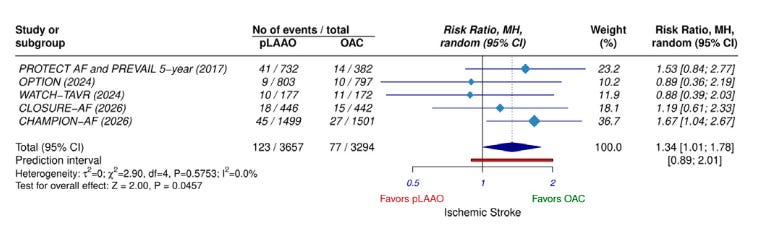
Here is what a typical Forest plot looks like (for ischemic stroke).
Four trials reported ischemic stroke and systemic embolism. The relative risk (RR) was 1.48 with 95% CI from 1.06-2.07. An absolute risk increase of ≈ 10 per 1000 patient years.
Six trials reported ischemic stroke alone. The RR was 1.34 with 95% CI 1.01-1.78. Absolute risk increase was ≈ 8 more per 1000 patient-years.
Seven trials reported hemorrhagic stroke. The RR 0.65 with 95% CI 0.39-1.07.
Six trials reported major bleeding, including the procedure. The RR was 0.98 with 95% CI 0.84-1.15.
A Bayesian analysis found a 45% probability that the relative risk for LAAC vs AC for ischemic stroke or systemic embolism was less than the non-inferiority margin of 1.4 (or 40% worse than AC). And a 66% probability that the relative risk was less than 1.4 for ischemic stroke.
The trial sequential analysis found that the accrued sample size was well below the required size to definitively establish non-inferiority of LAAC vs AC. However, the major bleeding Z-curve crossed into the futility zone, meaning a 20% bleeding reduction is unlikely to ever be shown.
Comments
While I am biased by being an author on this paper, I see the data as strengthening the case against using LAAC as a substitute for oral anticoagulation. There is a clear signal of higher rates of ischemic stroke. From a Bayesian point of view, the probability of reaching non-inferiority for stroke and systemic embolism using a lax measure of 1.4 is less than 50%.
There also appears to be no safety advantage. Bleeding is not reduced, nor is hemorrhagic stroke.
Some might argue that even when you combine seven trials there remains uncertainty due to the small numbers of events. This is true. Yet the reason I don’t recommend LAAC to AC-eligible patients is that anticoagulation remains one of modern medicine’s most well-established beneficial therapies. Nearly 100,000 patients have been enrolled in oral anticoagulation trials, and the drug’s ability to reduce stroke is certain. So, to upend such a strong evidentiary signal, I would want much more compelling data. Instead we have higher stroke rates and no signal of lower bleeding with LAAC.
Keep in mind also, that patients who have LAAC still have to take a tablet. Instead of an anticoagulant, patients take an antiplatelet drug. And even aspirin can cause bleeding. In the 5000-patient AVERROES trial of apixaban vs aspirin in patients who had reasons not to take anticoagulation, major bleeding rates were similar on low-dose aspirin and apixaban.
Clinical Implications
Many LAAC proponents say that it can be offered to patients as an option. A patient might accept the higher rates of ischemic stroke. I disagree with this idea. Medical doctors are not in the business of recommending inferior therapies to patients. If LAAC fell within the noninferior bounds, I would consider it, but ischemic stroke is consistently higher with the device—from the first trials to the last one.
We also don’t know what to do for patients who cannot tolerate oral anticoagulation. Here, I am not talking about people who dislike bruising, but people who repeatedly bleed when giving anticoagulation. Some of my colleagues believe LAAC is a suitable alternative in these patients.
I don’t agree with this idea either. For one, these patients were excluded from the trials. There is zero data to go by. Second, patients who bleed with anticoagulation also bleed with antiplatelet drugs. Third, high-bleeding risk patients often have serious medical illnesses, which make them less not more likely to benefit from a focal stroke prevention strategy.
Final Sadness about a Regulatory Failure
More than 600,000 LAAC procedures have been done worldwide. If regulators had required evidence we would know whether this device actually worked.
If I were a regulatory leader, I would have said to proponents: we will pay for this device but only if the patient is in a trial. If a fraction of these 600,000 patients were randomized we would know the answer.
"...stroke (and bleeding) are thankfully low incidence events." So why bother with expensive drugs and interventions + what is the absolute risk reduction?