

Some argue that mainstream newspapers are incapable of covering science accurately— they lack scientific expertise. A recent NY Times article, seems to support this thesis. Let’s examine this article:
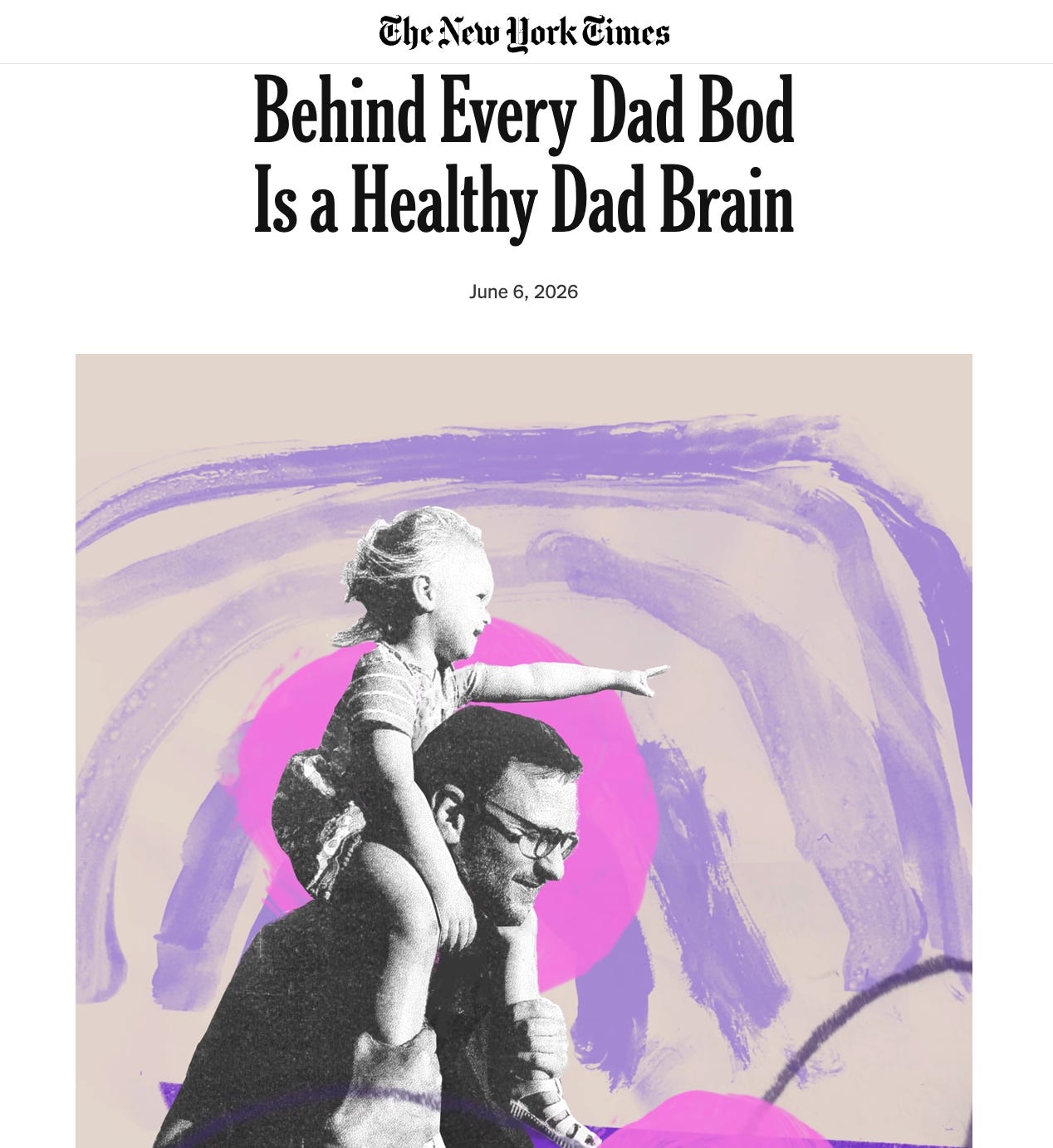
Before I clicked the link (they baited me), I already knew one important and obvious fact about the world. People do not have kids at random.
People who are in relationships, married, have kids, have jobs to support those families, etc, are different than those who don’t pursue these endeavors. While there are some perfectly happy and well-adjusted people without kids, there is undoubtedly a link between being agreeable, health seeking behavior, mental stability and having a family.
I am willing to bet people who have kids are less likely to smoke, more likely to do some physical activity (apart from chasing after kids), more likely to be able to get along with others (their co-parent/ spouse), and probably better off financially.
My question is: assuming that a “good brain”-parent relationship is true, did the authors do anything (anything at all) to separate the chicken from the egg? Did they try to answer the question: Do the kids come first, or is the type of person who has kids more likely to also… have good brain health (whatever that means)?
I click on the link to find out….
The op-ed writer begins, “as I discovered when researching my new book”
In my experience, people who discover something while writing a new book, and not before, seldom persuade me. Often, they twist the facts to fit their thesis (already sold to the publisher), rather than fashion the thesis upon the facts.
Very soon in the essay the author makes her claim causal. Having kids will improve your brain. Kids—> brain health, she claims, and not vice versa.

At last, I get to the key data (and a link) to support this claim.
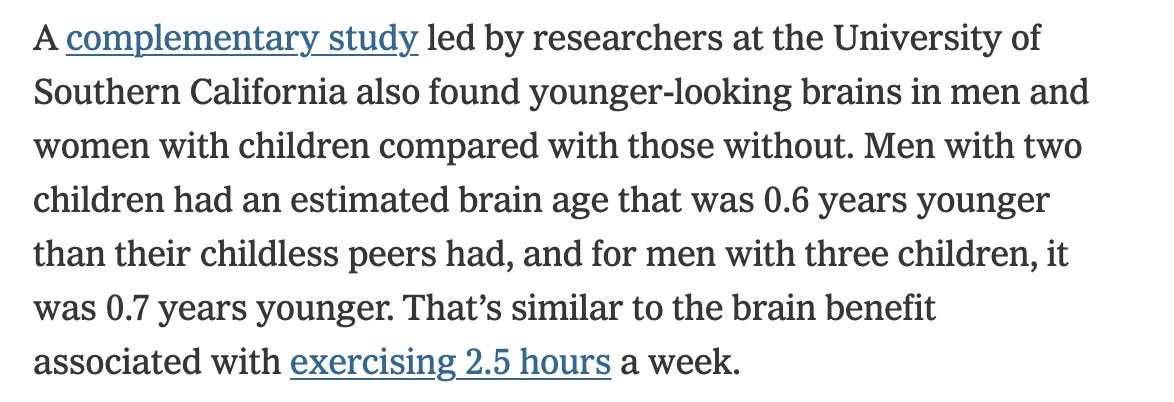
I pull the paper. It analyzes “brain metrics” by number of kids.
Question 1: are people who have kids otherwise similar to those who don’t?
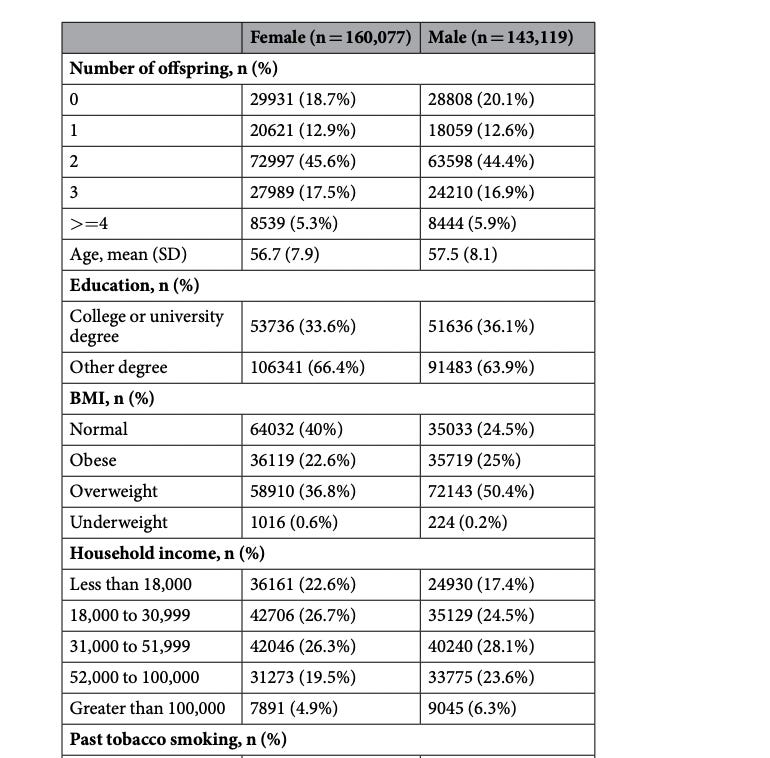
The authors have hidden this information. They provide demographic data for men and women, but do not separate the data by the number of offspring. They deprive the reader of the most important information. Both in the paper and supplemental tables. It is astonishing the editors permit this choice— it violates basic scientific standards— which requires displaying demographics among the groups you will compare. It’s astonishing peer reviewers did not ask for this (a commentary on asleep-at-the-wheel peer review).
Then they show their key finding.
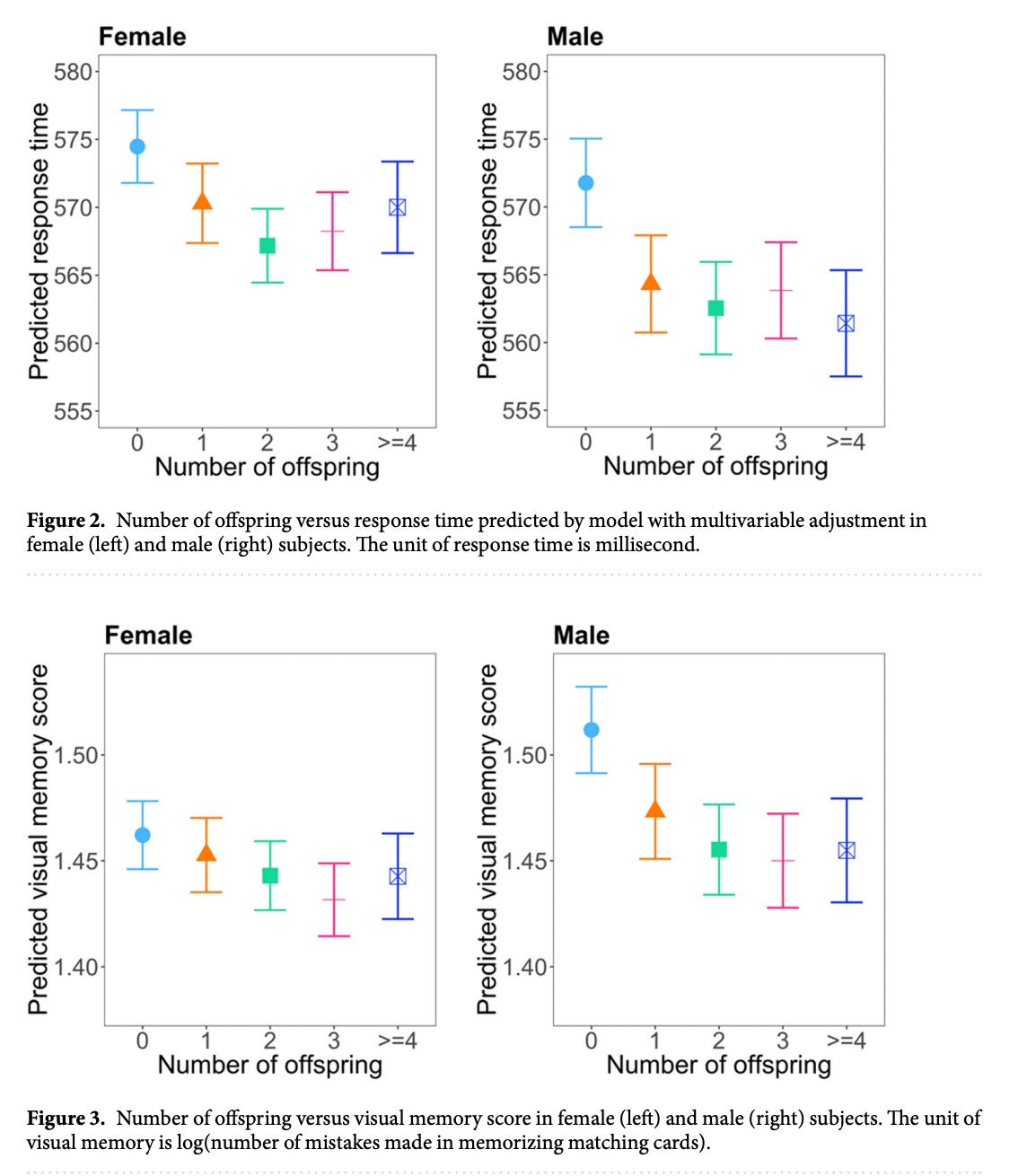
Yes, there is a relationship. No, the paper can’t separate the chicken and egg.
I read the full paper wondering if the authors employ any clever natural experiments. Just like economists used car seat laws to see if people were more likely to have 2 vs 3 kids (yes). They do not.
Any effort besides adjusting for some poorly measured covariates?
Nope.
The authors even concede this.

Note: I didn’t even explore whether the authors’ metric is actually a reliable, global indicator of brain health.
Who benefits and loses from science like this?
Winners are the authors of the paper- they increase their CV. They may even justify receiving federal funds. The journal editors— they fill their pages, and typically earn a small amount. The journal owners. They benefit from open-access fees and free content. They make more profit (in % terms) than the owners of oil and natural gas companies. The reviewers probably don’t benefit: they got paid nothing to not do their job. Like hiring a volunteer lifeguard that wanders away. The author of the op-ed wins big— gets to promote a book in the pages of the Times.
Who loses. The taxpayers who fund this work and the researchers’ salaries. The readers of the New York Times, who are not educated about good vs bad science.
What can be done?
The only solution is for newspapers to hire technical experts. The New York Times should have a John Mandrola. The Washington Post should have an Adam Cifu. Well, not Adam or John because Sensible Medicine owns them forever, but you get the idea; It is inconceivable to me that major news outlets operate without internal expertise in clinical appraisal if they are truly committed to the truth. Instead, when scientific questions arise, they look on Twitter for doctors they follow (who share their worldview) to provide commentary. A dangerous echo-chamber.
Bottom line: It is possible that all else being equal, deciding to have kids improves a man’s brain health. That might be the worst reason to have kids, but it is possible it is true. Yet, every bit of research presented in the op-ed fails to address the question. The op-ed author relies on the fact that the uninformed readers won’t question a narrative that fits their worldview.
The op-ed also offers many other evidence-free claims.
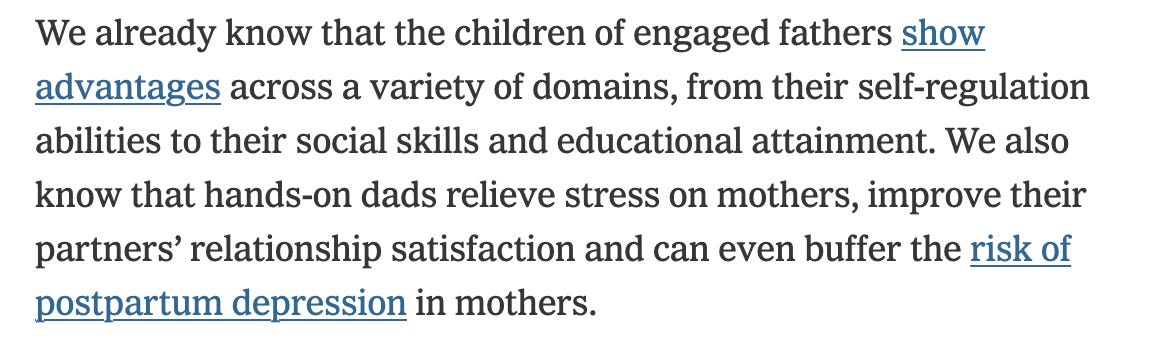
Being an engaged father improves kids self-regulation? Or… kids whose parents are disengaged do poorly for reasons besides the parenting? Maybe the parent is disengaged for the same reason the kid is doing poorly— they are in a tough life circumstance.
Hands on dads reduce postpartum depression…. let’s click the link. Wow, the paper measures the father’s performance based on the mother’s diary!
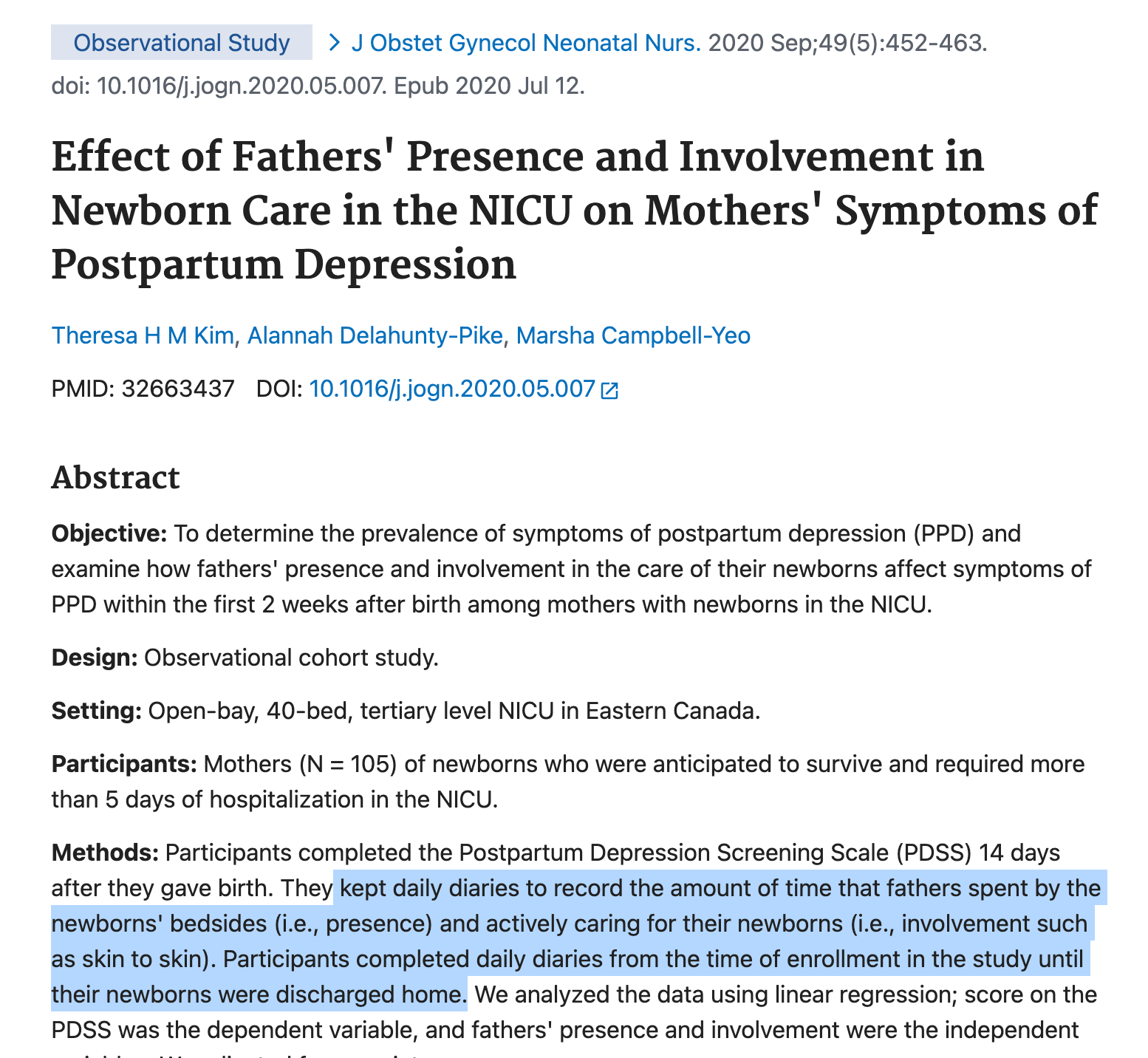
Is it possible that a mother who is more depressed may also feel like the partner is spending less time, and inaccurately document father’s presence?
Also, how does time spent by father in a small sample in the NICU generalize into “hands-on” parenting?
Maybe families who are poorer, have harder life circumstances, might have to have a man return to work sooner, so he can’t be at the NICU.
Like pulling on a thread on a cheap suit, the essay starts to fall apart entirely upon even superficial scrutiny. Strangely, it appears in the paper of record without any of this explaination.
So good. We joked about this article over breakfast this morning.
Dr. Prasad, "Strangely, it appears in the paper of record" Strangely? I would expect nothing less. I think reading NY Times, even if it was click bait, is your final Quixotic thing to overcome! I had first hand knowledge of two things written in the Times and they were both horribly inaccurate. So either they messed up just those two times (and this current article) or they just lie ALL THE TIME. Also, see Russian Collusion articles or anything ever about Covid. I wouldn't trust the P-Cubed Industrial Complex...what's that you ask? Press, Pharma, and Politicians