

The debate about whether online platforms, such as Kalshi, should be allowed to create a marketplace to bet on clinical trials is confused. Major news outlets, such as the New York Times, depict this as a dystopian scenario where gamblers hope drugs fail and patients suffer. The news coverage has forgotten that America already allows bets to be placed on the outcomes of clinical trials— this is true for many, but not all trials. Kalshi seeks to extend betting. What are the implications of this proposal?
First, a disclaimer: if you want to argue that we shouldn’t allow betting on any event— sports matches, political races, or clinical trials— that’s your prerogative, and, I will say, at least your position is logically consistent. Yet, the reality is Americans have voted many times— across cities and towns and states spanning decades— to permit betting.
Second, there is no bright line between Kalshi’s proposal and the current status-quo.
Consider the facts:
We already have widespread clinical trial betting for a subset of clinical trials. Any drug or device company with 1 lead product, which is publicly traded, and conducting a clinical trial is having investors bet on the results of that trial. Very likely there are millions of bets each day placed on the success or failure of a human clinical trial.
That is precisely what the stock price represents.
If a trial press release is positive, if the FDA issues a hold, if the FDA accepts a submission, if an ad-com is scheduled — the stock can go up or down 50x. If you buy a stock before a positive press release, you “bet” on that trial, and will make a windfall. If you short a stock before an ad-com, you are betting against favorable interpretation of that trial.
Critics of Kalshi and other platforms have to explain: why now? Why haven’t they taken efforts to prevent companies with 1 lead product from trading?
Betting on trials merely means extending what already happens with small companies to the large companies. Companies like Merck or Pfizer have stock prices which reflect market forecasts and penetration of existing products, as well as the hundreds or perhaps thousands of trials.
Kalshi is simply creating a level playing field. Currently you can bet on a start up pursuing a drug in rare disease, but not the cardiovascular outcomes of retatrutide? There is no moral, practical or logical difference.
What are the objections against Kalshi and other marketplace betting?
Insider trading. Critics say betting markets can allow insider trading. Insider trading is a concern, and one for which safeguards already exist. Here was one recent case:
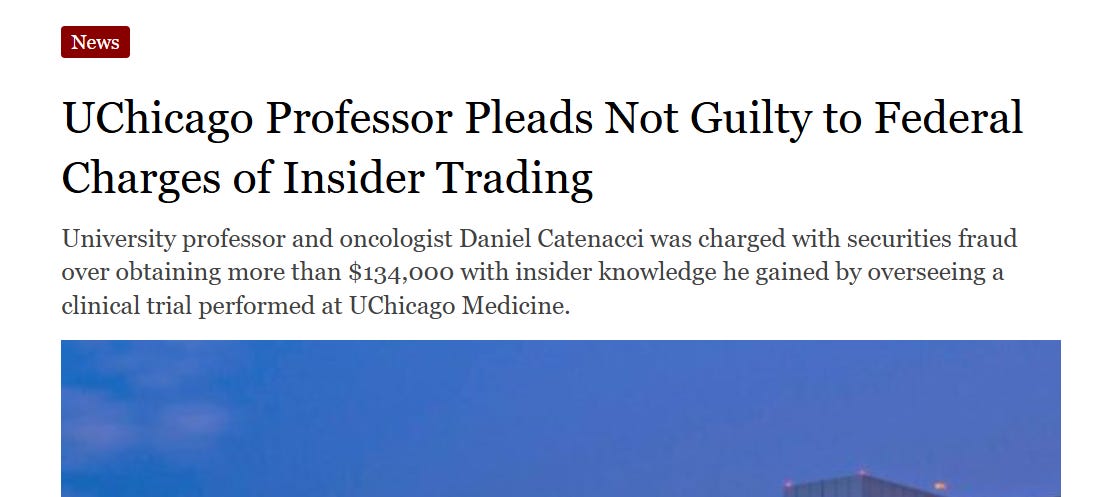
Kalshi is suggesting banning traders who are likely to have insider information— a standard more stringent than the current status quo, where an investigator at MD Anderson could have inside information AND make a trade on her brokerage account.
Furthermore, the risk of insider trading is not unique to clinical trials. You might know Messi is feeling weak before the Argentina match. Or that LeBron won’t play this Friday. There was a Kalshi betting market on when Graham Platner would drop out of the Maine race — a guy named Graham Platner could make a killing on that.
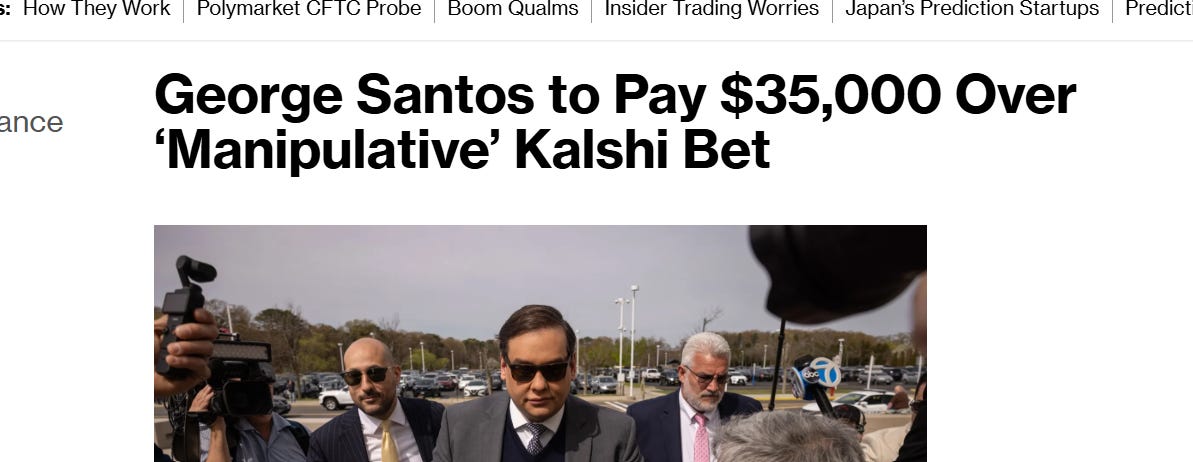
George Santos made a bet on George Santos, and was caught. I see no reason to doubt that current laws and processes will work here too. And if you disagree, again, explain to me why we allow trading companies with 1 lead product.
Patients lose heart in the study.
Imagine enrolling in a randomized trial of a cancer drug that causes an acne rash; you don’t get an acne rash, and the betting market is 98% that the trial will be positive. You know you got placebo. You can imagine a patient ghosting you. The patient stops coming to the visits. And the trial is ruined. Too much missing data.
I see a lot of commentors lament how making the odds of a trial success widely known will be bad for drug companies who want to accrue on lopsided trials.
But what about the patients.
If a trial is 98% going to be positive (p.s. many are), why are we running them? The easy fix here is: use an ethical control arm — and watch the betting market dip to 40-60% of being positive. Instead, the company was using the weakest, straw man comparator arm. You can’t have your cake and eat it too. You want to run an unethical trial and hide that from patients?
What about the other situation: There is only a 2% chance this will be a winner. Why is a company running that trial? Typically it is a one-product company with excess early capital hoping for a win — a Hail Mary pass. Patients should know not to join that study.
I have never been one to parrot the ridiculous lie in cancer medicine: that the best treatment is always a clinical trial — precisely because some trials are rigged at the outset. I have this knowledge from two decades in medicine; why shouldn’t patients have it too? Betting might even restore equipoise to trials.
It is distasteful
Some say it is distasteful to bet on a trial— when it might mean someone lives or dies. Kalshi allows you to bet on when a new Supreme Court justice will be confirmed. Hmmm, how would a seat open up? You can also bet on political causes and outcomes, government shutdowns, and some might argue that all betting is distasteful.
To claim it is uniquely distasteful, you have to carve a line between companies trading on the stock market with 1 key product and other companies. That just can’t be done. If anything, patients with rare diseases are subject to more trading, not less, in the current paradigm — as much of the new rare therapies come from fledgling companies, and while large companies pursue common indications like obesity.
It could be inaccurate.
Some argue the Kalshi betting market will have inaccurate odds. A trial might really have an 80-90% chance of being a win, but it is falsely lowballed at 30-40%. I am confident that in the beginning these miscalibrations will occur — but obviously that means there is a financial benefit to correcting those odds. With time, it may be that the Kalshi betting odds are closest to the real trial outcomes. Far better than “experts.” Would I bet on that? I would.
What is really going on?
I can’t help but be skeptical that the real opposition to betting on trials is driven by for-profit companies that don't want it revealed how bad our current trial landscape is. We routinely see companies testing their products against unethical, outdated comparators. Doctors and hospitals take money to run these trials. Patients are bamboozled every day. The current system depends on ignorance. Betting markets are a threat to that.
Would I bet on that explanation?
I would.
Might betting on trials be good?
By forcing manufacturers to ensure that both arms of a randomized study are in equipoise (ensure betting odds are 30-70% and not 98 or 2)— Kalshi might make investigators rethink unfair trials. Hindering extremely lopsided trials is likely good for science and medicine. Betting markets may mean patients can be better informed about the chance a therapy will help them. Right now, not everyone has access to an expert— Kalshi may democratize that.
It is easy for investigators to tell patients that every trial is great, wonderful, and worth your time— it is harder for them to say that if the odds tell a different story.
PS: Read my post and then the Times' take on this — note that the New York Times does not even mention that you can already bet on trials — companies with 1 product. They omit this information for readers. This is my issue with newspapers. Dishonest, and I believe the error is not of malice but ignorance.
https://www.nytimes.com/2026/07/28/business/kalshi-polymarket-prediction-market-drugs.html
Not just distasteful but unnecessary. If the goal is to make money -although for some people life is more than that-, there are so many things to bet on, why denigrate medicine opening it for betting?
Is betting open now for how the medical professional associations will react to this ?