

I am working on a column for Medscape on the announced null results of the ZEUS (ziltivekimab) and HORIZON (pelacarsen) trials. It’s big news because the lack of effect on major adverse cardiac outcomes (MACE) from both an anti-inflammatory agent and lipoprotein(a)-reducer surprised many in the field of cardiac prevention.
In two weeks, at the AHA meeting in Chicago, investigators will present the full results. The press releases describe decidedly null results for the overall trials.
ZEUS: For the the IL-6 inhibitor ziltivekimab the primary outcome of CV death, MI, and stroke were almost the same. (HR 0.99; 95% CI 0.88–1.11). Notably, it did its job in lowering markers of inflammation, such as hs-CRP.
HORIZON: For the Lp(a)-reducer pelacarsen, all we know is that trial failed to meet its primary outcome of CV death, MI, stroke and urgent coronary revascularization. It too reduced levels of Lp(a). We know from phase 2 trials that the drug reduced Lp(a) levels by 80%, though we don’t know what happened in HORIZON.
Both trials enrolled patients in whom you’d think the drugs would work. In ZEUS, patients had to have established vascular disease and chronic kidney disease and evidence of inflammation (hs-CRP ≥2). From the design/rationale paper, the baseline hsCRP was 4.5 mg/L. In HORIZON, patients had established vascular disease and high Lp(a) levels (≥ 70 mg/dl). From the design paper, the baseline Lp(a) level was 108 mg/dl.
The stakes for the makers of these drugs were high. A new inflammation-blocking drug would have been a big deal. Same for Lp(a); previous observational data had strongly correlated the genetically determined Lp(a) with the risk of cardiac events. A novel drug that lowers this particle might have made a lot of money.
The stakes weren’t just financial. Academically, there are many proponents of the inflammatory case for heart disease. While it is clear that inflammation plays some role in vascular disease, the search for a blockbuster anti-inflammatory agent has failed. Colchicine has shown only modest effects on cardiac events. Canakinumab had such a small effect, its makers did not pursue market release.
Many in the academy had high hopes for lowering Lp(a) as well. So the null findings from HORIZON will be a disappointment. Though there are other modulators of Lp(a) still in trials.
Beware of Subgroups
When there are both intellectual and financial interests in a drug, there may be a tendency to search for positive findings in these trials. For instance, the authors may say that in patients with the highest level of Lp(a) or hs-CRP, the drug looked better. One exception may be: HORIZON prespecified patients with Lp(a) ≥90 mg/dL as a specific group to look at, so a positive result there may deserve more weight than a typical subgroup.
Look no further than the drug sacubitril/valsartan in patients with heart failure and preserved ejection fraction (HFpEF). The pivotal trial, PARAGON HF, was null (HR 0.87, 95% CI 0.75-1.01), but the makers of the drug lobbied for approval in women and those with an LVEF less than 57% because those groups seemed to do better.

But these were two of many subgroups tested. I remain unconvinced that these are real. The main trial had a small (13%) reduction in the primary endpoint and it’s possible, even likely, that these results occurred by chance alone.
My simple understanding of subgroups are this: trials are powered for the full enrolled population. When we analyze a subgroup (say, male/female, old/young, diabetes/no diabetes), we compare smaller-sized groups. As such there are fewer events in these groups. Fewer events means a higher chance of detecting noise or missing a true signal. The other risk for detecting noise is multiple looks at the data. At a significant p value of less than 0.05, if you look at 20 subgroups, one would be expected to be positive by chance alone.
I discussed the classic example of detecting noise in subgroups back in 2022 when discussing medical vs N95 masks.
Richard Peto famously showed this in a landmark cardiology trial called ISIS-2, which found a benefit to aspirin after heart attack. Editors wanted to know which group had more or less benefit. Peto refused. But the Lancet forced him.
So, to make his point, he did an analysis of aspirin effects based on astrological sign. His team found that Libra or Gemini patients had no effect from aspirin, but all other signs had massive benefit. Peto explained in this paper:
To demonstrate the unreliability of subgroup analyses, these findings were subdivided into 12 subgroups according to the patients’ medieval astrological birth signs; the results in each were examined to find which of the 12 appeared least promising, and when just those with apparently unpromising results were collected together, it was ‘discovered’ that aspirin appeared totally ineffective for patients born under Libra or Gemini.
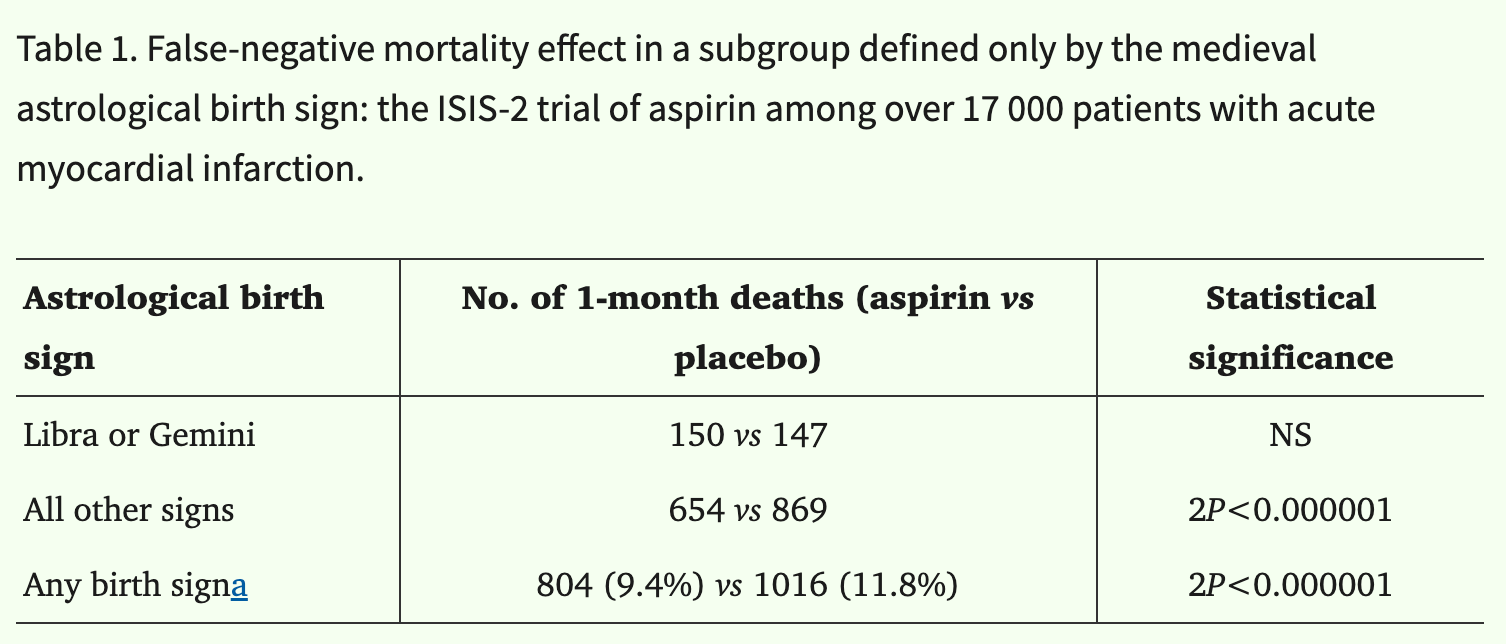
Peto described a few scenarios where subgroups may be helpful. Two factors are that both the subgroup and direction of effect should be prespecificed before the trial is done.
One example of a possible and plausible heterogeneous treatment effect comes from the DANISH trial of an implantable cardioverter defibrillator (ICD) or no ICD in patients with heart failure from non-ischemic causes. The main result was null, but there was an interesting subgroup wherein younger patients did better with the ICD and older patients seemed to do worse. This makes sense because an older patient would a) have more competing risks of sudden death and b) a higher risk of complications from the ICD.

While that subgroup finding makes sense (and the p value for interaction was positive), it’s still uncertain. We call such an observation “hypothesis-generating.” Meaning that to answer the question, we would randomize DANISH-like patients who were younger than age 59 to a trial of ICD vs no-ICD.
Another example of a subgroup finding that is likely true came from a study of renal function on statin effects. In this meta-analysis of 28 trials of statins, patients with the worst levels of kidney function seemed to garner no benefit from statins.
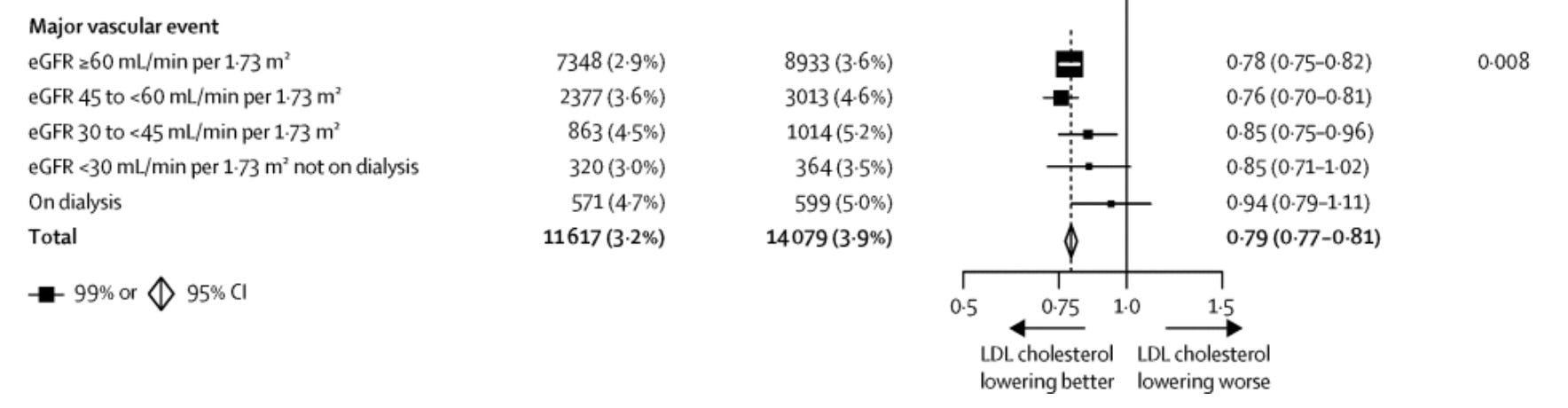
We can have confidence in this subgroup analysis because there are two trials of statins in patients with advanced kidney disease (4D and AURORA) and both were null.
Summary
Peto argued that the safest practice would be to apply the main results effect size to any subgroup.
That said, I could find other examples where a subgroup effect might be real. The emphasis is on might, and the proper practice is to use a subgroup finding to plan another trial.
When the null trials are presented in two weeks, be alert to the pitfalls in placing too much weight on subgroups—especially since the main results of the trial were null.
Peto's astrological subgroups never get old 😂 Thank you for this before AHA, John! I'll be reading the ZEUS and HORIZON subgroup slides with Libra and Gemini in mind.