

Many of you know that I am not convinced that percutaneous left atrial appendage closure benefits patients. The six trials against standard oral anticoagulation (OAC) simply do not reveal a net benefit in stroke reduction or bleeding.
But I concede that a group of patients who cannot easily tolerate OAC remain untested. These patients were excluded from the clinical trials. So we don’t know whether a LAAC procedure would be better than no oral anticoagulation. I doubt it, but the truth is I don’t know.
What I do know is that the procedure only protects patients from one type of AF-related stroke: stasis in the left atrial appendage leading to cardio-embolic stroke.
LAAC provides no protection against the many other forms of stroke. In fact, the INTERHEART study from McMasters found that the population attributable risk (PAR) for AF and stroke is below 20%. Meaning that in a model where all AF could be eliminated in a population, we would reduce stroke by less than 20%.
Another premise that everyone agrees upon is that if LAAC provides a net benefit (stroke and bleeding reduction) it takes years. That’s because you must overcome the finite (2-5%) upfront risk of harm from the procedure. If a patient dies in the year or two after the procedure, they did not have time to benefit.
Patient selection, therefore, is critical. You have to pick patients with minimal competing risks of stroke and who otherwise have a good expectation of survival.
Now let me show you an email from a doctor who works in middle America. I will change some of the details to preserve anonymity:
I have an 81 year old nursing home patient with Vascular Dementia, HTN, COPD, Paroxysmal Atrial Fib, who is s/p Pacemaker Placement some years ago. He is wheelchair-bound, but due to his dementia tries to get up and occasionally falls, so he has been on no anticoagulation since prior to my assuming care.
His son took him to the cardiologist, who now recommends Eliquis, followed by Echocardiogram, Carotid US, and Cardiac Stress Testing, all in preparation for doing a Watchman Procedure.
I am now trying to convince the son that these will most likely be of no benefit, and actually very likely to cause some harm in this frail, demented 81 year old who falls.
This is such a common occurrence - when I think more positively I attribute it to the cardiologist being trained to do these things and trying to “do something” to help him; in my uncharitable moments I think the specialists see these elders as untapped gold mines waiting to be prospected - maybe it’s both.
To show you that this extremely poor choice is not an outlier, here is a slide that I show of four recent studies that document how badly doctors are choosing to use this device.
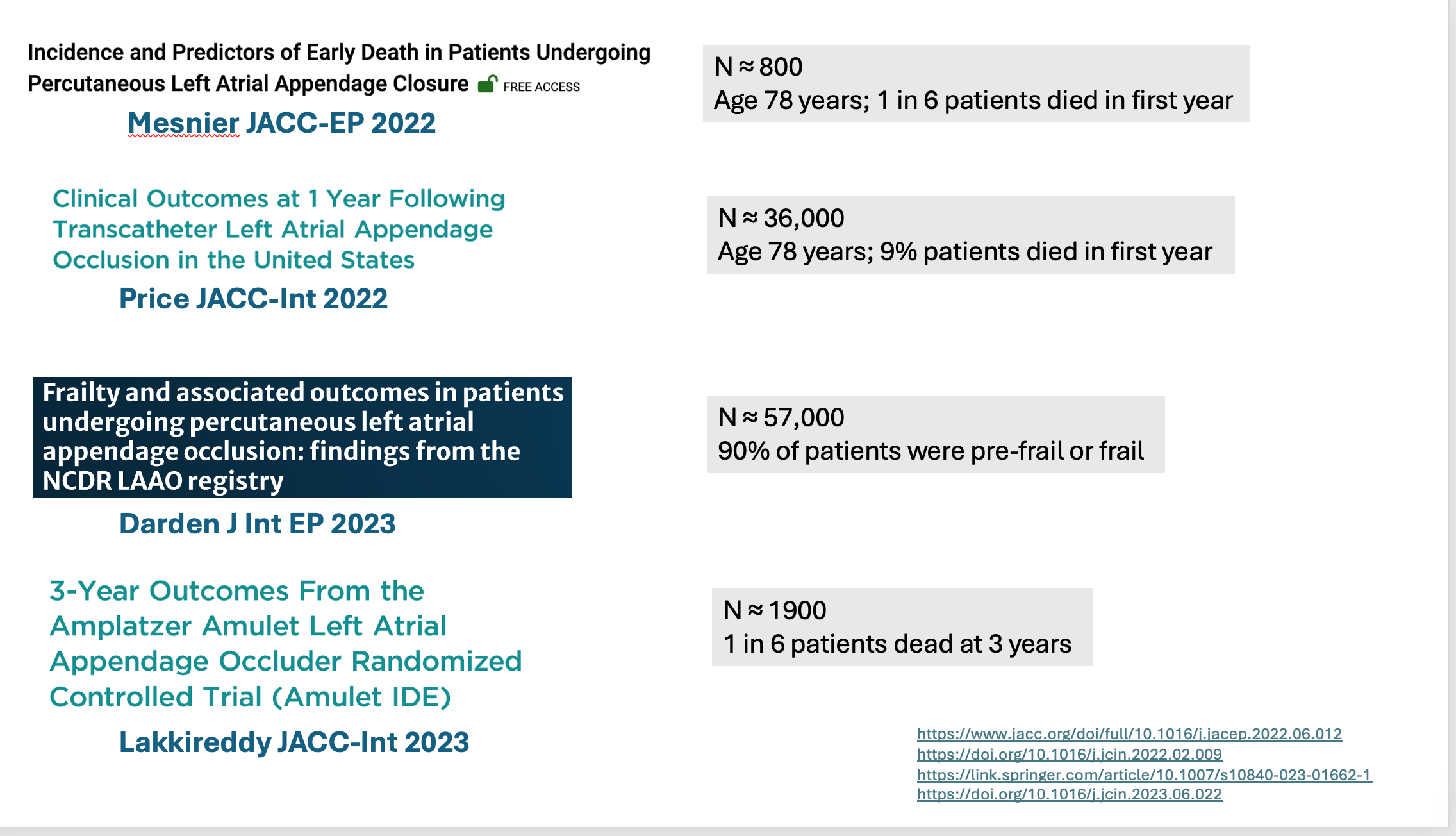
The reason that older frail patients are such poor candidates for the preventive procedure are that a) they have a higher procedural risk due to frailty, b) they have tons of competing risks of stroke, like in the case above, vascular dementia means that there is severe disease of the brain blood vessels, and c) patients who die in 1-2 years cannot gain any probabilistic benefit from the device.
The solution is obvious: you do an RCT randomizing older adults with anticoagulation contraindications to the device vs nothing. The group randomized to nothing goes to lunch the day of the procedure and incurs no risk of bleeding, tamponade or device leaks. I would predict that such a study would be stopped early for harm in the device arm.
The problem is that I cannot convince enough colleagues that there is equipoise to do such a trial. That baffles me because I do not understand how their brains connect the lack of benefit in the 6 LAAC vs OAC trials to benefit in a group of sicker patients who were excluded from these trials. It reminds me of the old debate that doctors were worried that randomizing post-MI patients with ventricular ectopy to the placebo arm of CAST was unethical.
Perhaps you have ideas. To be sure, financial conflicts play a strong role, but I believe it is more than just money driving this misthink.
The compulsion to “do something” is embedded deeply in the medical education process. This is an issue independent of financial incentive. The notion that to do less is of patient benefit is a hard sell in the procedurally based American medical system. To teach this point would require a major ethical overhaul in the collective mindset of academic leadership in this country. Sadly I don’t see that happening.
So, should it include tort reform ? Like stated many a times in this forum, we think aging and dying are options. And, the three main causes of malpractice are failure to diagnose, delay in treatment, failure to consult. We are programmed / mandated / expected to do something or else If the standard of care is dependent on where you are practicing, then, you see the snowball getting larger by the second.