

Every Sensible Medicine reader I hear from tells me that he or she does not read all the articles. We are lucky enough to have a diverse enough readership that we get good numbers of reads whether the article is a detailed critical appraisal, a thoughtful reflection, or a prickly attack on the establishment. This article is for those who are looking for straight-out guidance on the practice of medicine.
As someone who used to insist that students present hematocrits rather than hemoglobins and pulse and blood pressure as even numbers only, I found a lot to like about this article.
Adam Cifu
Early in medical school, one attending asked pointedly, “Do you speak in hemoglobin or hematocrit?” Not wanting to embarrass myself, I replied, “I can speak either.” Similar dichotomies often reveal how clinicians practice medicine. Do they prescribe a prednisone burst or taper, prescribe azithromycin for sinusitis, or treat a presumed UTI before culture results return? The most perplexing discordance, to use a word we’ll return to later, has been the language of kidney function.
Back in residency in the mid-2010s, everyone seemed to speak the language of creatinine. Now, a decade out of training as an internist, I’ve come to think of myself as functionally bilingual. I spoke of rising creatinine but dosed medications according to estimated GFR. Recently, I had a humbling realization. I wasn’t bilingual at all. In fact, I was barely aware of a practice-changing language for kidney function. That language is cystatin C.
The Case for Cystatin C
Here’s the case that sent me back to the literature and changed my practice.
Myles, an elderly man, arrived at subacute rehabilitation following a prolonged hospitalization for heart failure. I imagined him before his month-long hospitalization, flipping burgers at work instead of lying frail in bed. Now he looked frail and was taking more than a dozen medications each day. A few days into his stay, he described a new tremor affecting all four extremities. He struggled to stand and even shook while lying in bed. I dutifully ordered electrolytes, thyroid function tests, and a magnesium level. I had recently cared for a patient with muscular dystrophy and had used cystatin C to more accurately estimate kidney function in a patient whose muscle mass made creatinine unreliable. So I added a cystatin C test for Myles, a decision that ultimately led us to the correct diagnosis.
Here is Myles’ estimated GFR based on creatinine and cystatin C.
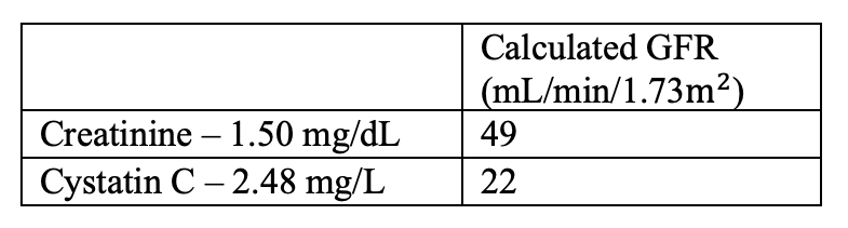
How should we make sense of the discordance in estimated GFR? I knew that creatinine tracks with muscle mass. Muscular patients tend to appear to have worse kidney function, while frail patients often appear to have better kidney function. Myles resembled the latter. His recent loss of muscle mass and frailty caused creatinine to overestimate his kidney function.
Cystatin C is influenced by a different set of factors. It inhibits enzymes known as cathepsins, which normally degrade proteins. Every cell in the body produces cystatin C at a relatively constant rate, largely independent of muscle mass. But diseases associated with systemic inflammation, obesity, diabetes, cardiovascular disease, corticosteroid use, and hyperthyroidism can all increase cystatin C production. Myles’ recent steroid use, diabetes, and inflammation elevated his cystatin C level, making his kidney function appear worse than it actually was. In other words, his elevated cystatin C reflected inflammation rather than reduced filtration.
In summary, creatinine and cystatin C both estimate kidney function, but in certain clinical situations they have biases that often point in opposite directions.
Why Both Markers Matter
So, should we speak in creatinine or cystatin C?
A number of papers published over the last five years suggest the answer is both. Each biomarker has its own predictable blind spots, and combining them helps offset those biases, producing a more accurate estimate of kidney function.
A 2021 New England Journal of Medicine paper found that the revised combined creatinine-cystatin C equation estimated measured GFR more accurately than equations using either creatinine or cystatin C alone. By 2024, the international KDIGO guidelines recommended using the combined creatinine-cystatin C equation whenever greater accuracy would influence clinical decision-making, including CKD staging, medication dosing, and kidney transplant evaluation. When I entered Myles’ laboratory values into the calculator, his combined eGFRcr-cys was 32.
The combined equation split the difference to arrive at a more accurate estimate. Overall, his chronic kidney disease was more advanced than the discharge records suggested. We slowly reduced his near-maximal gabapentin dose, and his myoclonus gradually improved. If one additional blood test could lead us to Myles’ diagnosis, how many patients in my primary care panel might also benefit?
When I reviewed my patient panel, very few patients had undergone cystatin C testing, but many met criteria for testing. The 2025 VA/DoD guidelines recommend obtaining cystatin C in patients with borderline kidney function (eGFRcr 45 to 59 mL/min/1.73 m² without albuminuria) when greater diagnostic accuracy is needed. They specifically highlight that creatinine may be misleading in older adults with frailty or recent weight loss, patients with obesity, and those at extremes of muscle mass. A combined equation may improve risk classification in patients with heart failure as well.
In a secondary analysis of the PARADIGM-HF trial, switching from a creatinine-based eGFR equation to the combined creatinine-cystatin C equation reclassified 29% of patients into a different CKD stage, with 18% moving to a worse category and 11% to a better one. Notably, those reclassified patients had higher mortality and poorer quality of life.
Although I primarily practice outpatient medicine, cystatin C may prove even more useful in hospitalized patients whose medications require frequent renal dose adjustments, particularly those with cancer. Large discrepancies between creatinine- and cystatin C-based GFR estimates in oncology patients are associated with higher rates of medication-related adverse events, including supratherapeutic vancomycin levels and hyperkalemia.
Closing the Gap
My primary care panel includes many patients who meet criteria for cystatin C testing: people with extreme muscle mass, paraplegia, obesity, borderline kidney function, and heart failure. Until recently, I routinely estimated kidney function with creatinine and spoke the language of creatinine with colleagues. The experience with Myles felt especially close to home because I had recently given a lecture about the discordance between guideline-directed medical therapy and real-world prescribing patterns in heart failure.
Narrative reviews have identified several barriers to the widespread adoption of cystatin C, including limited laboratory availability, higher testing costs than creatinine, workflow challenges, and clinician unfamiliarity. To bridge the gap between evidence and practice, we need both system-level and clinician-level solutions. Globally, Sweden and many VA hospitals have incorporated cystatin C into routine care.
For a busy clinician, however, the additional steps of ordering another test, waiting for the result, and manually calculating the combined score can feel cumbersome. Still, for Myles, the extra effort was well worth it. Looking back, I may have been onto something when I awkwardly insisted that I could speak both “hemoglobin” and “hematocrit.” When it comes to kidney function, becoming fluent in creatinine and cystatin C has the potential to improve care
Note: Patient details have been modified to protect privacy
Tom Peteet, MD, MPH, M.Ed, is a board-certified internal medicine physician and educator in the Boston area. He teaches pharmacology to physician assistant students and writes Against Medical Advice, where he examines evidence behind common medical practices and the science of human physiology. He is currently writing a book on the history and physiology of blood pressure.
Photo By Europeana on Unsplash

Thanks for this article. A lot of older folks are now taking supplemental creatine to increase their muscle mass and maybe preserve cognitive function (poor evidence for the latter). Since taking supplemental creatine may bump up their serum creatinine levels, cystatine C levels can be useful to determine whether this rise in creatinine is of concern or not.
Thanks for this. Squarely in the “learn something new everyday” category. And also “I need to read more” box as well.
Is this something more relevant in stable CKD (out)patients? Or is it applicable to AKI (in)patients as well?