

Last week, the news media and internet were abuzz about a trial conducted jointly by Moderna and Merck. The study compared a combination of pembrolizumab and an mRNA-based individualized neoantigen therapy with pembrolizumab alone in treatment-naïve patients with completely resected stage IIB, IIC, III, or IV cutaneous melanoma. The combination therapy improved recurrence-free survival and distant metastasis-free survival.
The treatment is very interesting. The Merck product, pembrolizumab, is a checkpoint inhibitor that we have used for years. The Moderna product is an mRNA vaccine designed specifically for antigens associated with an individual’s cancer.
The impact of the news on the stock market was immediate and (to my amateur eyes) impressive.
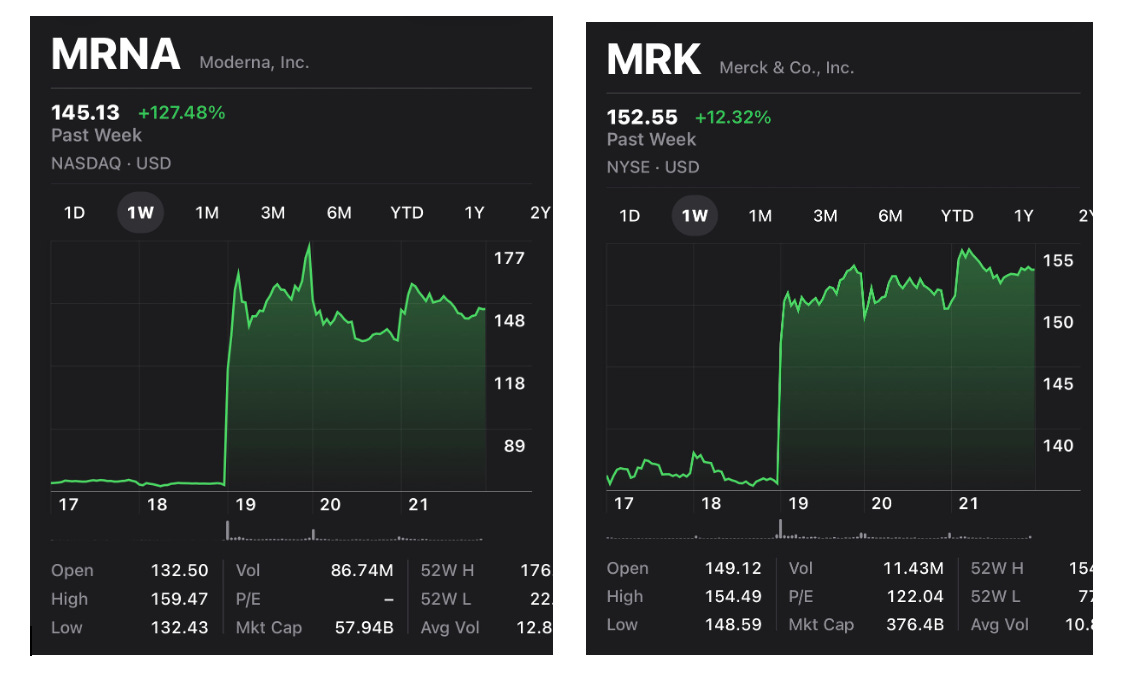
You’d think this kind of reception would be in response to a lead article in Lancet or NEJM. But no, the cheering and stock frenzy was in response to a press release. You can follow that link and read it yourself, but really, I have pretty much told you everything it includes. Once you read it, you realize that all the coverage of the study is true churnalism. Not our definition, but the Dictionary.com definition of churnalism:
A form of journalism that is characterized by a lack of original research and fact-checking and by reuse of existing material such as press releases.
We certainly go a bit nutty with our critical appraisal shtick here at Sensible Medicine, but the amount that we don’t know after reading this press release is shocking. Who are the patients? What is the severity of their disease? What are the dropout rates? What is the relative risk reduction, let alone the absolute risk reduction? Are they even close to showing a mortality benefit? How bad are the adverse effects? What is the cost? (Oh wait, I forgot, we don’t care about costs.)
I think the science behind this treatment is cool. I also really want it to be effective. Although we have made enormous strides in its treatment, malignant melanoma can still be an awful disease. But I don’t see any reason to get excited based on a press release. These are two companies that have everything to gain if this treatment is successful, reporting on a study that they designed. This is like if I were to tell you that John, Vinay, and I have conducted a study showing that buying a subscription to Sensible Medicine has an overall mortality benefit, and that we might show you the data someday.
Ok, those are my swipes at Merck, Moderna, Wall Street, and the media. How about RFK Jr.?
RFK Jr. has made no secret about his skepticism regarding mRNA vaccine science. He made headlines last year when he canceled $500M dollars in federal funding for mRNA vaccine research. If we eventually get an actual journal article about the Merck/Moderna trial (I am sure we will), and the results are as promising as the press release suggests (I expect they will show marginal benefit over present therapies), how will our HHS secretary respond? I suggest three possibilities.
1. Unfortunately, the most likely possibility is that he will say nothing. Public figures seem completely unable to admit mistakes these days.
2. He will say that he has nothing against mRNA technology, only the COVID vaccine. He will say that he knows that even safe and effective therapies have toxicities. No drug or drug development process is all good or all bad; it is all about how we use our therapies. If a safe therapy is used in a huge population that does not need it, the therapy will be ineffective and harmful. This was the issue with COVID vaccines after the initial series or after a COVID infection. The story might be different in patients with melanoma.
3. What I would love him to say is that he was wrong about mRNA vaccines and that no drug or drug development process is all good or all bad… (see #2 above). He would then go on to say that the run-up in the stock price indicates that mRNA vaccine science clearly has a robust market to support it and therefore it does not need the support of federal dollars.
This will be a great story to follow in the coming years. I hope we end up with a great new therapy for melanoma and an honest assessment of it from the federal government.
I expect to be disappointed.
To publicly traded companies, the stock price is everything. The press release was about money, not about medicine, and certainly not about improving patient care.
Shame on the mainstream media for noting it at all. In the old days of paper newspapers, it would have rated a column inch in the Business section. Maybe.
The stock trading done by algorithm-driven computers drove up the stock price of both companies in response to the press release, closely followed by retail investors chasing the next big thing.
Those of us who care about the treatment, and whether it makes a difference to melanoma patients will wait for the paper. And Sensible Medicine’s careful take on it.
Thank you for your thoughts on the nature of sensationalist reaction to the Merck/Moderna announcement of positive topline results from the Phase 3 INTerpath-001 trial. Having worked half my career in academic research and the second half in pharma, I can tell you that the conclusions in the press release will indeed be confirmed. That is not to say that it is a good practice, but honestly, the companies are restricted from providing more detail if they plan to publish the results in a good peer-reviewed journal where the results will be trusted.
I will note also that the "results" come from a pre-specified interim analysis. When reporting clinical trial results, companies usually have a plan that includes publication at the time of database closure. Here, I suspect the trial team was truly surprised that the primary and some secondary endpoints were already met. That is why they didn't have a publication ready to go. Hopefully, they will be getting the publication out ASAP.
Companies also need to provide topline summary in order to comply with government regulations. They certainly don't want results known within the company to leak and put the companies at risk to insider trading and other ethical problems.
If you look at the trial record (NCT05933577) in clinicaltrials.gov, you will find that completion of the primary endpoint was expected in October 2029, over 3 years from now. The fact that the data were statistically significant now offers a dramatic clue that the published results are also dramatic. Furthermore, the record shows that the enrollment was over 1000 patients and the clinical characteristics of those patients are defined, though obviously not the demographics.
Just one more thought about safety - the Phase II trial results were just reported at ASCO this year. Yes, it is very important to know whether the Phase III confirms the risk/benefit picture.
The real problem here is Wall Streets' reducing clinical trials to binary pivots as your graphic shows. But in this case, they are probably right.