

Public health messaging around the hantavirus cruise ship outbreak has been, ‘there is an extremely low risk to the general public,’ but this is suboptimal. Instead, messaging should be, ‘there is no chance this will become a pandemic. You have no risk of contracting hantavirus, unless you decide to sweep mice droppings in New Mexico.’
Ten years ago, this would have been natural. No one would be burdening the public with a discussion of whether hantavirus was once spread by saying “Hello.” The media would be broadly disinterested in the topic, and would not cover it beyond the broader context of cruise ships spreading infectious disease, and being a supposedly fun thing I will never do again.
Of course, the COVID pandemic has altered that. SARS-CoV-2, a new virus, had all the properties that guaranteed a global pandemic (Andes hantavirus doesn’t*). With COVID, the concern among many Sensible Medicine columnists was that our response choices — prolonged school closure, cloth masking kids, Paxlovid for healthy, vaccinated people, booster mandates for college students, or those who just recovered from COVID — were pointless theater, and worse: very likely, on balance, harmful. Two things were true: COVID killed many Americans, and we did a lot of harmful, pointless, self-defeating (and kid-defeating) things in response.
But just like the doctor who makes a medical error because they are hung up on the last patient they saw — Tommy had appendicitis, so we have to be extra careful not to miss it — a phenomenon called ‘recent case bias’, the entire biomedical ecosystem is suffering from a ‘recent case bias’. Many can’t think objectively — because COVID is still on the top of their mind.
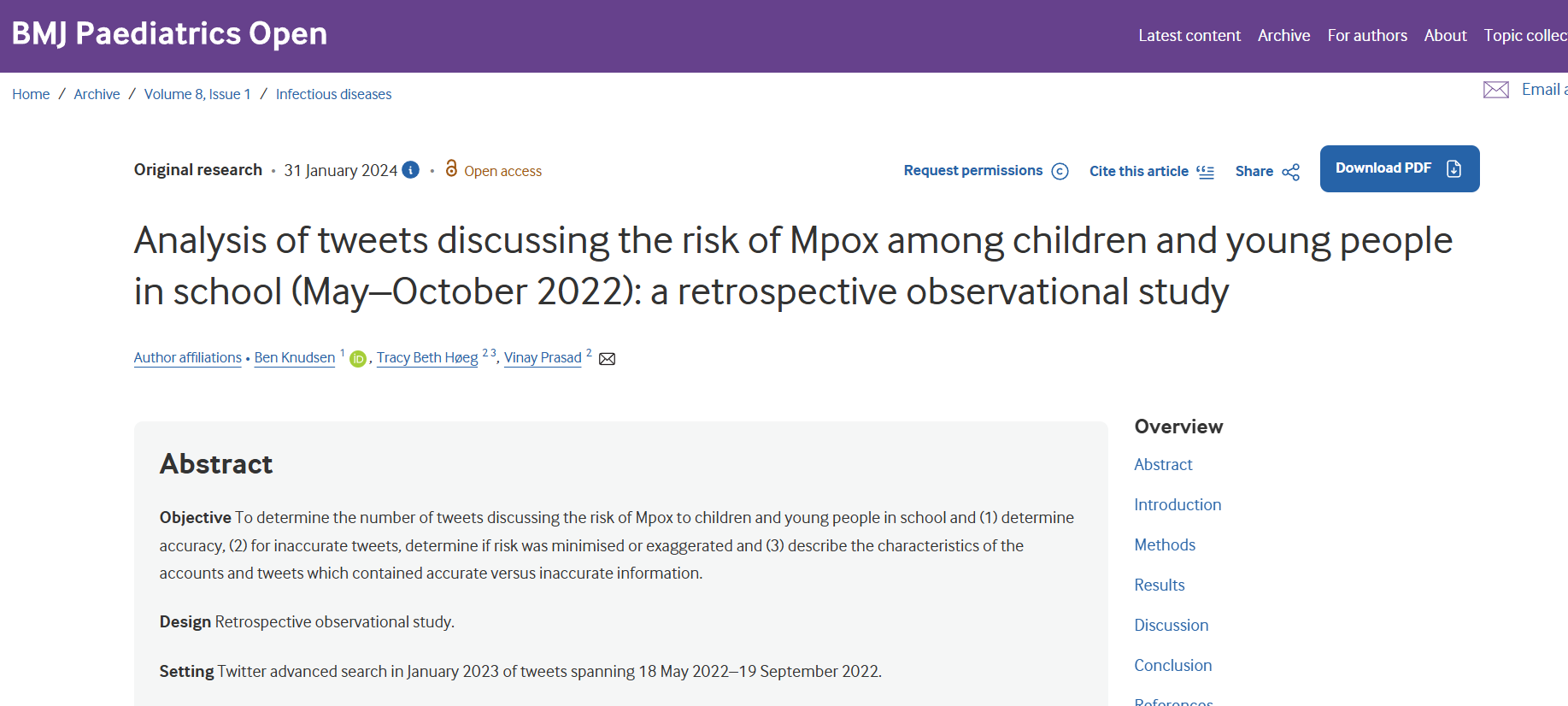
We saw this with monkeypox. Monkeypox affected men who had sex with men. In fact, data showed it disproportionately affected a subgroup — men who had sex with a lot of different men. It didn’t affect school children. Kids at school didn’t have to wear masks to avoid it, and all those obvious things. And yet, my research lab documented how hysteria spread across social media — even by distinguished experts, such as former Surgeon Generals, who relentlessly fear mongered about kids.
The same pattern has emerged with hantavirus.
Some argue that hantavirus shows how ‘unprepared we are for the next pandemic.’ I don’t follow this logic. You can believe we are prepared or not, but it is hard to see how hantavirus points in any direction. The response has been (appropriately) minuscule in comparison to COVID. It’s like saying a pizza deliveryman is unprepared after he gets just a single order.
This argument is often a preface to a call for greater funding of public health agencies. In the absence of a serious reflection of COVID policy errors — school closure, cloth masking, kids masking, vaccine mandates, beach closure, invented ‘6’ distancing, censorship of origins discussion, buying unproven Paxlovid — this will continue to be a hot button political (and not scientific) question of the first half of this century. There is no middle ground, and I suspect the pendulum will swing back and forth wildly in the next decade.
Never say never, I imagine a reader cautioning me. That is always true in life, but practically no way to live. We have to worry about our blood pressure, weight, and waist circumference, about our kids making it to soccer practice on time, and paying the bills — spending mental energy on hantavirus is a waste of time for average Americans.
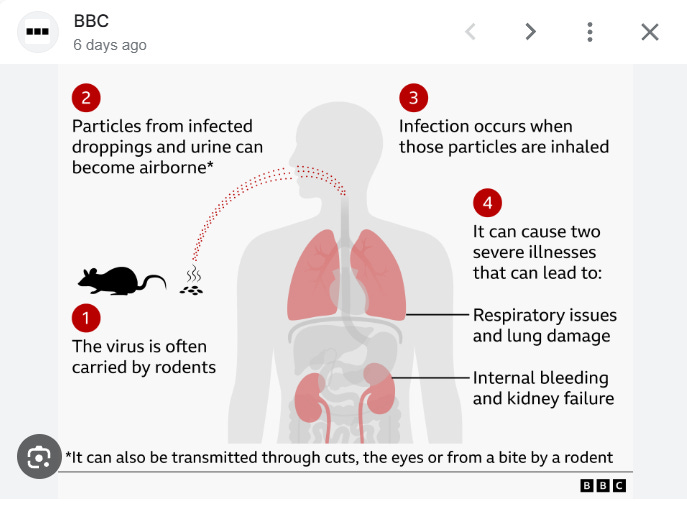
The BBC figure above alerts readers that hantavirus can cause internal bleeding. Yet, car accidents will be a far more common cause of internal bleeding than hantavirus— likely by many orders. Thus, it’s better to raise awareness about driving more cautiously. Hantavirus should be forgotten by average Americans, just like those experts have already forgotten about their monkeypox tweets.
—
*Human-to-human spread is a necessary but not sufficient prerequisite for a global pandemic. There may yet be more cases of hantavirus, but there will not be a global pandemic.
As always, Vinay remains one of the adults in the medical community with a sane take. Breathless catastrophizing gets us nowhere. Thanks Vinay - so glad you have time to write again!
The dangerous infectious disorder is the media and social media predilection to spread panic.