

My experience with postmenopausal estrogen replacement (ERT) stimulated my interest in medical reversal. It seems incredible now, but in the 1990s, it was common to counsel every postmenopausal woman that, in addition to getting a colonoscopy and beginning mammograms, they should start estrogen replacement therapy. This recommendation had nothing to do with treating the symptoms of menopause. The argument was that the benefits of ERT in the prevention of cardiovascular disease and osteoporosis outweighed its harms related to risk of breast cancer and venous thromboembolism. One of my favorite articles, and one that served as a strong foundation for ERT, was published in the NEJM in 1996.
This article reported data from the Nurses’ Health Study. The NHS has gained near mythic status as a textbook cohort study. The study began in 1976, when > 120,000 female nurses, 30 to 55 y/o, were recruited. The nurses completed a questionnaire about their medical history, including their use of postmenopausal hormones. The data were updated with biennial follow-up questionnaires. Follow-up data were available for over 90% of the cohort.
Results
The key results from this publication of the NHS were presented in Table 2, reproduced below. Estrogen replacement therapy, used with or without a progestin, lowered the risk of major coronary disease, defined as nonfatal MI, fatal coronary disease, coronary-bypass surgery or angioplasty, and fatal or nonfatal stroke – a pretty robust endpoint.
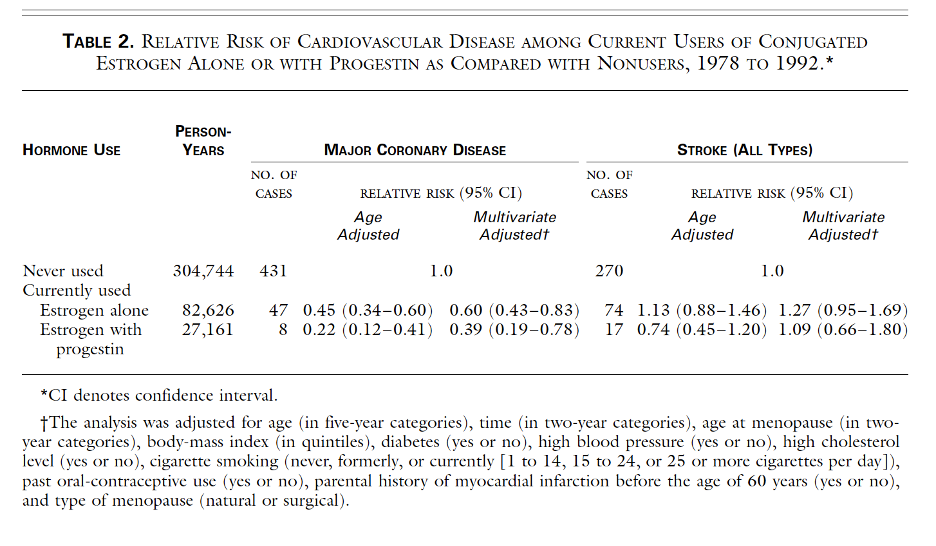
Let’s reflect for a second on these results. The benefit is enormous: a reduction in the risk of the primary endpoint, the most common killer of women, by 40-60%. And remember, this is not in high-risk people; this is in healthy, working nurses. Sure, it is observational data, and you should be worried about confounding, but look at all those adjustments in the footnote! You can probably understand why a generation of primary care physicians (including yours truly) and gynecologists adopted ERT as the standard of care.
Now, of course, even at the time there were concerns. The adjustments reveal clear positive confounding – adjustments make the effect of the exposure less pronounced. Thus, residual confounders probably make the exposure's effect appear greater than it is. Also, the authors did not adjust for socioeconomic status. The authors assumed all nurses were the same in this regard, which was certainly a mistake.
What Happened Next
In the following decade, randomized controlled trials testing the effect of ERT began to be published. First was the HERS trial, which suggested that ERT increased the risk of cardiovascular events in women at high risk. Next came the Women’s Health Initiative, a trial that suggested that, at best, the harms and benefits of ERT were balanced. The results of the NHS and the subsequent RCTs became a textbook example of the risk of basing treatments on observational trials.
There, of course, remains debate as to whether the NHS results were as misleading as subsequent trials made them out to be. All the studies should have weighted quality of life more heavily. ERT remains the most effective therapy for many, if not most, menopausal symptoms. Medicine also overreacted to the reversal. Where we should have given up on ERT as a public health intervention and begun seeing it as an effective therapy for menopausal symptoms, most doctors gave up on it altogether.
I find it especially interesting that the WHI itself was compromised by post-randomization confounding. The years during which the WHI was conducted were those of increasing statin use. At the time, statins were initiated and dosed based on lipid levels (rather than overall cardiovascular risk). ERT improves patients’ lipid profiles – one of the ways it is presumed to lower cardiovascular risk. The graphs below show that patients assigned to placebo in the WHI were more likely to be prescribed statins than those assigned to ERT.
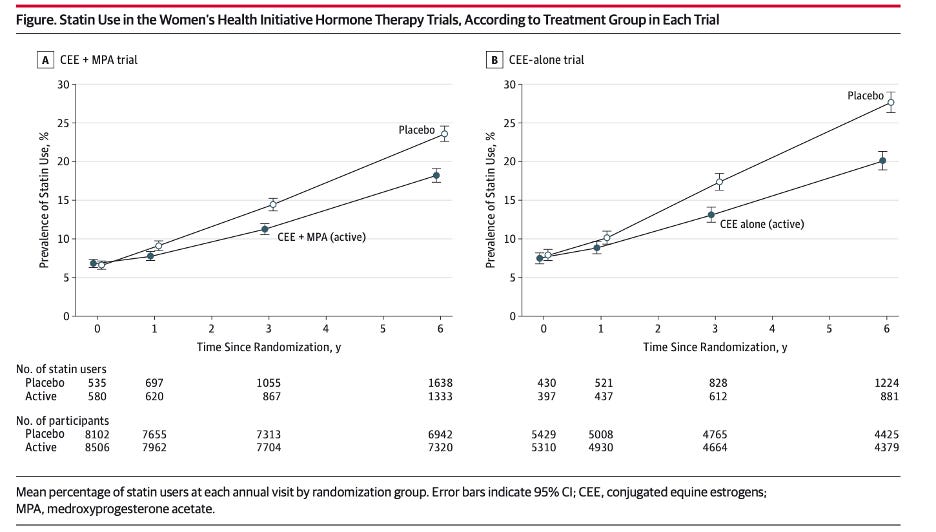
Might it be that the WHI did not show that ERT was ineffective but showed that the beneficial effect ERT could be offset if it kept women from being prescribed statins?
Conclusion
The 1996 NEJM NHS study article is one of my favorites. It describes a beautiful cohort study, convinced me to prescribe ERT, humbled me when I read later RCTs, and stimulated my work with Vinay Prasad on Medical Reversal. In the end, I think we adopted the therapy too willingly based on observational data and then abandoned it too enthusiastically after the RCTs were published.
I too have followed the research around HRT since the 90s. Today I speak for myself that as a post-menopausal, s/p TAH woman, if someone came for my HRT (estrogen only, of course), I would tell them they would have to pry it from my cold, dead hands. My spouse and my patients don’t know how lucky they are that I’m on it (or maybe they do?).
And yes my weight is normal, HDL in 90’s, non smoker, no CAD in my family history.
Thanks Sensible Medicine for another excellent article!
Around the time the NHS was published, I attended a lecture given by a local cardiologist who stated failure to prescribe HRT to post-menopausal women amounted to malpractice. Then came the RCTs you review. Over 50 years we've all seen innumerable "great" ideas crash and burn on the shores of well executed RCTs. The road to scientific accuracy is bumpy at best.
A few years ago at the annual ACP meeting, I attended one of Marty Samuels MD terrific yearly update in Neurology lectures where he commented, "I'm sometimes slow to adopt new therapies, in fact I'm just now getting comfortable with phenobarbital." It's a funny line and also a meaningful point.