

Dr. Eidus has previously written for Sensible Medicine. Now he is our man in New Zealand, sending reports back to the home front. The report is appreciated.
Adam Cifu
In 1974, Victor Fuchs popularized the idea of diminishing returns on investment in healthcare services, describing an S-shaped curve with a slow takeoff, rapid rise, and then flattening.
Recently, I moved to New Zealand to work as a General Practitioner to get out of my comfort zone and see how medicine is practiced elsewhere. When comparing health systems, you must weigh spending against performance. The graph below, from the Commonwealth Fund’s “Mirror, Mirror” analysis, shows the performance of 10 Organisation for Economic Co-operation and Development member countries
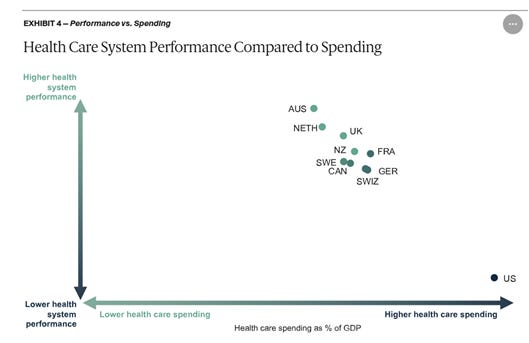
Many of the top-ranked health systems in the graph above seem to focus on optimization rather than maximization, trying to thread the needle at Fuch’s inflection point. They concentrate on balancing healthcare spending against other social goods. One analysis estimated the theoretical inflection point at around $3400 per person-year.
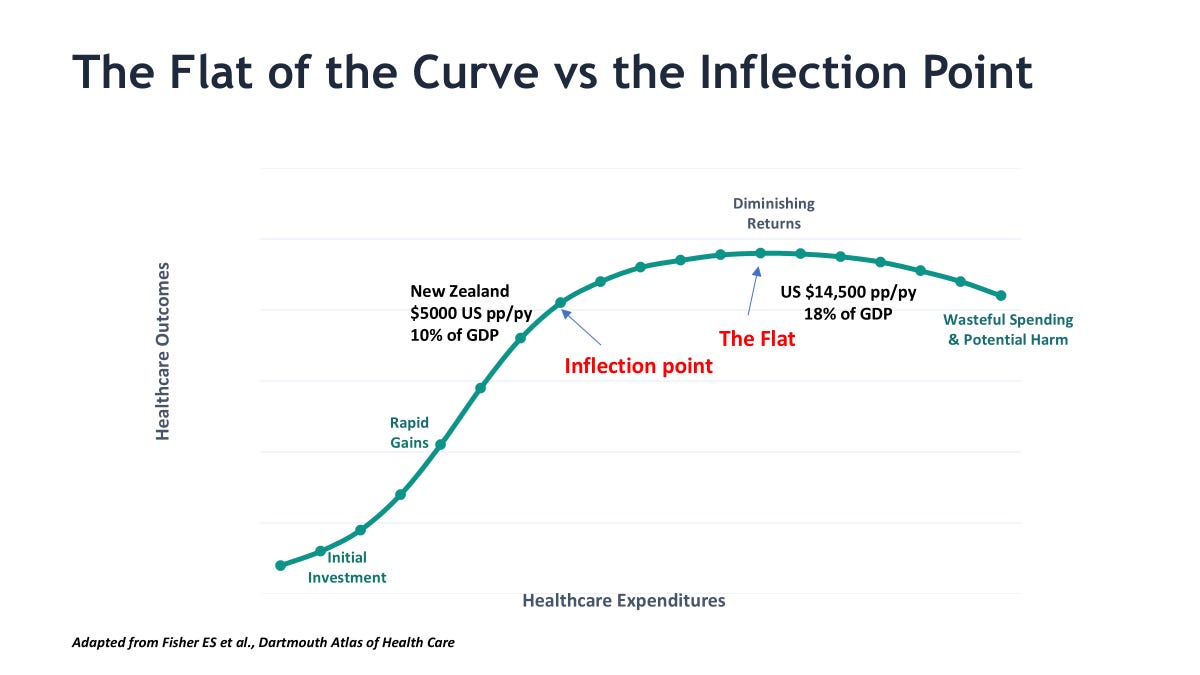
Some important and related comparisons between the US and New Zealand are:
Healthcare spending as percent of GDP: US 18%, NZ 10%
Percent of population without health insurance: US 7.8%, NZ 0%
Life expectancy: US 78.8, NZ 82.1
What are the consequences for patients and providers in a country trying to be at the inflection point?
New Zealand tries to stay at the inflection point through price controls, administrative simplification, intentional friction in the system, and medical conservatism.
Controlling prices: Price controls are the primary determinant of the discrepancy in total cost of care between the US and other developed countries. In New Zealand, GPs earn about $200,000 NZ ($130,000 US), with specialists earning only 30% more (specialists in private practice earn significantly more). All drug prices are negotiated through a single government agency.
What are the consequences? I have far fewer meds to select from, yet there are only two that I miss (GLP-1s and buprenorphine). Price controls have other consequences, too. Lower salaries strain the provider workforce, with many healthcare providers going to Australia, which offers reciprocity and higher salaries. That reality forces many practices to hire itinerant physicians, like me, resulting in poor continuity. On the other hand, a consolidated formulary with single-source price negotiations is considered a major factor in controlling costs. 9% of US healthcare dollars are spent on prescription drugs vs 6.8% in NZ.
Administrative Simplification: A much greater percentage of New Zealand’s healthcare spending goes toward patient care. Single-source drug negotiation eliminates middlemen like pharmacy benefit managers. Administrative costs in New Zealand are about 2% of the healthcare budget. All citizens (and those on long-term work visas like me) must enroll with a GP, who then receives a capitation payment of about 55% of the practice’s total revenue. All prescriptions are expected to be renewed only by the GP. From a patient standpoint, it is fairly easy to navigate. Accidents are covered for everyone, including tourists, through a separate funding mechanism. Because these social support systems (including disability) are funneled through the general practitioner, this greatly increases the GP’s administrative workload with activities that should be performed by non-physicians.
Systemic Friction: In the US, for those with insurance, a key cost-control mechanism is prior authorization, which is both costly and ineffective. In New Zealand, friction comes from cost sharing and waiting. Copayments are set by the practice but average around $65 NZ for a 15-minute visit and twice that for a 30-minute visit. Indigent patients pay less with an upward adjustment of the capitation. This friction decreases trivial visits but can also prevent needed follow-up. The other type of friction is waiting. In New Zealand, patients cannot see a specialist without a referral from the PCP. Even then, the specialist often rejects the referral. A patient of mine had prior back surgery and, after hardware removal, was having recurrent pain. The specialist rejected the referral.
Another of my patients had endometriosis, refractory to medical treatment, and has been waiting over a year for surgery.
To lubricate this source of friction, one needs to buy private insurance, which can be costly. 34% of Kiwis take this option. New Zealand has a double bottleneck for access: first establishing care with a GP, then accessing specialty care. Overflow often ends up in the ER where there is no copay.
New Zealand is strategic about targeting areas to reduce friction. My clinic has government-funded embedded health coaches, psychologists, pharmacists, and diabetes health educators assisting with my care at no added cost to the patient.
Medical conservatism: Government-run colon cancer screening (stool cards) starts at age 56. Cervical cancer screening is HPV-only, by self-swab. There are no office visits for routine PAP smears. The only approved GLP-1 agonist is Dulaglutide, with Māori and Pacific Islanders receiving prioritization, and it cannot be prescribed with an SGLT-2 inhibitor. For my patient with a suspected rotator cuff tear, I ordered an ultrasound, not an MRI.
Personally, I do not like the large number of transactional visits where patients come in just to get meds renewed or have a form completed. I also miss the depth of understanding I had of patients in the US. That said, the patients I see in my clinic here have greater medical and social needs, and the system forces me out of my comfort zone. I find myself simultaneously practicing above and below my license. For me, doctoring here is professionally fulfilling, but more frustrating and less enjoyable, because of the lack of continuity. I know that most US physicians, and especially PCPs, would not be comfortable with the compromises, but it is hard to argue with the macro outcomes.
In his 2011 analysis, Berwick identified administrative complexity, pricing, overtreatment, and fraud as the top 4 reasons for waste in the US system. New Zealand addresses at least three of these.
The best way to get off the flat part of the curve where the US resides is to not get there in the first place. Price control, though the greatest source of savings, would face enormous political pushback in the U.S., with the possible exception of centralized drug price negotiation, which would move significantly toward the inflection point. Systemic friction, New Zealand style, would be intolerable for Americans. Administrative simplification has broad support, and cultural changes and aligned incentives could boost medical conservatism. Unfortunately, spending 18% of GDP on healthcare, with a life expectancy of only 78, should be equally intolerable to Americans, but the adverse consequences are far less apparent.
Robert Eidus, MD, is a Family Physician currently working in New Zealand

As long as healthcare allows big pharmaceutical companies, lawyers, insurance companies, and healthcare administrators to keep doing business as usual; US healthcare will not change.
The problem in comparing the US as a whole with NZ is the size and diversity of cities. Miami vs Minneapolis have different production frontiers and functions. I asked AI for an apt comparison, and Portland and Salt Lake most closely resemble NZ, despite their different systems. There are different ways to crack an egg: different inputs but similar outputs.
Keep up your occasional reports from NZ. This is interesting to read!