

I started this series with a case-control trial study and then followed it up with a cohort study, so the next one had to be an RCT. Why go back almost 30 years for this one? When I consider the medical innovations during my career as an internist that truly changed the lives of MY patients, the list is not that long. There are the modern HIV medications, H. pylori treatment, the COVID vaccine, and statins. Statins were introduced to the world by the 4S study, published in The Lancet in 1994, and by the West of Scotland (WOS) study, published in The New England Journal of Medicine the following year. While the 4S study was earth-shattering, it pertained only to people with established coronary artery disease (CAD). It was a secondary-prevention study. The WOS study showed the powerful effect statins could have in primary prevention, preventing people at high risk for CAD, but without known disease, from developing it.
Before we get into the intricacies of this study, let’s start with the basic design and results. The researchers randomized men, 45 to 64 years of age, with an LDL > 174, no serious ECG abnormalities, and no history of myocardial infarction or other serious illness, to treatment with pravastatin or placebo. In the end, 6595 men with a mean age of 55 and a mean LDL of 192 were included and followed for a mean of 4.9 years. The graph of LDL levels demonstrated the efficacy of statins (and the inevitability of declining adherence).
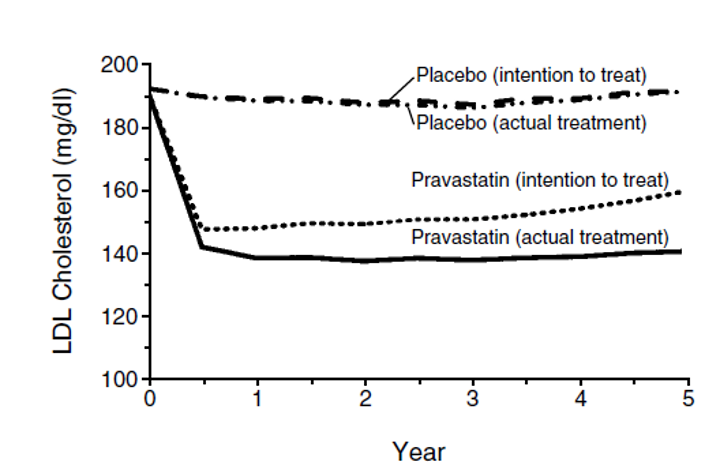
The primary endpoint in the WOS study was the occurrence of nonfatal myocardial infarction or death from coronary heart disease. In the years that followed WOS, as we got more and more complicated composite endpoints, with the least important and least objective endpoint always driving the results, “nonfatal myocardial infarction or death from coronary heart disease” became the kind of endpoint we would long for. Here are the results:
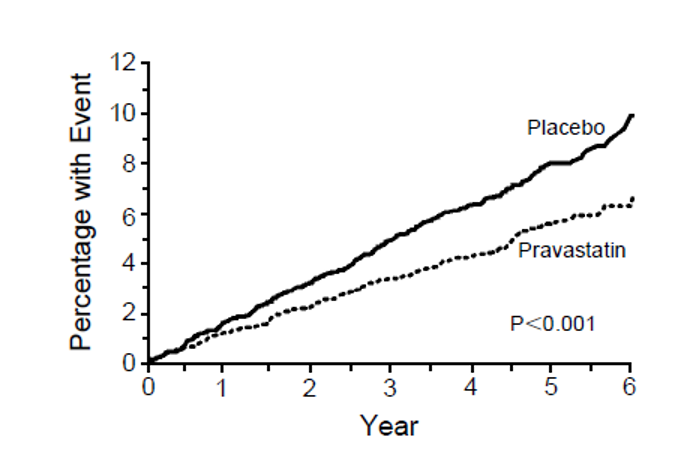
7.9% of patients assigned to placebo reached the endpoint compared with 5.5% in the statin group. That is a relative risk of 0.7, a 30% relative risk reduction, an absolute risk reduction of 2.4%, and (apologies to anti-NNT fundamentalists) a number needed to treat of 42. Those are some pretty impressive results for a pill, given to healthy people.
Now, of course, the WOS study is a complicated study, and the complexity, in addition to the splashy, practice-changing results, is what makes this one of my favorite articles. Here are a couple of the points.
1. The WOS population is not terribly generalizable. Putting aside the fact that it is a study of middle-aged, Scottish, male smokers (78% of the participants were current or ex-smokers!), read the run-in to this study:
160,000 men ranging in age from 45 to 64 years were invited to attend the clinics to assess their coronary risk factors. 81,161 appeared for the first visit. Those whose non-fasting plasma cholesterol level was at least 252 but who had no history of myocardial infarction were given lipid-lowering dietary advice and asked to return four weeks later. A total of 20,914 men returned for the second visit. If, on this occasion, the LDL cholesterol level was at least 155 mg per deciliter he was advised to stay on the lipid-lowering diet for a further four weeks and then to return for a third visit (13,654 attended). On the fourth visit the patients underwent randomization if they met the following criteria: LDL > 155 during the second and third visits (with at least one value > 174 and one value of < 232 mg per deciliter); no serious ECG abnormalities; and no history of myocardial infarction or other serious illness.
These are the most compliant middle-aged, Scottish, male smokers in the history of the world. This study is an excellent example of how a run-in period can completely change a study's external validity.
2. Although this study is always referred to as a primary prevention study, it is notable that about 5% of participants actually had angina and 3% had claudication. Maybe this is a primary prevention study that demonstrated a benefit only in the small subset of people who were getting secondary prevention.
The 4S study demonstrated the effectiveness of statins in people with hyperlipidemia and coronary artery disease, with a primary endpoint of overall mortality. The WOS study demonstrated their effectiveness in patients with hyperlipidemia who were (mostly) free from symptomatic CAD. The endpoint grew a bit to include death and nonfatal MI. Later statin trials progressed, as you might expect, to people with CAD and normal lipids and then to people with normal lipids without CAD. The endpoints progressed as well. The AFCAPS/TexCAPS study, published in 1998, was billed as a primary-prevention study in people with average cholesterol levels. The endpoint in this study was a “first acute major coronary event defined as fatal or nonfatal myocardial infarction, unstable angina, or sudden cardiac death.” After this study, we started hearing the always-irritating comment, “we should really put statins in the water.”
Coming next…
So what are we to conclude? That yes, everyone should be on statins?
My cardiologist does not recommend statins for me even though my dad died of a heart attack at 53 and my cholesterol is 250. She referred me to the following editorial. Who should I believe?
Statins for Primary Cardiovascular Disease Prevention: Time to Curb Our Enthusiasm – 2022 JAMA Internal Medicine Editorial
https://jamanetwork.com/journals/jamainternalmedicine/fullarticle/2795661
This editorial discussed the USPSTF's 2022 recommendation (largely unchanged from 2016) on the use of statins for primary prevention of cardiovascular disease. There continues to be concerns around the recommendation statement and the limitations in the clinical research considered by the USPSTF, including the arbitrary cutoff points used to risk-stratify patients in trials, the lack of patient-level data, and the lack of focus on clinically-meaningful outcomes. The editorial encourages a prioritization of lifestyle counseling over the marginal and uncertain benefits of statins.