

JP was 92 when he died in hospice. I had cared for him for a decade and knew him as an intelligent, witty, and charming man. In the social history Epic tab, I had written that he had been a celebrated professor and had three children. After his death, I read three different obituaries for him. I wished I had known him when he was younger and wished I’d spent more time talking to him about things other than his illnesses when I did know him.
I joined the primary care practice at the University of Chicago in 1997. I thought I’d be here for three years, until my wife finished her training. My practice quickly filled with the people who needed to start seeing a general internist, mostly people in their 50s and 60s.
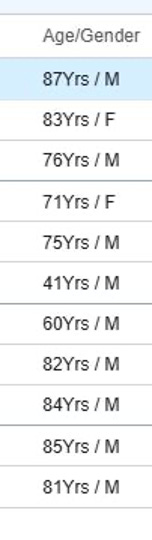
I didn’t move after 3 years, or 5 years, or 10 years. As I push up against 30 years, many of the people I started caring for in the late ’90s still see me. Although I haven’t aged a single day, these patients are now in their 70s, 80s, and 90s. There are even a few who have reached their 11th decade. Here is the Age/Gender column from my Epic schedule on the day I begin writing this post.1
The one thing guaranteed to happen to all of us eventually, despite what the longevity gurus might tell us, is that we die. It is fortunate that I’ve had decades of experience before my practice reached its current level of maturity, as I am not sure I’d have been able to tolerate the frequency of deaths early in my career, when I blamed myself for every untoward event.
I’ve written about how I feel when a patient dies.
I’ve also written about saving the face-sheets of all the patients I have lost.
This is about a way of memorializing patients that I have, only recently, stumbled into.
I almost always receive some documentation of the lives of my patients after they die. Sometimes these are emails from the University memorializing a former faculty member. Sometimes these are memorial pamphlets from a funeral. When I don’t receive anything, I usually search for obituaries.
Although it may sound morbid, I treasure reading about the lives of my former patients. These pieces are usually written by those who loved them, learned from them, respected them. After reading them, I usually spend a few minutes thinking about my relationship with the person I knew. My mini-personal-memorial service ends with snapping the face sheet and the obituary — broadly defined — into my Memory Binder.
I never leave this private mini-memorial service without feeling like I didn’t know my patient well enough. The “social histories” that I bury in epic usually say something like:
Retired English professor (Quantrell awardee)
Grew up in Brooklyn (Prospect Lefferts Gardens)
St. Ann’s, Smith, Harvard
Married to SW
3 kids, live in NY, DC, and Austin
Or
Originally from Mississippi
Moved to Chicago in 1960s for work
Worked in steel and automotive
Married over 60 years
Grandchildren: “too many to count”
These summaries are embarrassing, the encapsulation of a life in a 5-line doggerel. They are meant to jog my memory about who a person is for the first couple of visits. With time, I learn more, but seldom update the social history; there is no need. I’ll hear about hobbies and vacations. I come to understand how people relate to healthcare in general and to me in particular. I see how they deal with disease and progressive disability. I learn about the important relationships in their lives. We often discuss end-of-life plans.
What I learn from obituaries is all that I missed. Early career accomplishments, hobbies, volunteering, and interests that enriched lives but never came up in the office. Their qualities for which they were identified and loved.
My job as a doctor, even a primary care doctor, is to care for, and about, people. My job is not to be their friends. Although that sometimes happens — as we get older, more of our patients become friends and more of our friends become patients — mostly, my relationship is close enough to engage in collegial patient care, the shared decision-making that most of us, patient and doctor, aim to achieve.
Still, I regret not knowing more about what amazing people my patients were when I knew them.
You’d think, from this schedule, that I see mostly men. It is a limited sample. My practice is about 50/50.
This is the secret sauce of internal medicine and is one of the reasons why I still love coming into the office every day for nearly 30 years. They don’t tell you about this in residency, and you don’t really appreciate it until a few years in when you’re not scared every day you’re going to see something you’ve never seen before. I went into internal medicine because I love solving problems, but I stay for the relationships.
My mother in law passed away this last September. I often took her to her doctor's appointments since she could no longer drive herself. Her doctor was a very warm and kind, younger (probably 30s if I had to guess) man who really spent time asking questions, and more importantly, listening carefully to her answers. I am so thankful for his care for her, especially in her waning days. The last appointment she had with him was within the last week of her life. She was so defeated and frustrated by her failing body. As he greeted her in the exam room, and saw her weariness, his eyes filled with such compassion, and he asked with earnestness "How are you Gail?" She replied, "Not very well, doc." with a tear in her eye. He came over and gave her a hug. There was very little he could do medically for at that point, but his compassion meant the world to her, and to me.