

About 6 weeks ago, I wrote a reflection about how I am still processing my experiences during the worst of the COVID pandemic. I am so pleased that Dr. Colleen Smith is back with us today with her own reflection. She had it infinitely harder than I did during the pandemic; I loved reading about the feelings we share and the different things we took away. Her essay struck me with its honest transparency.
Adam Cifu
This is my second attempt to write this. My first attempt came out full of anger. In the early days of COVID, we didn’t act soon enough. When we finally did act, many of the restrictions and measures that might have helped us months earlier were too late and unreasonable for the time. We were let down by institutions that we trusted. We were lied to by our government. As an emergency medicine doctor in a major New York City hospital, I have been hailed as a hero. But I have also been denigrated as a liar who would shill for the government to promote a “plandemic” as an excuse to deprive us of our freedoms, and who would falsify death certificates to profit from taxpayer money. I am neither a hero nor a liar.
As I reflect on COVID from six years ago, my two overwhelming emotions are gratitude and sadness.
I’m thankful for the relationships I have with my colleagues throughout the hospital. We supported one another through something we can barely describe to an outsider. I work less often now, and when I step back into the hospital, I greet patient care techs, janitors, security guards, nurses, staff who stock our supplies, doctors in various departments, and others with a real sense of camaraderie, with fist bumps and sometimes hugs. We all went through a trial together, survived, and conquered. We showed up despite our fears and did our jobs as best we could. We helped each other.
I am sad for my colleagues who died. Yes, more than one of my coworkers was killed by COVID in the spring of 2020. And several lived, but only just. Imagine standing at the foot of the bed of a man whose COVID-infected lungs were drowning him when he had stood with you two days before at the foot of a bed of another man whose COVID-infected lungs were drowning him. Except this time, my colleague-turned-patient knew how little we knew and that he would most likely die just as we had helplessly watched many of our patients die. Months later, when he miraculously returned to work, we had a new crop of residents who had missed the worst of COVID. This critical care doctor, survivor, came down from his intensive care unit (ICU) covered from head to toe in protective gear (PPE) when most of us had switched to eye protection and an N95 mask. My new resident, who didn’t know him, didn’t know how we had all watched him nearly die, said, “Maybe he’s overdoing it with the PPE?”
I’m thankful for the ways in which we came together as a country, as a city, as a hospital. New York City was hit hard. I dare you to tell me it wasn’t. And as a city, we came together in the early days. Restrictions were tough, even punishing, but over April and May of 2020, cases dropped to manageable levels. Across the city and hospital, everyone pitched in. People stayed indoors. People wore masks. Schools figured out online instruction. Restaurants brought food to the hospital. Emergency medicine docs worked ICU shifts. Orthopedists and otolaryngologist and podiatrists worked emergency department shifts. People paid their domestic workers to stay home. Restaurants began delivering family meals, and families ordered them to help keep neighborhood restaurants afloat. Instead of dinners and brunches, we met friends on Zoom. Eventually, we met for walks in Central Park.
I am sad for our country that is so politically divided. I think COVID worsened that division. If we were to face another pandemic in our lifetime, I’m not sure we would come together to fight it as well as we fought COVID. In many ways, we didn’t do enough, and in many others, we did too much for too long. Maybe only the vaccine push, Trump’s Operation Warp Speed, was done well. And then that was politicized, and the messaging was bungled.
I am sad that I lost confidence in our scientific and public health institutions. I learned to be a doctor at Emory School of Medicine, on the doorstep of the Centers for Disease Control and Prevention (CDC). Many of their researchers taught my medical school courses. I revered the CDC as an institution that guided us during public health emergencies, and that reverence and trust are gone. Other agencies didn’t present much better. Why was there such reluctance to admit what we didn’t know? Or that we needed help? How will we ever recover this lost trust?
I’m thankful for the experience of treating COVID patients; it made me a better doctor. I have taken care of so many patients with acute respiratory distress syndrome (ARDS) — the basic problem with COVID patients’ lungs. And because the hospital was so overwhelmed, I managed these complicated patients over days in our makeshift emergency department ICU. Since COVID, I have had a few patients who developed ARDS from other illnesses. Recently, I cared for a pregnant young woman, horribly septic with bacterial emboli to her extremities. I saw her X-ray and knew. But I was able to manage her ARDS almost without thinking, which allowed me to spend more mental energy on dealing with the rare, complex infection threatening her and her pregnancy. She lived.
I am sad for the compromises we were forced to make in caring for our patients during COVID. For their discomfort — stuck sitting in folding chairs in the emergency department for days. Because we had converted hospital beds to ICU beds, if all you needed to live was oxygen, there was no bed for you. Hospitals that weren’t overwhelmed were forced to accept transfers of these patients. There were times when I delayed intubating patients because I had one ventilator available and two people on the verge of needing it. I will never know whether that delay led to a death. I will have to live with that. I’ve made a lot of difficult decisions, but was that what I signed up for when I went to medical school, when I became a doctor?
I’m thankful that COVID forced me to re-evaluate my priorities. I work less, I focus on my own physical and mental health, and I spend more time with my children. In a few years, they will have moved on, and medicine will still be there. Emergency departments will still need doctors. Someone once said to me that it’s okay for your life and work to have seasons, and COVID pushed me to take that advice. This season of my life still includes being a doctor. I’ll always be a doctor - and a plague doctor at that. But I’m focusing much more on being a mom. I’ll always be a mom too.
I am sad for the way that we couldn’t protect our children. Schools were closed for so much longer than necessary. The playgrounds closed. My own children were afraid of me, trained not to go near me after I came home from work. This lasted for years. My teenager has only just begun to let me hug her again. She still sometimes asks, “Have you been to work today? Did you shower?”
I’m thankful that COVID has become less virulent and that the vaccine prevents deaths (it really did save us at the time). I’m thankful that I have evolved as a doctor and as a person. I’m thankful for what we learned, overcame, and survived. But I am also filled with sadness for everything we lost.
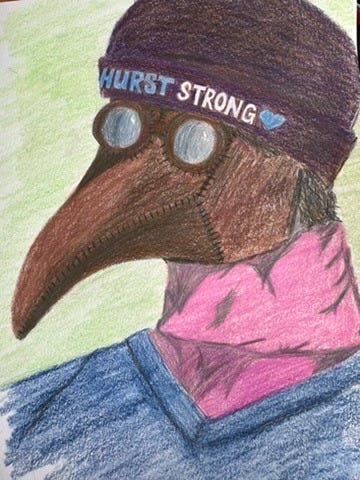
Caption: Modern Plague Doctor. By Colleen Smith. Colored Pencil
Dr. Colleen Smith is an Emergency Medicine physician and educator who practices in New York City. She is a visiting fellow for the Center for Modern Health think tank, a Roots of Progress Institute Fellow, and writes a Substack about medicine, health, and related topics.

Is there a difference between dying with and from ??? Which one pays more ???
And the ones bought out PPE and disinfectant wipes to then gouge the citizens ?
One thing I hope we never have to experience is dying alone, by mandate ….
Lots of lessons to be learned. Like I tell friends, we should all be like 3 yr old kids again and always ask “ but why ? “ If you can’t explain it simply or back it up, well, what is it ?
Thank you for sharing. I worked at a hospital in a “back office”role during the pandemic. I had the option to work from home even though I had my own office. I chose not to in solidarity with the medical staff who were there fighting the good fight every day.