

At least daily I receive a notice from a surgeon to clear a patient I have seen for surgery.
In the last decade, I can count on one hand the times I have called the surgeon and advised against operating. These were patients with end-stage heart failure who had weeks to months to live.
I have a form we send to surgeons that says something like…if this patient is free of chest pain, new shortness of breath or fainting, then there are no cardiac contraindications for surgery. I cannot remember the last time that I ordered a test before surgery.
But my office is an outlier. The pre-op clearance machine in our place and many others runs at a steady purr. Consults, ECGs, echocardiograms and stress imaging procedures done in the name of cardiac clearance are commonplace. The sky is blue and stress tests get done to clear patients for surgery.
A few weeks ago on a Fortnight episode on Sensible Medicine we covered one of the trials underpinning the therapeutic fashion of “preop clearance.” Today I want to review it in hopes of a) shocking you, b) giving it a home base on this site, and c) teaching about the strength of therapeutic fashion in Medicine.
The CARP trial (NEJM, 2004)
The question in CARP was whether fixing severe coronary lesions (revascularization) before major vascular surgery improves outcome. Notable is that vascular surgery is perhaps the most risky surgery from a cardiac perspective.
The VA-led group randomized 510 patients who had clinically significant coronary artery disease who were scheduled for vascular surgery to undergo revascularization or no revascularization before elective major surgery. The primary endpoint was long-term mortality.
The indications for vascular surgery included an expanding aortic aneurysm (33%) or severe peripheral artery disease (66%).
Revascularization included percutaneous methods (stents and angioplasty) in 59% and coronary bypass surgery in 41%. Median time from enrollment to vascular surgery was 54 days with revascularization vs 18 days without.
Here is a picture of the KM curve of the primary endpoint of survival.
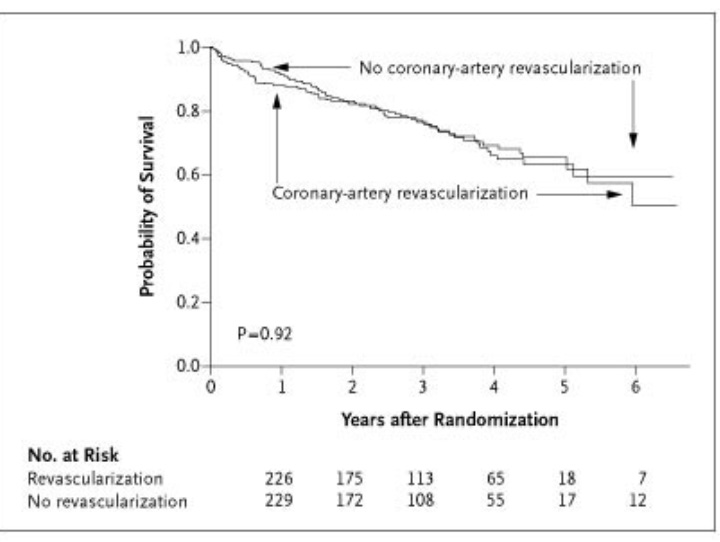
At 2.7 years after randomization, mortality in the revascularization group was 22 percent and in the no-revascularization group 23 percent (relative risk, 0.98; 95 percent confidence interval, 0.70 to 1.37; P=0.92). While a bit underpowered (note the wide confidence intervals from 30% better to 37% worse), CARP is clearly a null trial.
Interesting was that in the 54 days before vascular surgery, 10 patients died in the revascularization arm vs only 1 in the 18 days before surgery in the no-revascularization arm.
You might think that fixing coronary lesions reduced the risk of having a post-op MI. No. It was 12% vs 14% (p = 0.37).
No subgroup, including the highest-risk patients, showed a significant benefit.
A note on the patients enrolled. These were not well people. Nearly a half had previous MI, one in ten had heart failure, 40% had diabetes, and a third had previous CABG.
Yet, not even a tiny signal of benefit could be seen from “fixing” these lesions before having one of the highest risk surgeries.
The authors added a remarkable sentence in their conclusion:
On the basis of these data, a strategy of coronary-artery revascularization before elective vascular surgery among patients with stable cardiac symptoms cannot be recommended.
Comments
In sum, high risk coronary patients who had high-risk vascular surgery garnered no benefit from having their hearts “fixed” before surgery.
Proponents for preop evaluation might say that patients with left main disease, severe aortic stenosis, and unstable symptoms were excluded. This is a reasonable caveat, but no one should have trouble diagnosing severe AS, left main disease and unstable symptoms with a simple history and physical. The anesthesiologist and surgeon, I assume talk to and exam the patient.
Yet, in 2026, two decades after CARP, pre-operative clearance often drives non-invasive testing of asymptomatic or minimally symptomatic people before even less risky operations, such as orthopedic or general surgery.
The obvious question is: if actual revascularization of severe CAD does not improve outcomes why even look for CAD with tests?
That’s the thing about therapeutic fashions. I propose it happens because of habit. The older docs did it. The younger docs learned the practice of older docs and just continue to do it. Plus, it makes sense to patients; they feel good about “being checked.”
And it doesn’t hurt that imaging tests bring large productivity numbers to the readers of these tests. They often find disease too, which can then lead to more procedures and more productivity.
I don’t have data to support this belief, but I strongly suspect the new influx of non-MD clinicians have continued the preop practices. In general the less experienced a clinician, the more they follow the fashions of the day.
Yet the whole preoperative medical complex persists despite a negative trial.
The CARP trial is exactly the reason Sensible Medicine exists.
I remember when CARP came out. We read the conclusion, nodded, and kept ordering stress tests. Twenty years on, I still get referrals asking me to "clear" a patient for a knee replacement, and the patient is usually more worried about the “clearance” than the operation. Part of it is habit; part of it is that nobody gets blamed for being thorough. Still, it's odd how a trial this clean has changed so little.
I'm an old (retired) doc. Since 2004 my clearance note routinely concluded: "Based on the CARP trial, preoperative stress testing and/or revascularization are not indicated. Therefore, the patient is in optimal CV condition to proceed with surgery."
The patient was relieved. The surgeon was suspicious.