

COVID in kids made the news recently. There were 119 news studies published in 112 outlets that referenced a recent MMWR report on COVID vaccine effectiveness in children. Many of these stories were identical, having simply been republished from a story disseminated by AP (a testament to the sad state of journalism these days). They said
“This week, the CDC published research showing the COVID-19 vaccine can keep kids from developing a severe illness. Among children 9 months to 4 years old, the shots were 76% effective at preventing symptoms severe enough to send a child to a hospital ER or urgent care center, the agency found. Among kids 5 to 17 years, it was 56% effective.”
That was the headline and the entire story. At a time when the public has lost trust in health authorities because of poor performance during the pandemic, with various HHS agencies pulling back on vaccine recommendations, the CDC went all in with a headline suggesting a huge benefit of COVID vaccination in kids.
The headline was widely disseminated in conventional and social media with the subtext that this CDC data supports COVID vaccination in children -- a treatment that many in healthcare believe is misguided.
Most of the dozens of news stories about this MMWR report mentioned severe COVID disease. The research did not investigate severe COVID disease; it only counted children who were seen in emergency or urgent care departments for COVID-like illness, of whom only 3% had COVID. There was no mention of disease severity or what happened to the children after they were seen in an ED or urgent care facility.
Let’s start with the hypothesis: That very young children will benefit from COVID vaccination. Let’s stipulate that COVID vaccines do not prevent disease transmission. They may reduce symptoms, and they definitely prevent severe illness and mortality in high-risk individuals. Children are generally not at high risk. Do they benefit from vaccination?
Breaking the hypothesis down further, we can ask:
1) Does COVID vaccination reduce mortality in children?
2) Does COVID vaccination reduce the risk of severe disease requiring hospitalization?
See the table below with data from 2023-2024 for COVID and the flu. COVID deaths in the age group studied in the MMWR report are extremely rare, <1 case per 100,000 children. As compared with older adults whose death rates range from 50 to 500 per 100,000 and in whom the vaccine is clearly beneficial, it makes no sense to vaccinate young children for COVID if the intent is to prevent death.
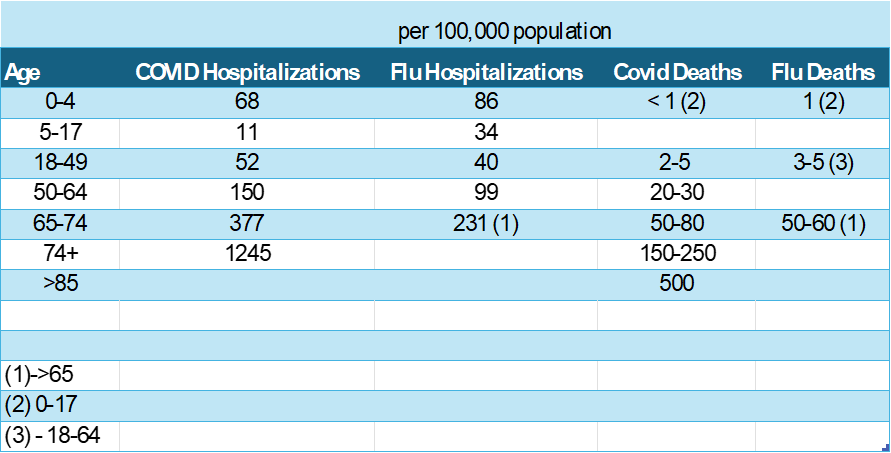
Source: CDC COVID-NET and FluSurv-NET surveillance systems
There are COVID-related hospitalizations in young children: 68/100,000. The numbers were much higher for older adults (and were more common for COVID than for flu). In kids, the rate of hospitalization for flu and COVID was similar. It is true that flu vaccination is recommended for young children. Those recommendations are based on vaccine-related reductions in flu incidence and modest reductions in influenza-like illness. There is no evidence that flu complications are affected by the vaccination. (Perhaps calls for flu vaccination in young children are also excessive…)
The MMWR article states, “On June 27, 2024, the CDC’s Advisory Committee on Immunization Practices (ACIP) recommended 2024–2025 COVID-19 vaccines for persons aged ≥6 months” with no rationale as to why this recommendation was given. In an era of public distrust, statements like these are insufficient. At a minimum, an article trying to convince clinicians and the public should explain the basis for such a recommendation, not simply “trust us, we are the ACIP!”
Practicing clinicians and patients appear to be ahead of the experts in doubting the need for COVID vaccination in children. From the MMWR report:
“Among children aged 9 months – 4 years, 44,541 ED/UC encounters met criteria for inclusion in the analyses, including 1,292 (3%) case-patients and 43,249 (97%) control patients (Table 1). Twelve (<1%) case-patients and 1,847 (4%) control patients had received a 2024–2025 COVID-19 vaccine dose.”
As summarized above, COVID vaccination was recommended during this time period, but very few kids were vaccinated. Clinicians and parents have voted with their feet. They have largely rejected the public health hierarchy’s recommendations. This speaks volumes about the public’s loss of confidence in public health recommendations.
For all those who predict health-care Armageddon because of recent changes in ACIP and other organizations, a lesson can be learned from the observation that the public ignored their recommendations on a massive scale. Change was necessary.
From the MMWR: “Effectiveness of a 2024–2025 COVID-19 vaccination against a COVID-19–associated ED/UC visit was 76% (95% CI = 58%–87%) during the first 7–179 days after vaccination.”
Vaccine efficacy is calculated from the number of unvaccinated patients who were seen in an ED or urgent care center (n = 42,682); 12 had positive COVID tests. There were 2,207 vaccinated children seen, of whom 15 tested positive for COVID. The vaccine effective rate (VE = 1 - (Risk in vaccinated / Risk in unvaccinated) × 100% is 1 – (0.00680/0.03004) x 100) is 77%. The number needed to treat is (1 / Absolute Risk Reduction) of 1/.0256) = 39. The vaccine is associated with a 77% reduction in the risk of a COVID-related event (ED or urgent care visit), and 39 children need to be vaccinated for one to benefit.
A number needed to vaccinate to prevent severe disease from COVID in young children of 39 would be amazing. But…
Some of these children who were classified as having COVID events were ill from something else and had an incidentally positive COVID test. It is also likely that most of these children did not have severe disease, given that severe COVID disease in young children is unusual. Thus, the number needed to treat is probably much larger than 39 to prevent clinically important COVID in young children.
That is how the study’s findings should have been reported. The benefits of COVID vaccination in young children are uncertain. Given the current HHS recommendations for shared decision-making, CDC has a responsibility to present scientific information in a neutral, dispassionate way. Rather, they presented a big number, 76% effective, in a way that seemed intended to influence parents to pursue vaccination. That the CDC’s writings and how they were presented to the press were anything but objective, they appear to have had the intention to influence public opinion in favor of vaccination in contrast to messages coming from other parts of HHS.
CDC would be well-served to be an honest broker and present evidence completely, highlighting the strengths and weaknesses of science so that the public can use the information to make informed decisions. If they had done that, they would not have used the word ‘severe’ in their report, given that the disease severity and consequences of COVID in the very few patients who actually had COVID were unknown. By only presenting a big number for vaccine efficacy and referring to severe disease, the CDC has misled the public and pandered to the clickbait press that thirsts for headlines, especially when they are critical of the current administration.

It is a sign of the bankruptcy of the public health establishment that they continue to flog covid shots in healthy kids. In addition to the weak methodology that the author dissects, a fair analysis would almost certainly show that the highly reactogenic modRNA covid shots cause more influenza-like illnesses than they prevent, even if one accepts the flawed MMWR results at face value. We have already reached the point where even a single case of vax-induced myocarditis from these shots is an unacceptable risk for kids.
“CDC would be well-served to be an honest broker…” hear hear! Yet those days are long gone