

There is a rule in medicine: you learn the most from your mistakes. It’s surely similar in evidence appraisal.
And so today we look at the failure of critical appraisal with the Factor Xa reversal agent Andexanet Alfa, which the company recently pulled from the market, nearly 7 years after its approval.
The Factor Xa inhibitors (rivaroxaban, apixaban and edoxaban) have been a great advance for patients with AF. The drugs are convenient, noninferior to warfarin and in some cases likely superior in safety.
Yet, one knock against them was the lack of a reversal agent—in the case of severe bleeding that needed to be stopped quickly. Warfarin had fresh frozen plasma and Vitamin K, but DOACs had none.
The market, therefore, was primed to accept the novel antidote drug Andexanet Alfa when it was studied in the ANNEXA 4 trial (2019). I say “trial,” but you will soon see it wasn’t actually a trial.
We knew before ANNEXA 4 that the drug reduced both the unbound fraction of the plasma level of factor Xa inhibitor and anti–factor Xa activity in healthy volunteers. It did this by binding and sequestering Factor Xa molecules.
FDA approved the drug under its accelerated approval program in 2018. This approval was based on mechanistic studies showing that the drug reversed anticoagulant effect and preliminary data from ANNEXA 4. Notably: it had not yet been studied for clinical outcomes. And the original labeling included a boxed warning regarding clotting risks
Here are two comments which capture the feeling of the moment.
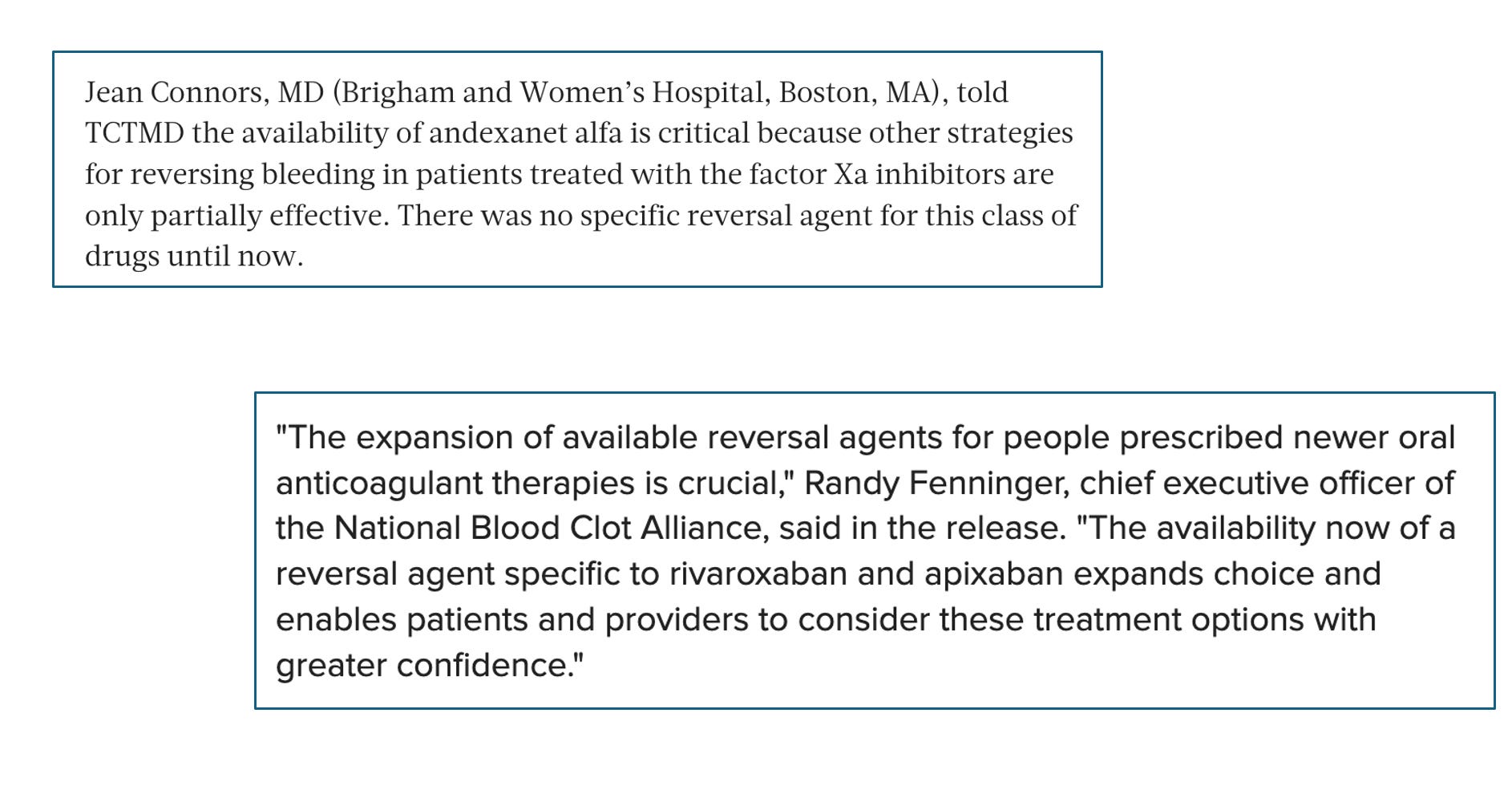
Let’s look at the seminal studies
The Full Report of the ANNEXA 4 Study
The study included 352 patients who had acute major bleeding who were on a Factor Xa inhibitor.
All patients received andexanet alfa infusion. The coprimary outcomes were the percent change in anti–factor Xa activity after andexanet treatment and the percentage of patients with excellent or good hemostatic efficacy at 12 hours after the end of the infusion.
The reversal agent successfully reduced anti-factor Xa activity. Excellent or good hemostasis occurred in 204 of 249 patients (82%) who could be evaluated. Within 30 days, death occurred in 49 patients (14%) and a thrombotic event in 34 (10%).
A slight warning sign: reduction in anti–factor Xa activity was not predictive of hemostatic efficacy overall but was modestly predictive in patients with intracranial hemorrhage.
A huge warning sign: no comparison group. And 10% of the group had thrombotic events, including 14 ischemic strokes. There were also 35 CV deaths.
The drug went to market and made money for the company. I never had the occasion to use it, most likely, because of its huge price tag of more than 20,000 US dollars per dose. (That is not a typo.)
Multiple guidelines incorporated the drug. This from hematologist Dr. Richard Buka’s thread:
2018 CHEST guidelines had the comment that in a patient with serious bleeding a specific reversal agent should be used instead, when available. General hemostatic agents are less effective and have not been shown to improve outcomes and are potentially prothrombotic.
ANNEXA I Trial
We had to wait six years for a proper randomized comparison study.
ANNEXA I (2024) compared andexanet alfa to “usual care” in more than 500 patients with acute brain bleeding. Usual care included prothrombin complex concentrate or PCC in 85% of cases.
The primary end point was hemostatic efficacy. Safety endpoints were thrombotic events and death.
The trial was stopped early for benefit. The primary endpoint measures of hemostatic efficacy favored andexanet, but thrombotic events were higher 10.3% vs 5.6%. That risk increase of 4.6% met statistical significance. There were 17 vs 4 ischemic strokes or 6.5% and 1.5% and 11 vs 4 MIs. The difference in stroke severity in the two groups was not different.
Editorialists at the time wrote: “longer-term outcomes at 3 or more months, a standard measure in most stroke clinical trials, including those for intracerebral hemorrhage, were not reported.”
Later in the year 2024, an FDA advisory committee questioned whether ANNEXA-I’s primary endpoint of improvements in hemostatic efficacy at 12 hours was clinically relevant and whether it outweighed the safety concerns.
This lack of support made it difficult for AstraZeneca to reach agreement with FDA on a feasible path to convert the drug from accelerated approval to traditional full approval—as the drug had been operating under accelerated approval status since 2018. And it was pulled from the market.
My comments
Here I again quote Dr Richard Buka:
This drug, that cost at ~$20k a dose, never showed real benefit, and caused stroke. The story is a fascinating example of misguided ethical thinking, and the human weakness for the power of narrative.
What he means is that nearly everyone (including me) was fooled by mechanistic thinking: bleeding is bad; the anticoagulant makes it worse, therefore reversal of the anticoagulant is good. And: the drug showed it can reverse the anticoagulant effect so it’s bound to be good.
But reversal of anticoagulant effect is a surrogate marker for a clinical outcome. Yes, in basic pre-clinical studies, we obviously care what happens with reversal of Factor Xa effect. But when it comes to use in humans-with-serious-problems, the only outcome of interest is death, or MI, or cardiovascular death or stroke.
That was not a point of emphasis in the ANNEXA 4 study and no one seemed to care.
That is, except one of our founding members Vinay Prasad who worried about the lack of outcomes data on his podcast in 2020—4 years before ANNEXA I found higher rates of thrombotic effects.
The lesson here is that we should have had ANNEXA I much earlier—perhaps even before approval.
Looking back, this is yet another example where we should not have put that much emphasis on surrogate markers and things that make good sense—especially when caring for extremely ill people.
A proper RCT could have saved us a lot of medical harm and costs.
Thanks for your support this year. Adam and I are grateful. We look forward to another year of bringing you independent industry-free medical thinking. Happy Holidays. JMM
Hubris and financial incentives sure do explain a lot. I'll bet Vinay drives a lot of people nuts, but he sure does ask good questions. Thank God for the skeptics.
My husband had emergency surgery for an incarcerated hernia 2 years ago. His surgeon walked in to talk to him pre-op and said “There is a reversal drug for your Eliquis, but I’d rather not use it. I’ve had two patients stroke after receiving it. I think I can do your surgery with minimal bleeding.” My hubby said ok. Surgery went without complications.