

As many of you know, I am skeptical of left atrial appendage occlusion as a stroke prevention strategy. But still I remain open-minded to new progress in the space.
I was therefore interested when one of the key opinion leaders in the field, and potential president of the Heart Rhythm Society, Dr. Dhanunjaya (DJ) Lakkireddy sent out these posts on X and LinkedIn regarding a new study in LAAO. I made a PowerPoint slide of his posts:
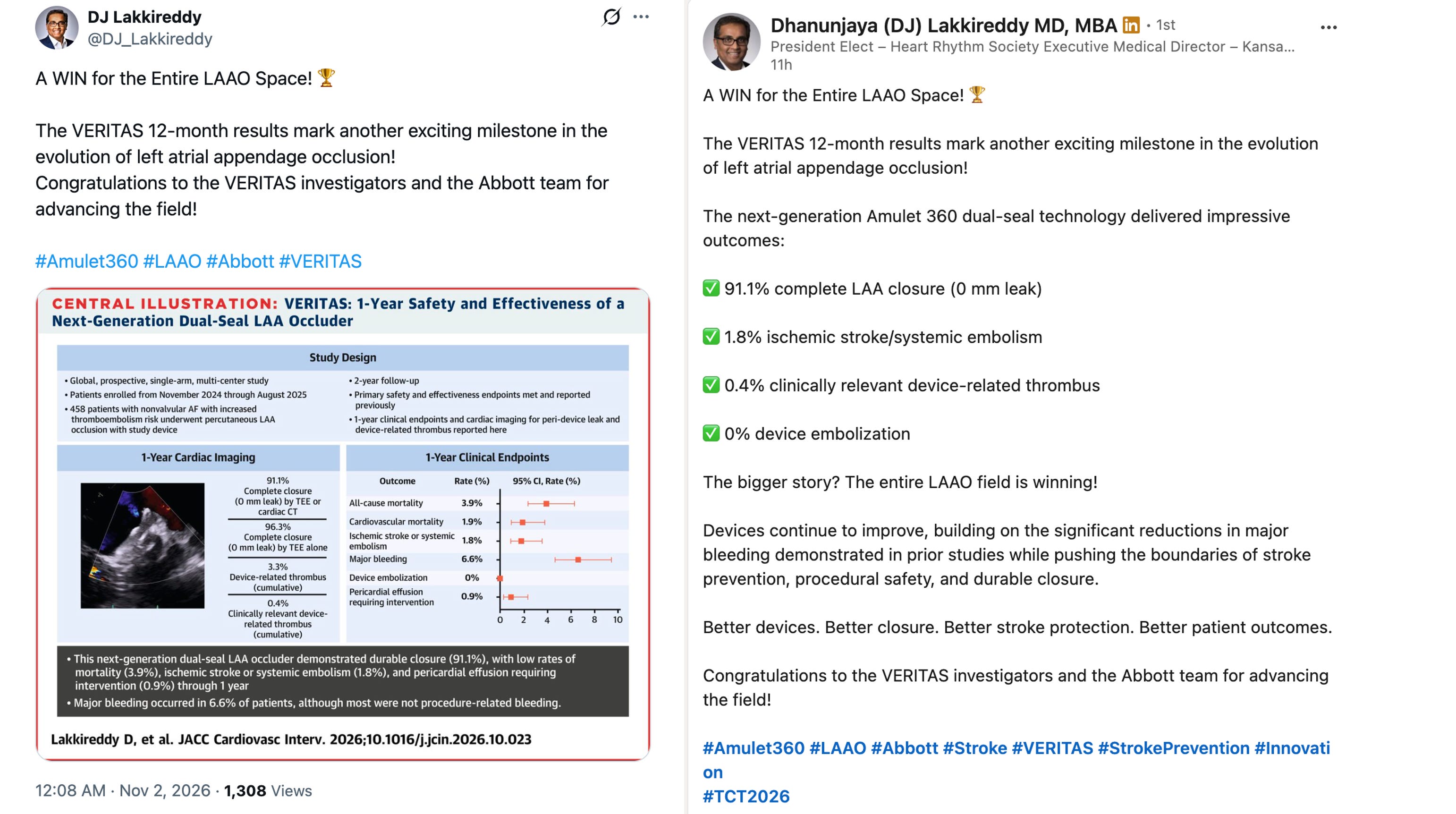
Given the enthusiasm of an important leader in the field, I naturally went to the linked study in JACC-Interventions.
This was a single-arm (no control) study of a new type of left atrial appendage occluder. About 458 patients had attempted LAA closure at multiple centers. Outcomes were descriptive.
The basic findings were as follows:
Complete closure of the appendage (0 leak) was observed in 91% of patients.
The cumulative device-related thrombus rate was 3.3%, but the authors deem only 0.4% of these clots to be “clinically significant” because most were laminar.
One-year clinical outcomes included all-cause death in 3.9%; CV death in 1.9%; major bleeding in 6.6%; ischemic stroke or systemic embolism in 1.8%; pericardial effusion requiring intervention 0.9%;
Median follow-up was 365 days
Critical Appraisal
The first irony (perhaps comedy) is that the trial was named VERITAS—Latin for truth.
The other systemic issue was the design of the study: it’s a single-arm study without a control arm. There was no anticoagulation arm, no non-device arm, or no standard LAAO device arm. I realize single-arm studies are sometimes done, but in the case of a new closure device, I would want to know how it performs against some…thing.
I’ve made a few comparisons with the oral anticoagulation study ROCKET AF of rivaroxaban vs warfarin. Patients in the ROCKET AF had a higher baseline stroke risk than VERITAS but had a similar stroke rate (2.1 per 100 patient years vs the 2.0% or 9 strokes in the one year follow-up of VERITAS. As for the comparison of bleeding, patients in the VERITAS study had a higher risk of major bleeding, but the 6.6% rate of major bleeding in the one-year of follow-up is nearly double the bleeding rate in ROCKET AF of 3.6 per 100-patient-years.
Another problem: Of the 17 patients with leaks >3 mm on 1-year CT, 13 had complete closure on their 45-day TEE. This means that either TEE missed those leaks early on, or the seal got worse over time. Neither situation is reassuring about a new device.
Obviously, cross-trial comparisons are fraught but the single-center trial design offers no direct comparison.
Other problems with the study:
The authors report a 91% closure rate with either TEE or CT. That means that 9% of patients had a peri-device leak, which we know is bad because it increases the odds of thrombus and stroke.
Furthermore, when you look at CT assessment of complete closure, which is more sensitive than TEE, the closure rate is only 80%*, which is hardly good. (*By subtraction from Table 1).
Another issue was a high rate of device-related thrombus at 3.3%. The authors dismiss most of them by calling them “laminar”. That a laminar or layered clot is less important than a non-layered clot is speculation. What’s more, DRT was only reported on TEE, and a third of patients had only a CT.
Concluding Comments
I am not an expert in regulatory affairs, but I don’t understand how such a study gives us any confidence that this iteration of the device is any better than what is being used now.
The practice of studying devices without a control arm is problematic. It’s just too hard to compare against historical controls.
When I look at the data, I see a pretty high stroke rate at ≈ 2% and major bleeding rate of 6.6%. I’d want to know what that would be vs oral anticoagulation, half-dose oral anticoagulation, or no anticoagulation. I’d even be slightly happy with a comparison to a standard LAAC device. Just compare it to something.
On the matter of cheerleading…why would one of the lead investigators in the field be so publicly enthusiastic about such a limited study? It is especially curious given his and the many financial conflicts of interest listed in the paper. These include the fact that Abbott funded the study; an Abbott employee is a coauthor; and Abbott staff did the statistics and the medical writing.
I realize that procedural doctors will work with industry to iterate devices, but when such relationships accompany unbridled enthusiasm for limited studies, the appearance is not one of neutral science adjudication.
Dr Lakkireddy is president-elect of the Heart Rhythm Society. How can members expect him to be a neutral arbiter of medical science.
This isn’t personal but it does not seem like an ideal place for our profession.
It speaks a lot to how poor LAA occlusion performs in the RCT data that academic cheerleaders want to promote such poor non-randomized studies.
I totally agree with
"On the matter of cheerleading…why would one of the lead investigators in the field be so publicly enthusiastic about such a limited study? It is especially curious given his and the many financial conflicts of interest listed in the paper. These include the fact that Abbott funded the study; an Abbott employee is a coauthor; and Abbott staff did the statistics and the medical writing. "
Dr. Mandrola is voice of reason and moderation in a crowded space where hospital-employed interventional cardiologists on RVUs are pushing patients to undergo marginally useful "simple procedures" with considerable risk, and worse patients wanting these procedures based on aggressive TV advertising, without comprehending the downside risk.. Medscape-Cardiology needs to be heard by patients, not just physicians.