

The Study of the Week column has two main goals: one is to inform you about a recent advance in medicine, and the other is to teach a lesson in critical appraisal.
Critical appraisal teaching is the reason to study the POET II trial.
It is the biggest head-shaker of the year. My issue is the author’s choice of primary and secondary endpoints. A rule of evidence is that you choose as the primary endpoint the most important outcome. Secondary outcomes are chosen to bolster or support the primary.
POET II authors got this backward; but readers of the trial can still make conclusions from the evidence—it’s just different from what the authors conclude.
Background: The medical issue and question is the treatment of bacterial endocarditis, which is infection of the heart valves. It’s about as bad as an infection gets. You can easily die form endocarditis because the infection can destroy the valve, or, the nidus for infection in the heart can keep seeding the blood and body with bacteria, and then sepsis can cause death. The other problem with endocarditis is that it can be tough to eradicate because there is often a full-on mass (or vegetation) on a heart valve. Sometimes a surgeon has to cut the valve out and replace it.
The specific question asked in the Danish-led POET II trial was whether a shorter course of antibiotics could be used.
In POET I, the Danish team had shown that switching from IV to oral antibiotics could be done at a point when certain criteria had been met. These criteria were then called the POET criteria, and, basically, were signs that the infection was going in the right direction. Things like falling white count and inflammation markers as well as a lack of fever.
The POET II trial enrolled only patients with endocarditis who had a) received the standard 2 to 4 weeks of abx, depending on pathogen and complexity of infection and b) met POET criteria and were considered to be stabilized.
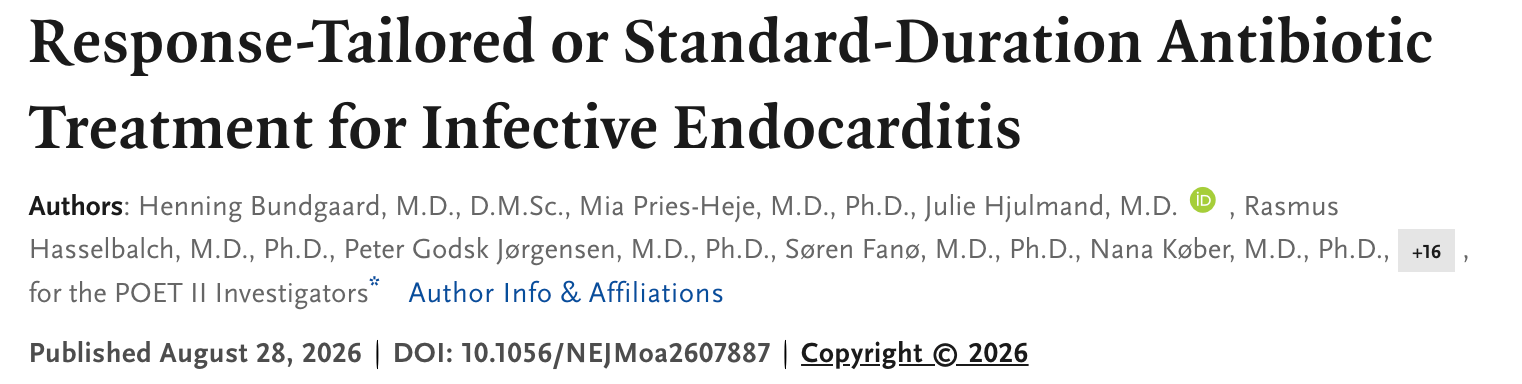
Patients were then randomized to either response-tailored therapy (stopping antibiotics) or continuing standard therapy duration. There were about 500 patients; half had the antibiotics stopped and half continued.
The primary endpoint was days alive without antibiotics within 6 months. This was tested for superiority. The primary safety endpoint was death, unplanned heart surgery or embolic events within 6 months, tested for non-inferiority. Relapse of bacteremia or endocarditis was a key secondary endpoint.
Pause there and think for a moment about the primary endpoint. If you are like me, you might wonder why days alive have to be modified by without antibiotics. More on that in a moment.
Results of POET II
The main primary endpoint of days alive without abx was 183 days in the tailored therapy arm vs 169 days in the standard duration arm. This 13 days difference was statistically significant.
A primary safety endpoint event occurred in 8.2% with tailored therapy vs 10.7% with standard therapy. ARD: −2.4 percentage points; 95% CI, −7.7 to 2.7; P<0.001 for noninferiority.
For the key secondary endpoint of relapse of infection: 5.1% tailored vs 1.6% standard therapy. HR 3.3 (1.07-10.1) and p =0.04.
The authors concluded:
Among patients with infective endocarditis on the left side of the heart, the use of a response-tailored antibiotic strategy resulted in a longer time alive without antibiotic therapy than standard-duration therapy and met the criterion for noninferiority with respect to safety but was associated with a higher incidence of relapse of bacteremia or infective endocarditis.
Media and Press Conference at the European Society of Cardiology Congress
News articles had headlines such as this: POET II Supports Shorter Antibiotic Course in Infective Endocarditis.
In the news conference at ESC, POET II primary author, Henning Bundgard said: “It seems that from POET I and POET II we have challenged dogmas… showing that less intensive antibiotic therapy after stabilization is superior and safe,” And we think that defining the stabilization point is a kind of personalizing endocarditis treatment.”
Following the presentation, the trial discussant said “despite some limitations, including the need for more information on the strict clinical stabilization criteria used in the study, the balance favors the shortened antibiotic course.”
He called it a positive study, and antibiotic therapy for endocarditis “should move from the fixed-duration therapy to [a] personalized, tailored treatment decision, but in selected patients and in selected centers with high specialization in the field of endocarditis.”
My Comments
The first thing to say is my surprise that a Danish team could be so wrong. Normally, I see Danes as highly intelligent right-minded people. But this interpretation of the data is about as wrong as it gets.
I covered this on the This Week in Cardiology podcast last Friday, and we covered it here on the Sensible Medicine podcast but I wanted to make sure readers were exposed to the mistakes made in trial interpretation.
When we treat infections, especially serious ones in the heart and bloodstream, there are a couple of important endpoints—and one is not days without antibiotics, but recurrence of infection or death.
And in this trial, the shorter course of abx led to a 3x (up to 10x in the upper bound of the confidence interval) more recurring infection or bacteremia.
Most of us have been patients and been on antibiotics, I surely have, and whether I take 1 week or 2 weeks of tablets is far less important than if I have recurring bacterial infection.
Plus, we are not dealing here with the sniffles. Recurrent bacterial infections is really dangerous. Infection of the heart, too, is not like a urinary tract infection or minor cellulitis.
The bottom line is that you don’t need to be an academic or infectious disease specialist to take from this trial data that the shorter course is clearly the worse strategy.
Why the authors weigh being off antibiotics more highly than not having a recurrent bacterial infection is a matter for speculation. I hope that it is not antibiotic stewardship run amok.
No matter, our job as users of the evidence is to find the best treatment for our patients. In this case it is the standard not shorter course of antibiotics.
I think you could subtitle this essay as:” When bad things happen to good data…’
There is bacteremia recurrence without harm. You restart antibiotics, and the patient has a good outcome. There is recurrent bacteremia with harm, mainly death, surgery, and embolic phenomena. I still see a rationale for the study choice. Even with the upper bounds of bacteremia rates you cite, the trade-offs still strike me as fair. As a patient, I want to know whether a recurrence will cause harm. Those are the measured primary endpoints. Would I feel comfortable with the tailored strategy on myself? Yes.