

This is an article that I think stands alone, but is also a follow-up to a discussion we had on This Fortnight in Medicine. I went into our podcast discussion about Antibiotic Therapy for Uncomplicated Acute Appendicitis knowing what I thought about the study. After our conversation, while I hadn’t really changed my mind, I had come to appreciate a whole lot more nuance. With regards to the appendicitis study, I realized how fraught shared decision-making, our current gospel, can be.
Surgery vs. Antibiotics for Appendicitis: Background
Antibiotic Therapy for Uncomplicated Acute Appendicitis is a 10-year follow-up of The APPAC Randomized Clinical Trial. In the APPAC trial, 530 patients with uncomplicated appendicitis were randomized to antibiotic therapy (3 days IV followed by 7 days oral) or open appendectomy. The primary endpoints were the successful completion of an appendectomy (for the surgical group) and discharge from the hospital without the need for surgery, and no recurrent appendicitis during a 1-year follow-up (for the antibiotic group).
In the study, 70 patients (27.3%) randomized to antibiotics underwent appendectomy within 1 year of presentation. Given the a priori non-interiority margins, this meant that antibiotic therapy was considered inferior to surgery. That said, many people remarked that a 72% success rate (avoiding surgery) was pretty good. Some wondered if this constituted a medical reversal, where a treatment we had been doing, one based on pathophysiology and tradition rather than data, was actually unnecessary.1
10-Year Follow-Up Results
The 2026 article reported on patient outcomes in the antibiotic group 10 years after randomization. The appendicitis recurrence rate was of 37.8%, with 44.3% of the patients having had appendectomy at 10 years. Here is the graphical representation of the time to appendectomy:
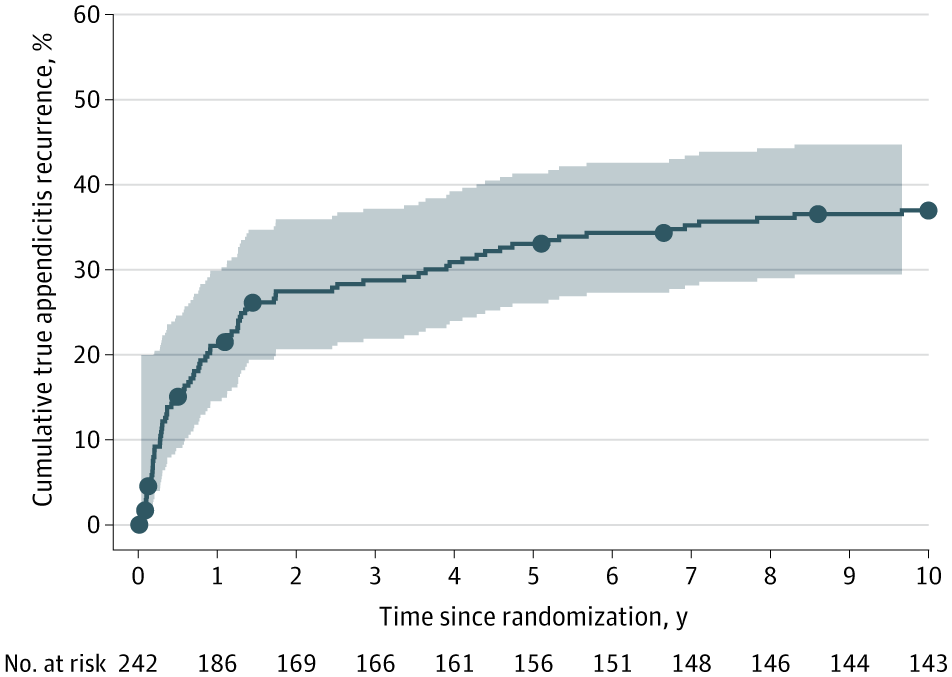
There were two other interesting results. At 10 years, 102 of the 143 patients initially assigned to antibiotics (71.3%), who still had an appendix, agreed to MRI imaging. None of these patients had signs of appendiceal inflammation on the scan, but 5 had abnormal appendices. The two patients whose appendices appeared malignant underwent appendectomy. Both had low-grade appendiceal mucinous neoplasms, cured with surgery. (In the appendectomy group, 4/272 patients [1.5%] had an appendiceal tumor at surgery.)
The authors also presented data on whether patients would choose the same treatment again. You will be shocked(!) to find out that 90.9% of the patients cured with antibiotics alone would choose that therapy again. 78.0% of those assigned to surgery would choose that therapy, while 46.6% of those who got antibiotics and then needed surgery would choose antibiotics. (The overall “choose therapy again” number for the antibiotic group was 67.3%.)
Analysis
I think there are two ways to read this article.
