

I’m not going to talk about the studies that support the use of glucagon-like peptide-1 (GLP-1) receptor agonists for weight loss or DM. Nor will I attempt to wax poetic about their effect on our society. A journalistic cottage industry already covers the cultural impact of these meds. Yet, as we approach the 10-year anniversary of their widespread use, it is hard to resist writing about them. When I am not distracted by shortages, pre-approvals, and dose titration1, I cannot avoid thinking about their impact.
My career has been marked by medications that have altered the course of medicine. The GLP-1s have not been as revolutionary as statins, protease inhibitors, CFTR correctors and potentiators, checkpoint inhibitors, or the like. But, as obesity is a few thousand times more common than cystic fibrosis, the impact is, at least, comparable.
The history of the GLP-1s is interesting. The drugs are somewhat famously inspired by a peptide found in the saliva and venom of the Gila monster. For a lizard that rarely eats, a peptide that inhibits GI tract activity (decreases gastric emptying) and suppresses appetite is pretty useful. The first GLP-1, exenatide (Byetta), was approved in 2005. It was a crappy drug that I almost never used. Exenatide needs to be injected twice a day and causes so much nausea that the associated weight loss seems beside the point.
Semaglutide (a long-acting GLP-1 receptor agonist) was approved at the end of 2017. Tirzepatide (a combination GLP-1 receptor agonist and GIP – a glucose-dependent insulinotropic polypeptide) came out in 2022. I’m pretty sure that the people who appreciate the effectiveness of these drugs most are people who have struggled with obesity for decades – either personally or as a primary care doctor.
Up until 2017, people with decades of obesity and their doctors had little hope. Sure, there were drugs, but these led to only modest weight loss and failed to improve the outcomes that weight loss should be associated with. Bariatric surgery was (is) effective, but it is, well, surgery. And there is diet and exercise.
Don’t even start with, “Well, you and your patients could have focused on diet and exercise.” Behavioral change is hard, and weight loss in your 40s and beyond, when you have been overweight since your teens, seems next to impossible. I can counsel diet and exercise with the best of them, but I have always estimated that the number to counsel to achieve weight loss is around 2000. I have, only half-jokingly, suggested that given these numbers, it is not something we should even do. I wouldn’t prescribe a drug that is this ineffective. This snarky comment of mine is always met by stories of the one person who comes back 6 months later, 25 pounds lighter, with an A1C 1 point lower. Not that there is any proof of causation in that story – and you never hear the follow-up when that patient presents one month later with painless jaundice. (Sorry, that was kind of dark).
A few clinical observations.
Maintenance of GLP-1 weight loss
The GLP-1 skeptics point out that these drugs are a treatment for obesity, not a cure. This is absolutely true. (Though, of course, the same can be said for diet and exercise.) Data suggests that most people who come off their GLP-1 regain the weight lost.
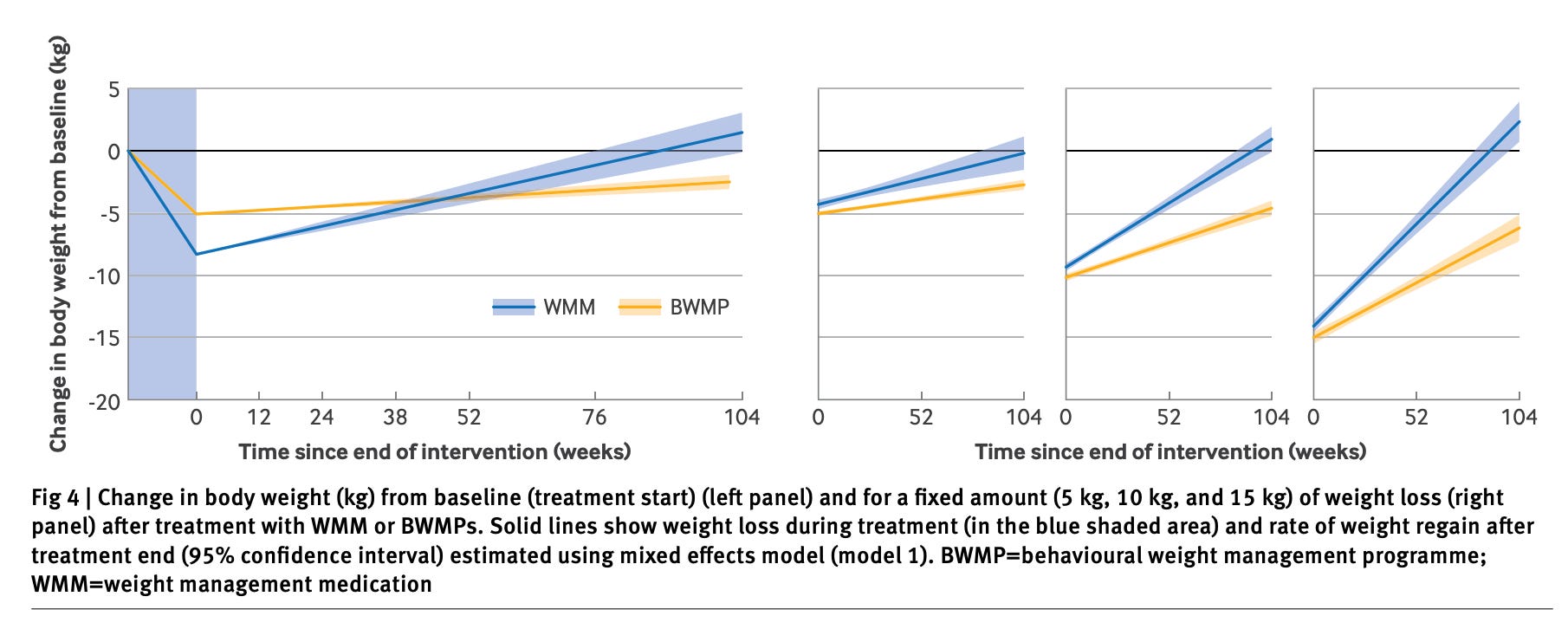
My experience is that the two types of people maintain their weight loss.
First are the record-keeping obsessives. These are the people who can track everything – food diaries, calorie counts, calories burned in exercise, fiber intake… – and recognize that they can’t let any of these things change after drug discontinuation. Most of these people tell me some version of, “I know why I have lost the weight, I know it will be harder to keep doing it off the drug, but I am committed to doing that.” It takes quite a lot to succeed, but some people, in the right situation, can manage.
Second are those whose use of the drugs provides a total reset. A case study may be best to explain this.
R and S are a married couple in their 60s. When their kids were born, they were in their early 30s, and they both had a BMI in the high 20s. Both slowly gained weight in their 30s, with the pace picking up in their late 40s and 50s. The explanation was obvious: falling basal metabolic rate, less exercise – mostly related to work and childcare responsibilities -- and more regular alcohol use. They describe adopting a COVID cocktail that they did not de-adopt post-COVID.
They both began tirzepatide with BMIs of 37-40. 18 months later, they discontinued the medication with BMIs of ~ 26. By the time they came off the drug, they had completely changed their lifestyle: different weekly meal plans, daily exercise together, cocktails limited to a Sunday evening Negroni. It’s been 18 months of weight stability.
Openness to discussing obesity in the office
Prior to the GLP-1s, I seldom discussed obesity in the healthy overweight – those people with BMIs between 30 and 40 who were biochemically normal – normal lipids, A1C, LFTs, blood pressure. I absolutely think these weights are associated with worse outcomes, but with little to offer, and knowing that most people already beat themselves up about their weight, I was happy to leave it unacknowledged.
Now with therapy available, I have made it my practice to bring treatment up with anybody with a BMI > 35. (Again, I am talking about people without other health issues that would warrant more aggressive weight management). I find the diversity of reactions interesting.
I’m glad you brought it up; I’ve been thinking about it.
No, I have no interest in looking like some gaunt influencer.
Huh. I haven’t considered it. Would it make sense for me?
Fewer of these people end up taking the medications than I would think.
GLP-1-related health concerns
I am not talking about medullary thyroid cancer, hair loss, “Ozempic face,” or muscle wasting. The effect on cancer seems to be a wash, and the other side effects seem to me mostly the expected effect of living in a calorie deficit for a time. (I am no Pollyanna. I am not sure we won’t eventually find some important side effect, though I expect the benefits of these drugs, broadly defined, will outweigh the risk.)
What I am talking about are the findings that weight loss reveals that send people rushing in for appointments. Visible xiphoid processes, palpable umbilical hernias, and partner-detected lipomas have reached epidemic proportions.
A new appreciation for the first law of thermodynamics
The first law of thermodynamics states that energy cannot be created or destroyed; it can only be transformed or transferred from one form to another. For years, my counseling around diet and exercise would be dismissed with, “I don’t overeat.” When I pointed out that losing weight is all about calorie balance, people pushed back.
I get it; we do all have different basal metabolic rates. One can eat a small amount and still not gain weight. We cannot all be Anthony Tucci, making a living eating in Italy while remaining trim at 65.
Not surprisingly, I’ve had dozens of patients express doubt that GLP-1s would even work because, “I don’t overeat.”
I never hear this after the person has gone on the drug and lost weight.
I have to give the clinical pharmacists I work with kudos for all the help they give me with these hassles.
This rarely gets mentioned but exercise is an absolutely terrible treatment for obesity, if you look at the studies it's very clear. There are lots of excellent reasons to exercise to a recreational level but weight loss isn't one of them. I think this common misconception, that even you seem to have Adam, might be a factor in why diet and exercise programmes fail so badly. People think, I'm exercising 3 times a week and nothing happens to their weight and they get dispondent. I tell patients that while exercise is great, weight loss is all about calories in. It still isn't easy but at least it's factual and realistic.
Honestly confused about your "now with therapy available" section: What is a doctor's role in the life of the "healthy overweight" person? Presumably the patient's goal is to stay healthy, and the best way to do that is to eat well, be active, avoid dangerous/unhealthy behaviors. In what way does the availability of a GLP-1 change that? An analogy might be if you met a person who rode a motorcycle and wanted to live a long life. Your advice should be "stop riding a motorcycle." The fact that you can now add a feature to their motorcycle that makes it safer for them to ride (or less fun, so they stop) in no way changes that the advice to stop was the right one. I understand that as a doctor you don't want to be a nag, but somehow doctors have become important players in the pursuit of health, not just the treatment of illness, and with that comes a responsibility to tell people the truth about what constitutes a healthy lifestyle.