

I need more time to edit the next video. In the meantime, I offer this.
-v
Observational literature can be helpful. Myocarditis spiked after mRNA covid vaccination in young men. The temporality and magnitude cinched the association. Self controlled case series, crude and adjusted associations— all made the case. It was clearly causal, and fundamentally altered the risk benefit analysis of the product. So yes, sometimes observational studies can be helpful.
But if an intervention is used preferentially by healthy people, or sicker people, and the endpoint doesn’t occur 2 weeks later, but 2 or more years later, then observational studies are often a disaster.
This tweet is by the Nebraska Public Health dean and former asst surgeon general.
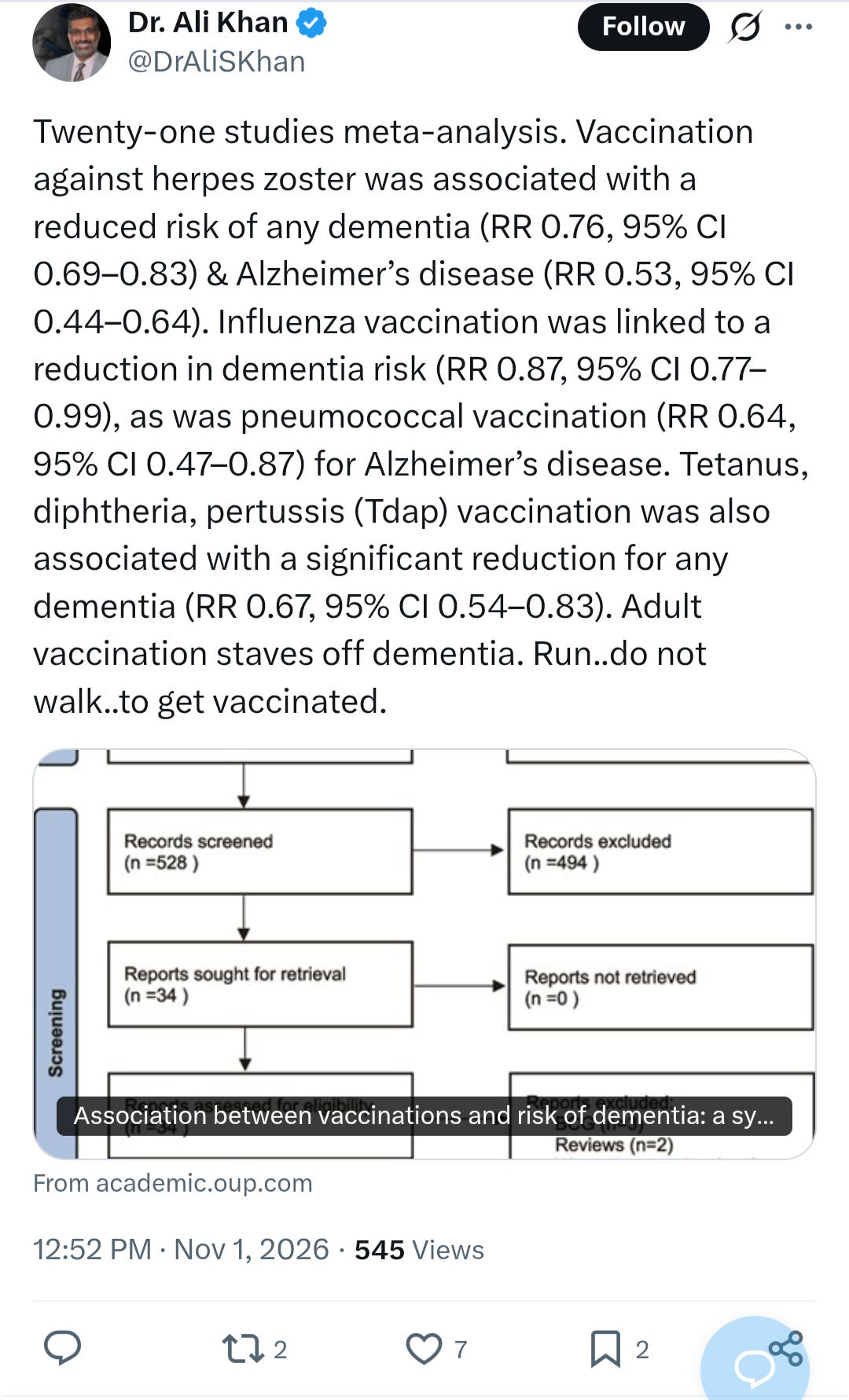
If all these vaccines are linked to lowered dementia in observational datasets, while every medication to date has failed to prevent dementia in randomized studies, which is more plausible
The core competency of policy making is understanding when evidence is good and when it is bad, but that competency appears to be lacking in many.
Of course, fake benefits are not the only way observational studies deceive us. You get fake harms too.
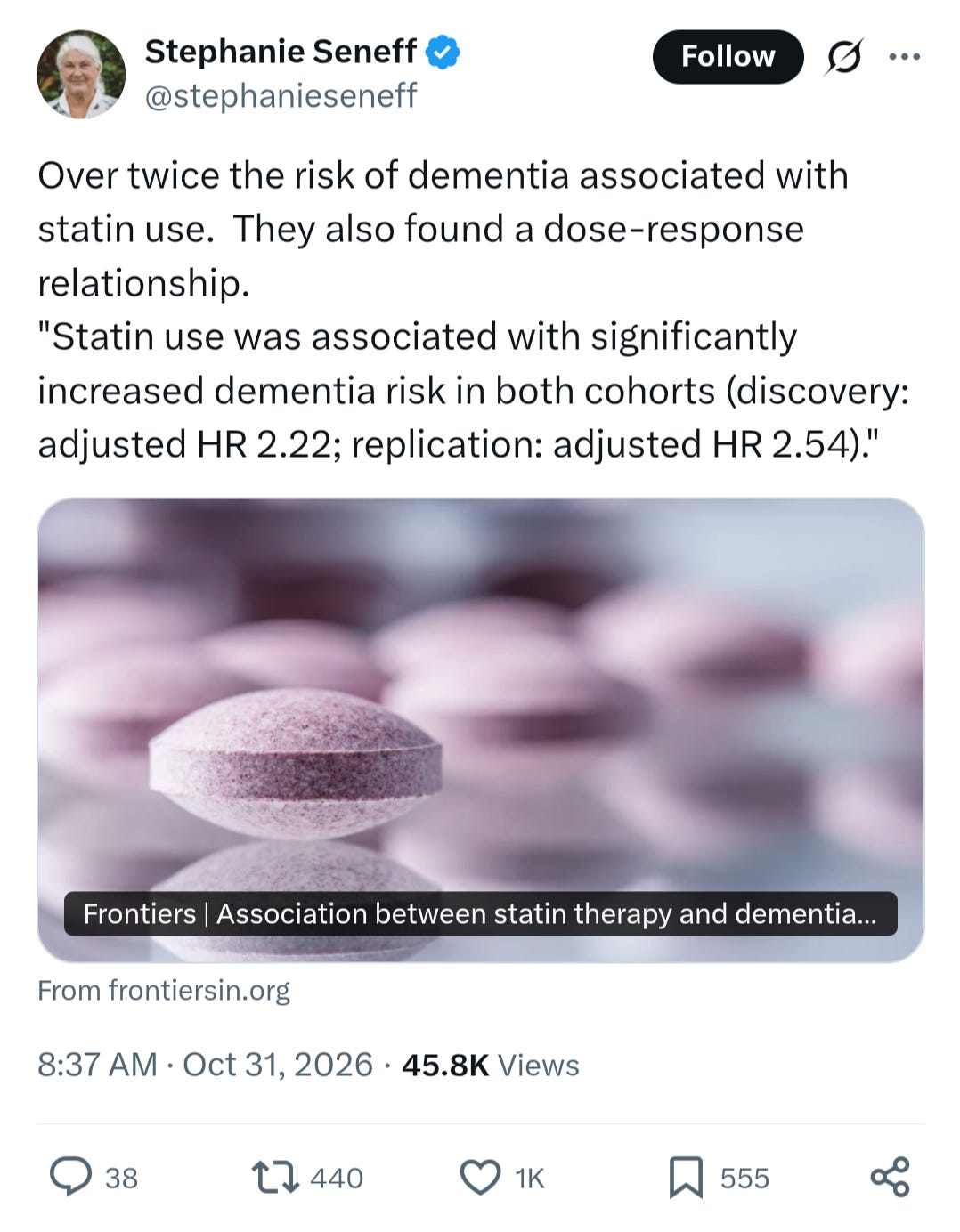
Again, what's more likely: although tested in hundreds of thousands of people in randomized fashion and never found to be linked to dementia, observational studies have unearthed this link or doctors like to give statins to people who they see in clinic and in whom they can diagnose dementia. And there's a dose response between being sick, being prescribed a higher statin dose, and having more dementia. Both confounding bias as well as ascertainment bias.
What I find fascinating about dementia articles is that the people who conduct the research, and tout the research, are obviously, by definition, interested in brain function. They want to avoid a failing brain. And yet, by embracing these studies, they reveal a brain that has already failed.
I do think there's a bit of a false equivalence here. When it comes to articles that claim ridiculous benefits of ivermectin or hydroxychloroquine, or fear monger about statins— you often find medical outsiders, people without epidemiology degrees, or folks generally not considered experts in that field.
Yet when it comes to the false benefits of therapies. Magic claims that vaccines halt dementia. Crazy claims that the covid vaccine reduces all cause mortality by 20%. Ridiculous claims that the watchman device saves lives or some toxic chemotherapy that failed in a randomized study actually is better than a less toxic alternative… In these situations, you find content specific experts. You find epidemiologists. You find the experts quoted by the New York Times.
Zeke Emanuel has a book called Eat Your Ice Cream. In it, he claims that ice cream is healthy. A colleague told me he doesn't believe that. He simply means that life is short and you should enjoy it. But I read the book. And I can tell you that's not what he means. He's sincerely believes that eating ice cream is healthy. This belief comes from a series of extremely low quality observational studies. It's riddled with potential biases such as confounding, reverse causality, and even differential false reporting. After all, if you're clearly overweight and unhealthy, do you really want to tell the truth about how much ice cream you eat?
Yet Zeke considers none of these potential explanations. He proudly criticizes the wellness influencers for being too stupid to understand science, while noting that ice cream is good to eat.
He went on Bill Maher's television show and said this and Bill Maher laughed in his face. Bill said that ice cream is obviously unhealthy as it is loaded with sugar and calories. But Zeke continued to stick to his narrative. Bill told him to take a hike.
If you randomized 200 people to usual care or usual care plus telling them eating Ice Cream is healthy, I bet the second group will be fatter, have higher A1c and worse BP a couple months later. If Kalshi ran a betting market it would be 99-1%. Unless the ice cream’s flavor was retatrutide, ice cream is going down.
Bill Maher has common sense; Zeke relies on bad observational research.
Medical students get lectures on how to think about climate change, and how to encourage their patients to vote. Call me old fashioned, but I just hope that someday they learn to actually know what they are talking about.
The funny thing about common sense is that it actually isn't all that common.
PS: if you want me to read and appraise a study you love add it in the comments. For fun: take your position and I will give you my 2c in a future post.
“Living among many, I live as many do and no longer think as myself; after some time, it is as though they wished to banish me from myself and rob me of my soul — and I grow weary of everyone and wary of everyone. Then solitude becomes necessary to me, so that I may become good again.”
— Nietzsche
We are solitary in this regard. Solitude is restorative. The mediocrity of the medical world distances us from genius.
We must learn to cultivate our solitude — as a possibility for distinction, as a possibility for creating ourselves, for becoming different.
Ezio Amaral - Brazilian Surgeon
Do medical students really get lectured on climate change and voting? How utterly depressing. (I wish they spent a lot more time learning to take a full history and how to perform a decent exam.) And yes ….. whatever has happened to common sense? Not only in medicine but in society as a whole?