

John Mandrola is out this week, probably licking his wounds (more on that this week on Weds). In the meantime, I am back— discussing the HORIZON trial.
First, the positive. In a world where people make love to un-validated surrogate endpoints, it is refreshing to see a trial powered for clinically relevant endpoints. The primary endpoint was MACE, which includes death from cardiovascular causes— and 3 endpoints of lesser severity: non-fatal MI, non-fatal stroke, and the need to cath you urgently. I would have preferred a composite with death from any cause included, but I won’t quibble to much here.
Next, the trial was randomized. It wasn’t a propensity score matched— historical control— before and after— or observational trial emulation from the St Louis VA. These papers bore us because they make claims that often fail to be confirmed in randomized fashion. They told us GLP-1s prevent alzheimers (they don’t), and that paxlovid saves lives when given to folks who had received the vaccine (it doesn’t). There is a cottage industry of academics who bamboozle taxpayers to fund studies that don’t answer questions. I need another target trial emulation like I need a hole in my shoe.
Third, the drug actually hits the target. It lowers lp(a) dramatically.
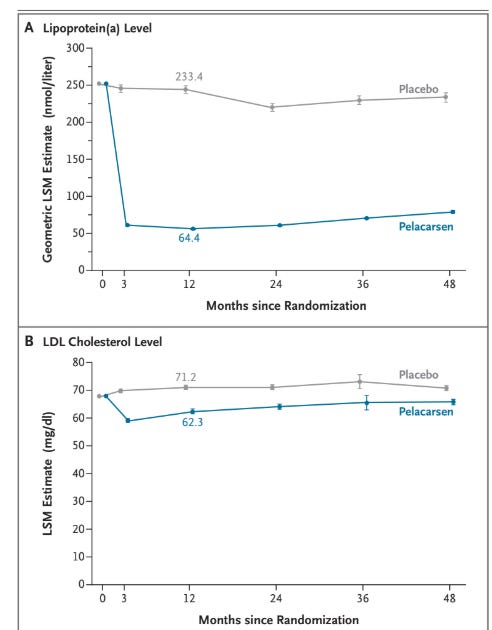
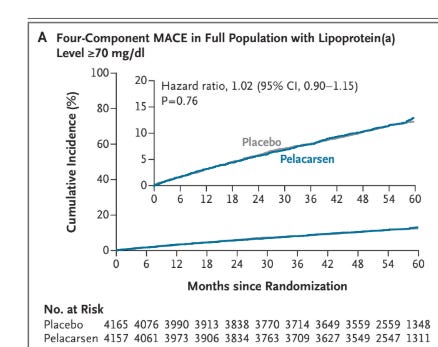
And of course, the trial is stunningly negative.
But the next figure is what many analysts were waiting for. There were 2 possibilities. The drug doesn’t work at any baseline Lp(a) level, or if your baseline was really high like >192 ish, you might see a trend towards a benefit. This would mean that maybe ASOs don’t hit the target long enough, or hard enough. This would give us greater optimism for ongoing si-RNA trials that enroll >200 baseline lp(a) only.
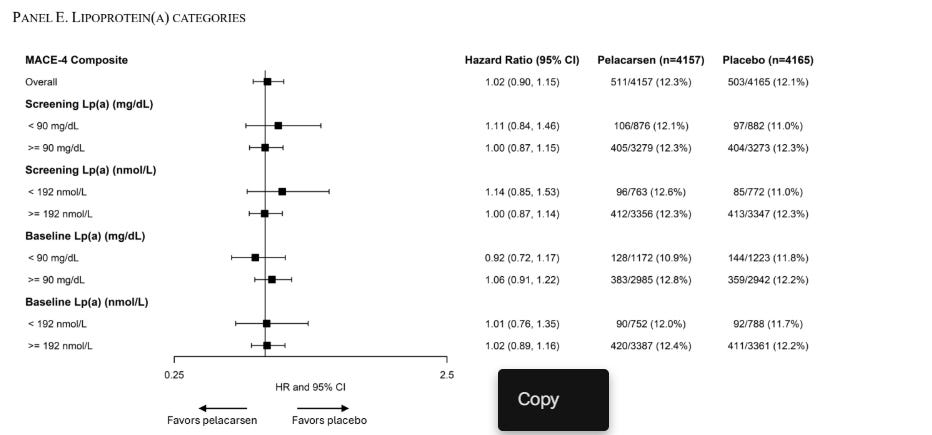
But, as you can see, that was not the case, there is no hint that any subgroup derives greater benefit. Of course, it is nevertheless possible that ongoing randomized trials will succeed. That more reduction, for longer, or earlier might someday work, but any rational actor would have to lower their pretest probability for that given these stone cold negative results.
Finally, I can’t help but re-up Joseph Marine’s great essay in these pages, that presciently pointed out that the urge to test everyone for Lp(a) lacked justification and felt like a marketing strategy for a drug that hadn’t proven itself yet.
Is Universal Testing for Lp(a) Warranted?

There has been lots of commentary on the 2026 Lipid guidelines. John Mandrola, Andrew J Foy, and Venk Murthy even did an “emergency podcast” on the topic which broke all download records for us. One thing that I think has been covered less is the recommendation for Lp(a) testing. Here, Dr. Marine offers a very sensible take on the issue.
I wonder how Pharma & Co are going to spin the results, because I would be very surprised if they don’t try to resuscitate this Lazarus…