

A short report of a computer-modeling study in the European Journal of Preventive Cardiology beautifully shows why medical practice leans so heavily on randomized controlled trials (RCTs) that measure outcomes.
You all know the story: the list of things that should have worked but did not work is long. Antiarrhythmic drugs after MI, HDL-raising drugs, intensive glucose-lowering and Swan-Ganz catheters in the ICU were all accepted before being felled by RCTs.
Vinay recently wrote about the “stone-cold” HORIZON trial of Lp(a)-lowering.
This morning I will show you a clever in silico (on a computer) modeling study—done before HORIZON results were known--that predicted that pelacarsen would lower cardiac outcomes. They actually locked the findings before the trial results were known.
A French team built the model based on how lipid exposures affect atherosclerotic plaque and cause myocardial infarction and ischemic stroke.
The Mandrola understanding of the model:
They built 21,000 virtual patients matched to the baseline characteristics of the HORIZON trial patients using the protocol paper.
They then gave pelacarsen and applied its 78% reduction in Lp(a), which was known from phase 2 studies.
The next step was like the engine of the model. Year after year, a person’s cholesterol levels and Lp(a) levels feed into equations for how plaque grows, changes and causes heart attacks and strokes. This data comes from cohort studies such as this analysis from the Copenhagen General Population Study as well as the PCSK9i trials.
The model has many unknowns, such as how fast plaque grows; how much worse Lp(a) is than LDL; how often a plaque rupture causes an MI (vs healing silently); and how fast lipid-lowering takes to alter plaque. So the next step was to calibrate the simulation using results from real trials, such as the PCSK9i trials.
They then added CV death and revascularization using statistical rules rather than simulating them.
Finally, they compared outcomes in the two virtual groups.
Here are their predicted outcomes:
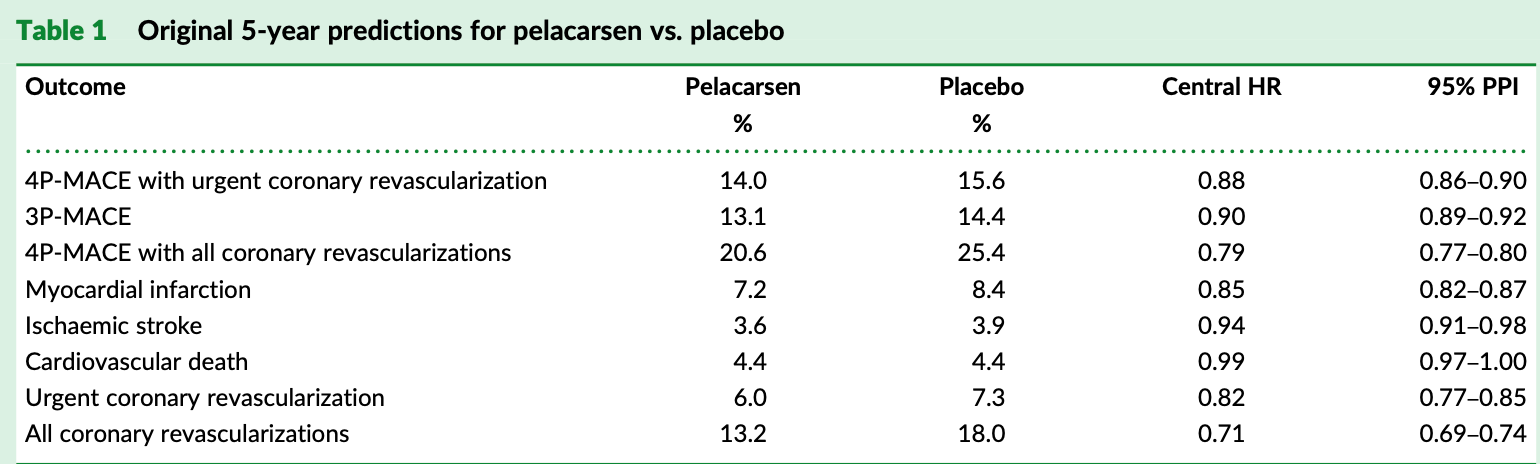
You can see that the model predicts statistically significant reductions in 4-point major adverse cardiac events, as well as a 15% reduction in MI, and 18% reduction in urgent coronary revascularization.
Here were the results from HORIZON, where pelacarsen dramatically lowered Lp(a) levels .
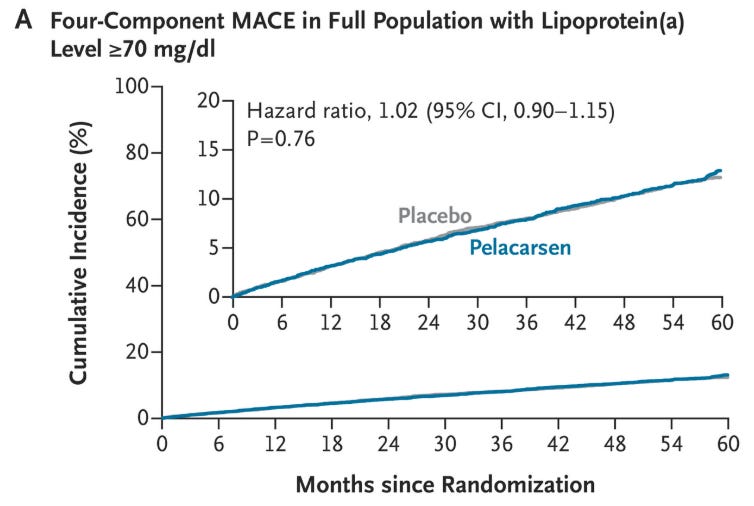
Unlike the model, in the actual trial, the number of events were nearly identical in the pelacarsen and placebo arms.
Putting it all together
It’s really cool that the French team locked their results before HORIZON results were known.
But by the time they finalized the paper, they knew the trial missed its primary endpoint but not by how much.
They wrote:
If the full trial results suggest that Lp(a) lowering with pelacarsen does not reduce MACE, several model assumptions warrant reassessment. Lp(a)–risk associations derived from observational cohorts and trials of agents lowering both LDL cholesterol and Lp(a) may not fully translate into the clinical effects of selective Lp(a) lowering.
The italics are mine. The problem in the simulation was step 3 in the model where assumptions were made between how Lp(a)-effects on plaque translate to outcomes. The Copenhagen study found higher levels of Lp(a) associated with greater risk of events. But that is the foundational weak link. Lp(a) may associate with more cardiac events, but lowering it (at least from pelacarsen) did not reduce outcomes.
(It’s possible that other Lp(a) drugs will work—though that seems less likely now.)
I would extend the take-home message further than one molecule, here Lp(a).
To me, this concept forms the core of evidence-based medicine: whether it’s a sophisticated computer model or just a human clinician thinking…”this should work based on biology” the message from negative trials like HORIZON is that the human body is not a machine where you can tweak one broken system and expect to improve the whole. We are too complex for that.
At the risk of sounding like a broken record, the law should be when in doubt, randomize. Randomization is a superpower, and I think will remain a superpower.
I know what you may be thinking: computing power is now shockingly strong and getting better. AI can do so much today and surely will be more capable in the months and years to come.
While this modeling study isn’t exactly AI, I would propose that it hints at why AI will not likely replace the work of randomization. The weak link for any such predictive effort is having to go back to the observational data.
But maybe I am just too short-sighted of what computing power can do? Let me know what you think.
There are at least a couple of reasons why the computer model failed.
First rule of computers - garbage in-garbage out. Was the information fed to the computer accurate?
Second, and somewhat in keeping with my first point, I don't believe we know all the processes at play in why someone has a cardiac event, stroke, etc. We know high cholesterol is a risk factor; we know Lp(a) is a risk factor, but do we really know how it works? People who don't have high cholesterol also have heart attacks - why? As you say, we are complex beings.
I read a book once, which the name escapes me at the moment, about things medicine was wrong about in the past, e.g. handwashing. We should be careful in believing we know all there is to know. Maybe that is the positive result of this exercise with computer modeling; it will keep us humble.
Another great article Dr. Mandrola. I wonder whether in the future we will have accurate digital twins of ourselves/ patients which can perhaps lower the cost of RCT in humans?
I understand creating digital twins of humans is not easy 😊