

There is a popular medical account that posts journal articles the moment they appear. “Now in Nature Medicine: A target trial natural experiment shows the Shingles vaccine regrows hair.”
This account probably has access to embargoed journal articles and, with this advantage, is consistently the first to post, gaining a sizable following. Sadly, it offers no insight or critical appraisal.
To many of us, the account is a metaphor for social media. Many want to be heard. Few have something to say. When it comes to the week’s medical papers, it’s easy to roll your eyes, but when it comes to a life— it becomes jarring.
Recently, a professional colleague and fellow physician died. It was untimely (late 40s), and the cause was cancer.
As an oncologist, I am constantly reminded of the unpredictability and fleetingness of life, and I pray it gives me perspective that many challenges I face daily are petty and minor and absurd. I pray it reminds me why not to go to the next conference or weekend ‘retreat.’
On social media, the RIP posts began.
even though I have only met her briefly at random meetings…
Although I did not have the privilege of knowing <the doctor> personally…
was a dedicated member of our <professional> committee…
I had the opportunity to present at an <professional> event where she was one of the judges…
Physicians posting RIP and tagging the photo of the deceased with the names of their living colleagues— perhaps in an effort to draw attention to the post?
I literally just had a whole conversation about her amazing shoes…
The posts reminded me of a eulogy I attended.
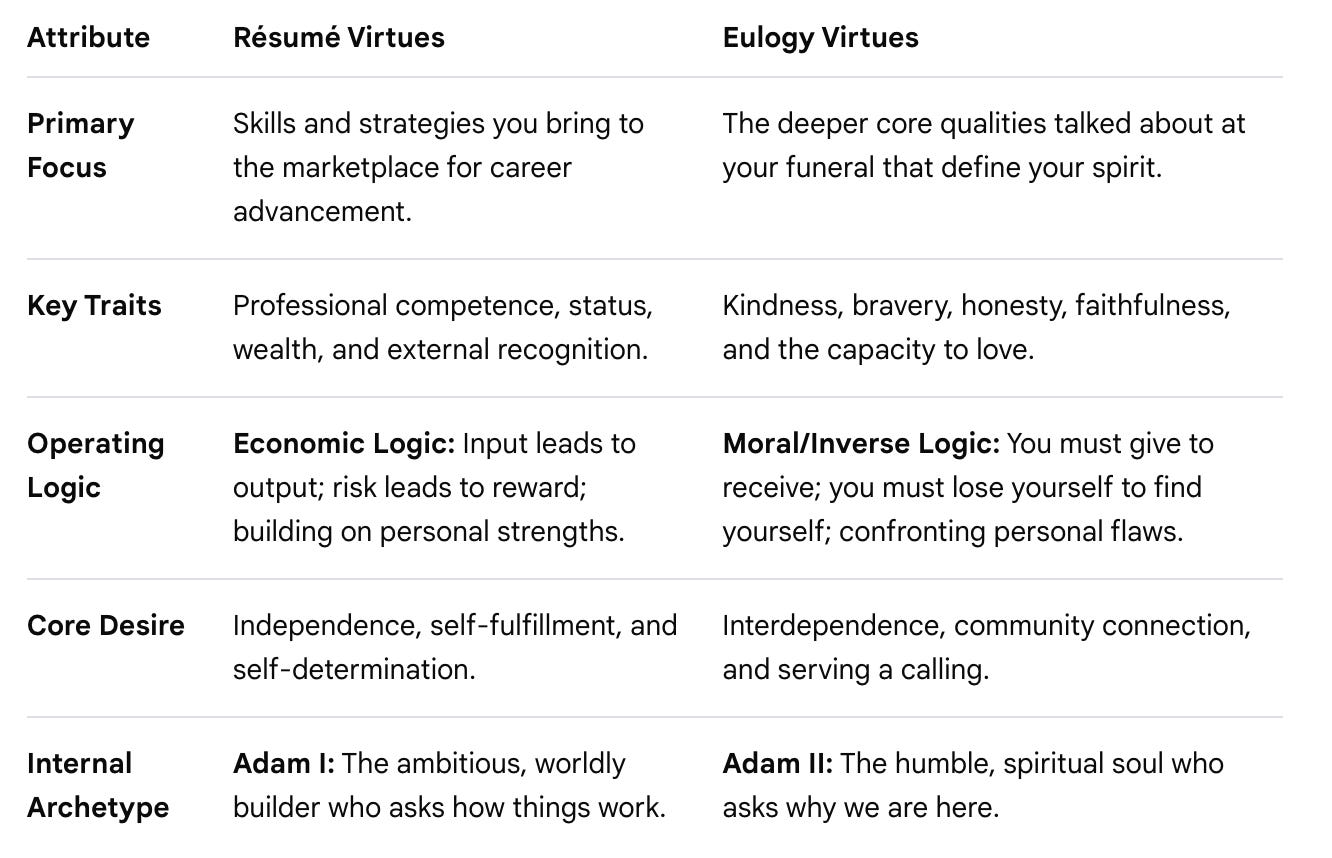
Eulogy versus Resume Virtues

Over the years, I have been saddened to see several colleagues die. Recently, a famous physician passed away. I did not know him well. The Department honored him with an in person eulogy. A powerpoint show was loaded on the screen, and several doctors spoke.
The speakers took turns talking about our colleague’s hirsch-index, and R01 grants. He had given 1000 presentations and published 300 papers. I felt uneasy. Later a student of mine gave me the words to understand what I felt. A eulogy should be about eulogy values, not resume values. How a person made those closest to them feel— not the accomplishments a person had to someone at a distance.
When David Foster Wallace gave the 2005 Kenyon College commencement speech, he used the venue to explore themes that eluded him in his novels. Using the story of the fish swimming in the ocean—being asked ‘how’s the water,’ and asking ‘what the hell is water’—Wallace notes we are oblivious to what is right in front of our eyes, even though that is what matters most.
The irony is not lost on me that a thoughtful speech has itself been turned into a cliche in the the form of a tiny book (with incorrect spacing) by the publishing house.
The obvious realities are the hardest to talk about.
An oncologist sees an incredible— staggering— amount of death. And you move from being a third-year medical student crying alone to being an attending, briskly moving the next patient and the next, without the time to truly process what you witnessed, and yet, perhaps later, at home, thinking about your patient and her kids.
Untimely death wounds us in unique ways. A few years ago, a colleague asked me to treat an 85-year-old patient with severe Alzheimer’s— unable to recognize himself or others— for non-Hodgkin’s lymphoma. The nodes appeared just weeks after he completed antibiotics for pneumonia. She thought the nodes were post-infectious, but biopsy revealed cancer.
“What is he allowed to die of?” I asked my colleague.
She was startled.
“Because he is not allowed to die of pneumonia, and you think he shouldn’t die of NHL… what is he allowed to die of?” I asked.
What is a 47-year-old allowed to die of? Someone otherwise sound of mind and body— someone with kids still in school. Certainly not cancer. It strikes me as cruel and grotesque.
And yet, in the 15 years I have been in oncology, I have seen, over and over, oncologists ignore the water.
How are we really going to improve if we give standing ovations for drugs that cure 0 people, add 6 months to life, and cost 477,000 per year?
How are we going to improve if we are incapable of learning that retrospective observational target trials give false conclusions?
How are we going to improve if we test our new drugs against dilapidated, antiquated standards of care?
How are we going to improve if we don’t run trials with the best post-protocol care?
What the hell is water?
Even while facing her own diagnosis, she established the <Award>, raising >$1.35M….
But as little consolation, we as a community clearly heeded the urgent call and made sure she could feel loved, heard, and leave a lasting legacy behind.
If a tree falls in the forest, is milled into paper, printed on a poster, carried in an overhead bin to a future cancer conference, and no one looks at the poster, did the tree make a sound?
Untimely death is a reminder that so much of our professional lives is misspent time. A weekend with your kids becomes a weekend in a hotel room.
Wallace’s graduation asks us to reconsider our default setting as humans, as “the absolute center of the universe, the realest, most vivid and important person in existence.”
And yet, online RIP can’t seem to avoid that fate.
We remember our colleague who, like us, expanded access to clinical trials.
But don’t think too much about what it means to leave young children behind when they need guidance most to discover who they are meant to be.
The former senator Ben Sasse is dying of pancreatic cancer. He is 54 years old, and will leave behind 3 kids, and a legacy of being a decent and honorable person in politics at a time when that was as common as water on Mars. When he dies, oncologists will remind us that daraxonrasib may have bought him a few months, perhaps the better part of a year. It did so with tremendous rash, a face that wept with blood, and was unable to hold the cancer at bay for as long as we need it to.
What the hell is water?
Thought provoking! It's why I'm a paid subscriber. No one better than Dr. Prasad to point out the obvious.
Indeed: WHAT are we doing?
"We give standing ovations for drugs that cure 0 people, add 6 months to life, and cost 477,000 per year"