

Last week we had an all-star cast of thinkers contribute to Sensible Medicine. Muhammed Ruzieh urged us to resist the urge to follow guidelines in using cardioversion patients with AF in the emergency department. Andrew Foy described the danger of wily-nilly application of trial data with spironolactone. And Vinay Prasad used both heart failure and cancer therapy examples to teach us how trials represent best case scenarios and how proponents can stretch trial results in inappropriate ways.
Beta-blockers in HFrEF is complicated
Today I want to revisit one of my biggest frustrations in cardiology: being forced to use specific beta-blockers in patients with heart failure (due to low EF) and atrial fibrillation (AF) when a) there may be better alternatives and b) there may be no benefit to these drugs in this scenario.
What do you mean beta-blockers may not have benefit in HFrEF? Mandrola, there are 10 trials that show that the drugs carvedilol, metoprolol XL and bisoprolol reduce mortality vs placebo in patients with HFrEF. CIBIS, COPERNICUS and MERIT HF were all landmark trials establishing use of beta-blockers in HFrEF.
My problem stems from the need to treat patients with AF. Does the presence of AF alter the benefit-harm ratio of these drugs? For instance, sometimes I would rather use digoxin to treat AF. But this brings an alert on the computer; and calls from my colleagues that I am not practicing evidence-based medicine.
Yet isn’t it possible that the rhythm may alter the treatment effect of beta-blocker? We give this the awful name treatment effect heterogeneity.
Eleven years ago, a British team led by Professor Dipak Kotecha combined 10 trials (having individual patient data) to assess the benefits of beta-blockers in patients with heart failure who had SR and AF. The Altmetric score of this vitally important meta-analysis is a measly 131. People did not like the results.

The authors benefited from the fact that 17% or 3066 patients in these trials had AF while 76% (13,946 pts) had sinus rhythm. The first finding is that patients with AF had a higher death rate than those in SR (21% vs 16%). They were sicker.
Here are the graphs for mortality (SR on the left; AF on the right):
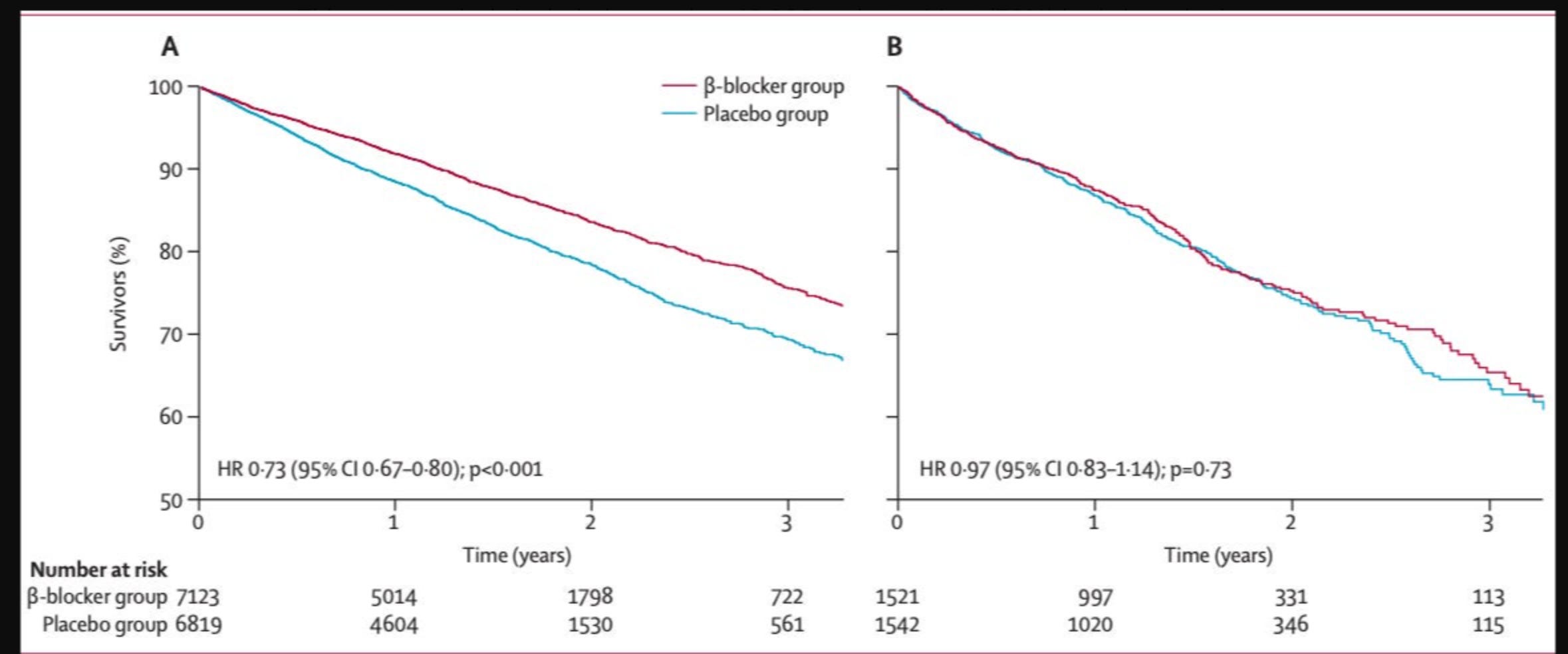
Patients in SR enjoyed a 27% highly significant reduction in death vs placebo. Patients in AF had no benefit from beta-blockers. It turns out that there is a statistical test for an interaction. As I understand it, if there was no interaction, how surprising would these differences be. The p for interaction in this case was extremely low at 0.002.
Here are the graphs for CV hospitalizations
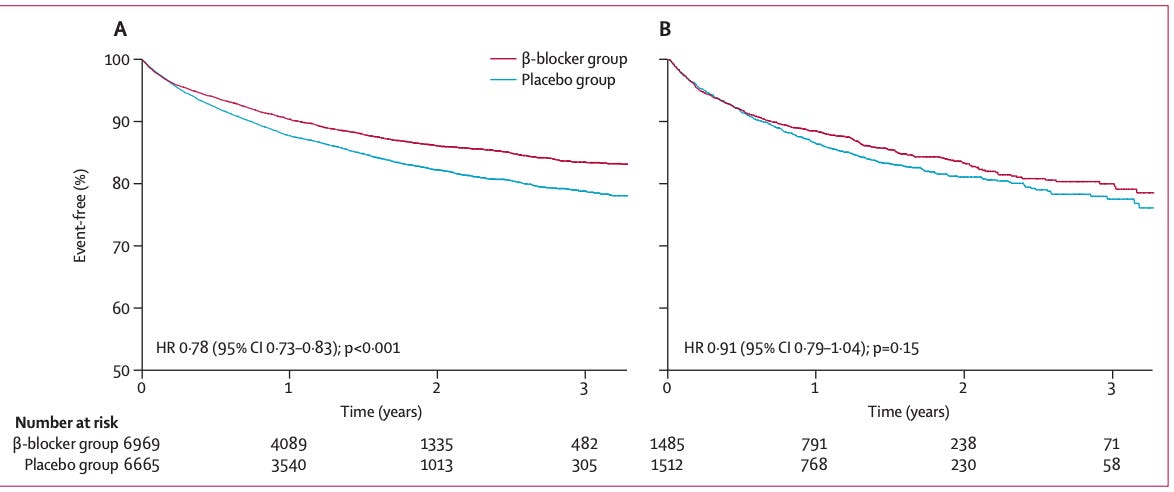
The pattern is similar. Nearly all the benefit is in patients in SR.
This graph shows that there was not one trial driving the result. The positive effect and size of effect of beta-blockers was similar in all the trials while the lack of effect was also similar. (A is SR and B is AF).
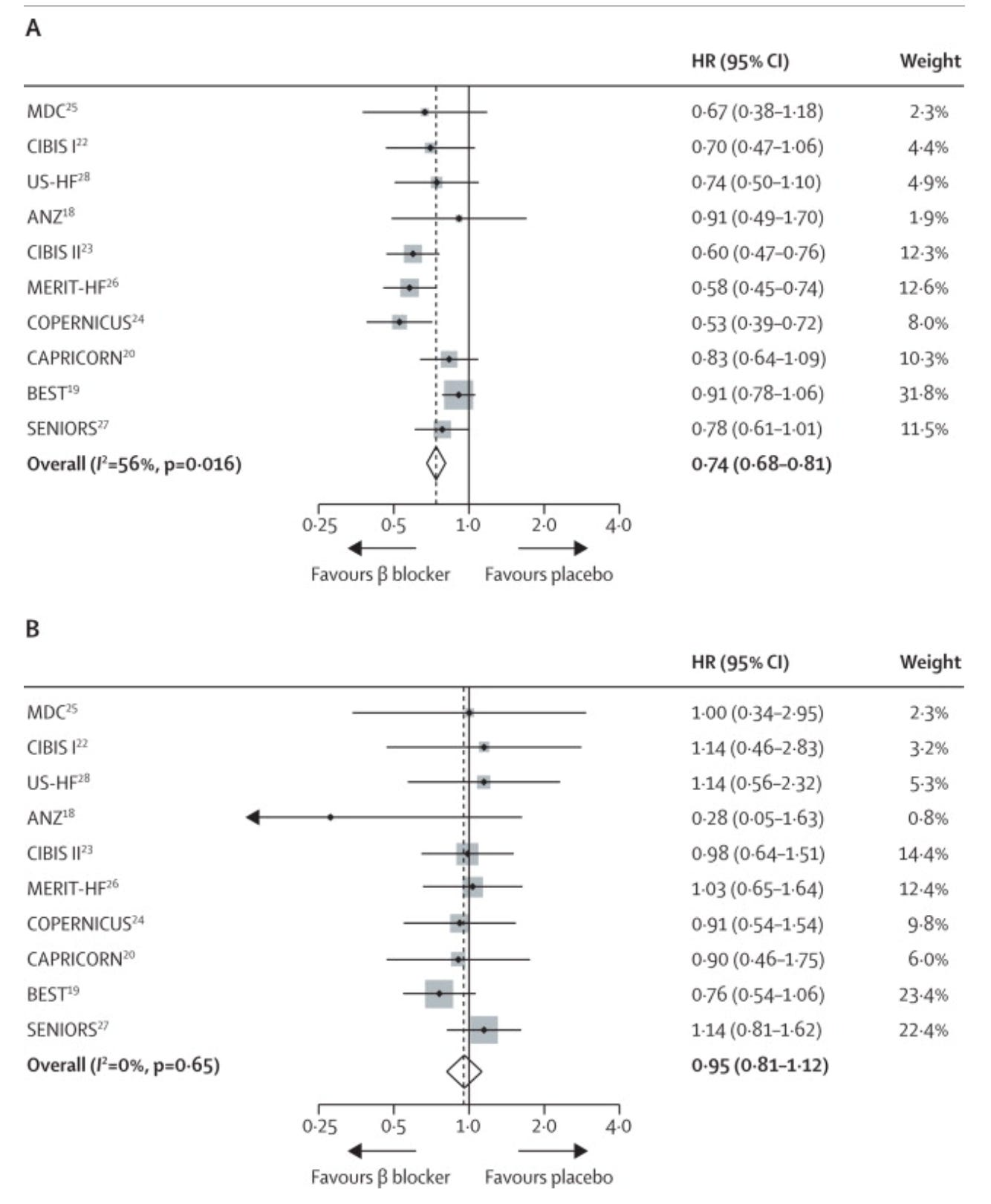
The authors must have had trouble understanding this observation because they also looked at subgroups of patients with AF who may have benefited from beta-blockers. None were found. Here is the graph:
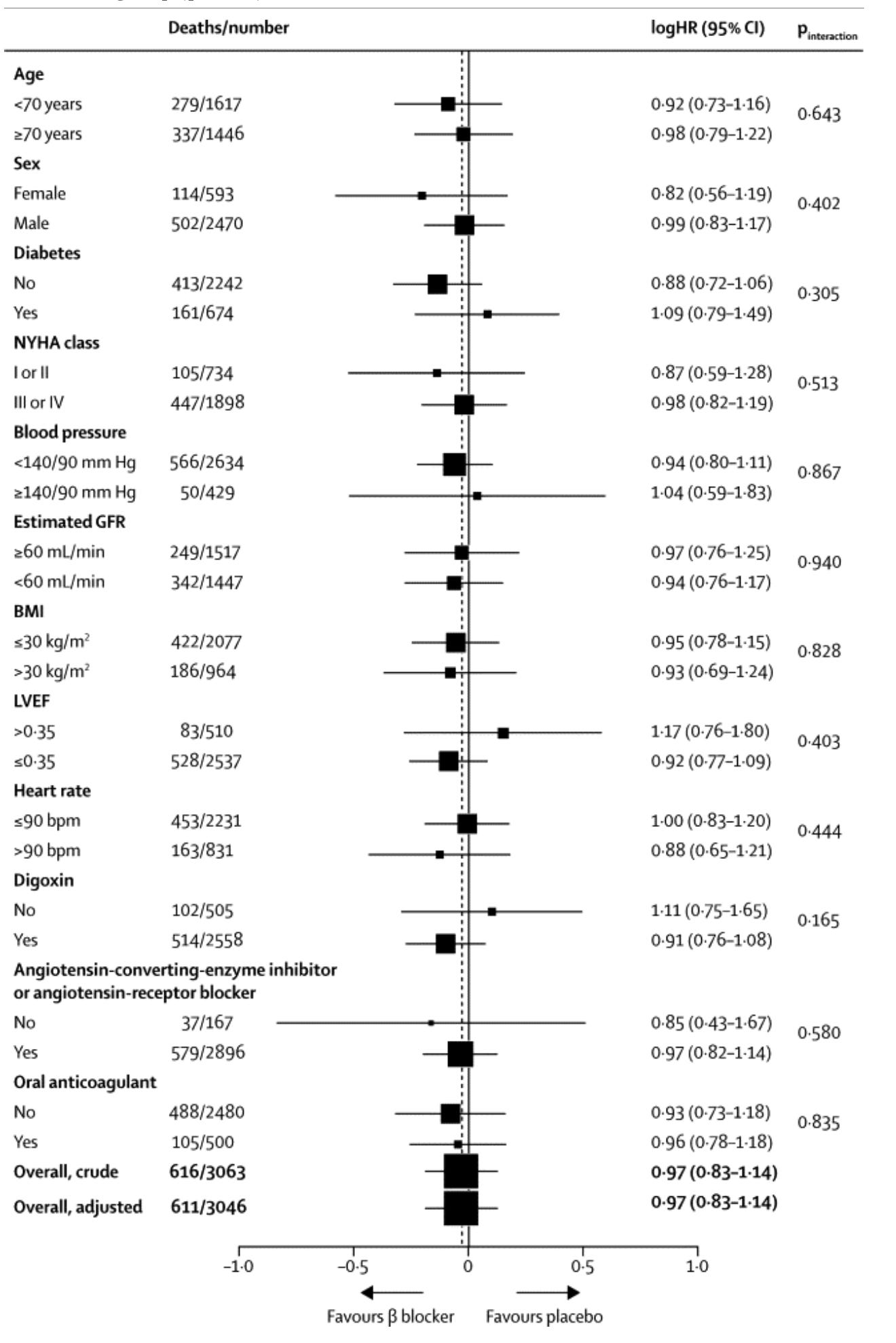
No subgroup of patients with AF seemed to benefit from beta-blockers.
The authors make a clear conclusion from this paper.
The results of our analysis suggest that the substantial benefit identified in patients with sinus rhythm should not be extrapolated to patients with atrial fibrillation.
Comments
I re-up this paper (my post in 2023) because it’s so provocative.
First, for statistical purists it raises the tension between using only the main effect in a trial vs that in subgroups. Trials are powered for the entire group not subgroups. The purist interpretation of a trial, therefore, should always be the main effect.
I understand this concept, but I also understand that it depends on whether you like the overall effect or the subgroup finding.
Take the DANISH trial, for instance. In this RCT of the ICD vs no-ICD in patients with non-ischemic cardiomyopathy, the main results were totally null. Look at those curves. Nada. No more ICDs for this huge group of patients, right?
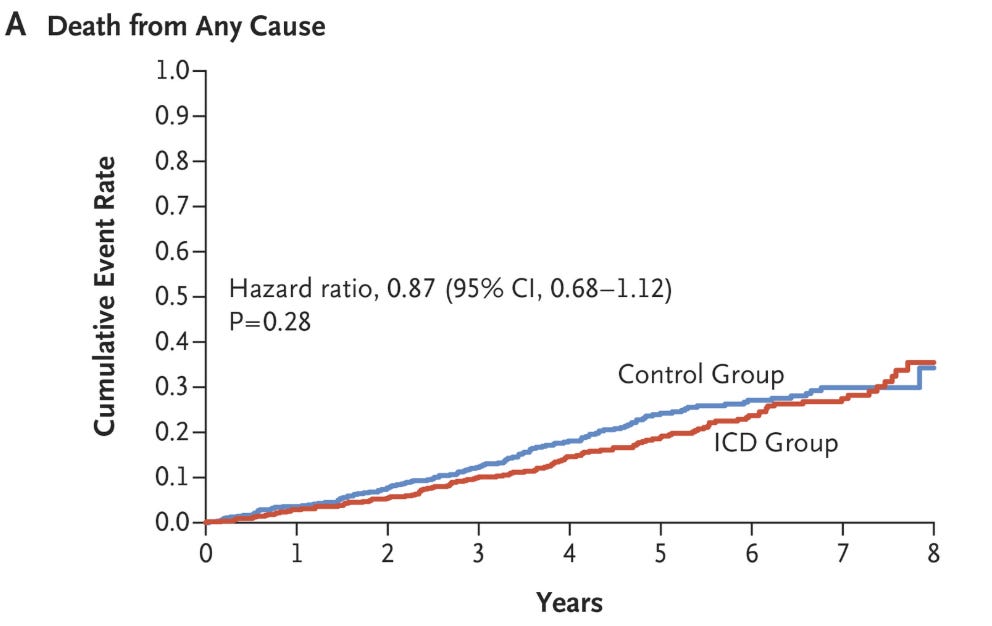
Electrophysiologists don’t love that result. So most of my colleagues point to this subgroup analysis based on age.

See…the ICD works in young people. And I admit there is a biological plausibility to the fact that young people may get more ICD benefit because there is less competing risks for death, and perhaps fewer complications.
I show you this example because if you turn down the beta-blocker analysis based on it being a subgroup analysis, well, then, you are going to have to stop putting in ICDs in patients with heart failure not due to ischemic causes.
The second tension of this beta-blocker analysis is that it sure seems real. A) the authors had individual patient data, B) there were more than 3000 patients in the AF arm, C) the p for interaction was highly significant, and D) you can tell a biological story that patients with AF may be too sick to benefit from the negative inotrope.
Yet neither the American nor European HF treatment guidelines give much weight to this subgroup analysis. Quality measures in the hospitals surely do not. I can’t help believing this has to do with not liking the finding.
The third tension that has come to light is that we now have two trials that (taken together at least) found benefit from another drug useful in AF—digoxin.
The DIGIT HF trial found benefit from digitoxin vs placebo. And the Dutch DECISION trial found a 19% nonstatisically significant reduction in the composite endpoint of CV death and HF events.
I wonder what would happen if I tried to treat a patient with AF and HFrEF with digoxin instead of carvedilol. It would align with evidence but would surely be shunned by those measuring how well I practiced evidence-based medicine.
Let me know what you think.
I truly don’t know what to think, personally or professionally.
I’ve had atrial fib since my second year of medical school, some (“many” is a relative adjective) decades ago, and for years the mainstays of my treatment were digoxin and quinidine….which at least made me feel part of the gang – seemingly half of my adult patients – AF or no – were taking one or the other drug (mostly digoxin).
Now I see a patient on digoxin about once every six months, and quinidine is a word roughly on a par with bathroom wall graffiti. On the other hand, despite having had no problems with rate controlI I have been taking metoprolol for years, and in my clinics I frequently encounter AF patients on a beta blocker per guidelines but with heart rates <60 and systolic pressures of <110 despite having 85-year-old brains that perhaps need a somewhat higher cardiac output/cerebral perfusion pressure for those brains to work at peak efficiency.
I have spent my career helping to develop evidence-based therapies for stroke and for migraine… and yet the current guidelines in my own medical neck of the woods do not always match up with the ever-changing existing evidence. I suspect the same maybe so for the beta blockers.
Unfortunately, guidelines can act much like the clinical trials that create those guidelines: like steamrollers that seek to flatten a diverse population with diverse needs into one where “one size fits all“.
Who, exactly, are “those measuring how well I practiced evidence-based medicine”? The clipboard nurses? Joint Commission? Insurers? I’m asking honestly—I am not a physician and don’t know how this monitoring works.
Physicians don’t have the full freedom to treat their patients as they see best.
One commenter said it well: it’s these “One size fits all” guidelines. How did we get here? Everyone BUT the patient’s physician is making decisions on how best to treat their patient. I get it that there are quacks doing really crazy things—and I bet they’re still doing them because they aren’t a part of these monitored health settings. There’s a place for oversight, but how do we let doctors be doctors?