

Ten years ago, I finally felt comfortable admitting my professional failures. I published an essay about patients of mine who had died and another on patients who had left my practice.1 I also typed up a CV of Failures.
Writing my CV of Failures felt strangely therapeutic. I embraced the professional shortcomings I had been hiding. I began to recognize that the failures that had bothered me were, in fact, forks on a road to happiness and satisfaction.
Sharing the CV with mentees also seemed helpful. Johannes Haushofer probably described best why a CV of Failure, authored by a successful academic, can be helpful:
“Most of what I try fails, but these failures are often invisible, while the successes are visible. I have noticed that this sometimes gives others the impression that most things work out for me. As a result, they are more likely to attribute their own failures to themselves, rather than the fact that the world is stochastic, applications are crapshoots, and selection committees and referees have bad days. This CV of Failures is an attempt to balance the record and provide some perspective.”
Why revisit this topic now? For the last couple of years, my home remedy for empty nest syndrome has been accepting speaking invitations. In previous years, the cost of being away from home outweighed the benefit of another line on my (real) CV. These travels have been wonderful. I have gotten to talk with amazing people. Sensible Medicine has benefited from the dozens of submissions from people I’ve met. I do feel a little guilty that I have learned more from the people I’ve visited than I have taught the people I was invited to educate.
On many of these visits, I’ve heard about peers' careers and answered questions about my own career path. What becomes obvious very quickly is that almost nobody follows a preplanned path. What we end up doing is dictated by uninformed choice, random selection, position availability, successes, and failures. In this respect, the CV of Failures is a map of the roads not taken, often because others closed them. Sure, four excellent institutions of higher education found my application wanting when I was 18. However, a couple of schools opened an on-ramp for me to merge onto a road that led to a pretty great place.
So here it is, my CV of Failures. I hope it helps. At the very least, I hope you attain some voyeuristic pleasure.
Colleges and universities that rejected me
Brown University
Princeton University
Amherst College
Williams College
Medical schools that rejected me
Harvard Medical School
Columbia University College of Physicians and Surgeons
Case Western Reserve University
University of Virginia
Duke University
University of Rochester
Johns Hopkins University
Internal medicine programs ranked above the one I attended: Brigham and Women’s Hospital
Awards I was eligible for that my medical school roommate won:
Joan Severino Parisi Prize in Internal Medicine
John Metcalf Polk Prize for General Efficiency
Lectures I was invited to give, only once
Mindful Practice
Stump the Professor
Academic journals that have rejected my submissions
The New England Journal of Medicine
JAMA
JAMA Internal Medicine
Annals of Internal Medicine
Academic Medicine
Medical Education
Teaching and Learning in Medicine
Medical Teacher
American Journal of Medicine
Mayo Clinic Proceedings
Least known journal I have resorted to in order to have an article accepted: Polskie Archiwum Medycyny Wewnętrznej (Polish Archives of Internal Medicine)
Newspapers that have rejected my OpEds
The New York Times
The Wall Street Journal
The Boston Globe
The Chicago Tribune
The Philadelphia Inquirer
The Baltimore Sun
USA Today
The LA Times
The Washington Post
Number of articles I have published that have never been cited: 33
National meetings that have rejected my workshop proposals:
Alliance of Academic Internal Medicine
Society of General Internal Medicine
American College of Physicians
Number of publishers that passed on Ending Medical Reversal: 13
Number of completed book manuscripts that sit on my hard drive, unpublished: 2
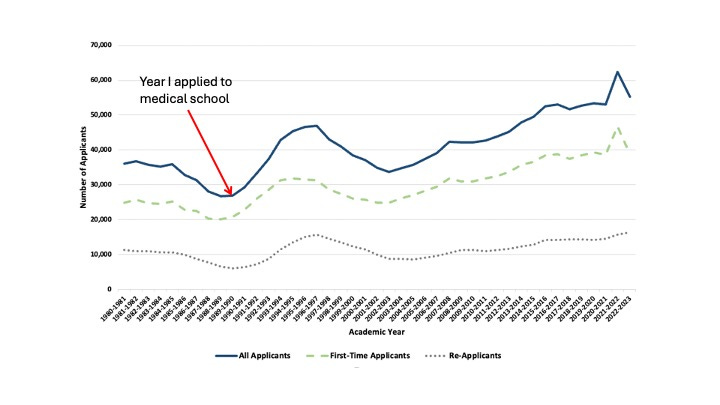
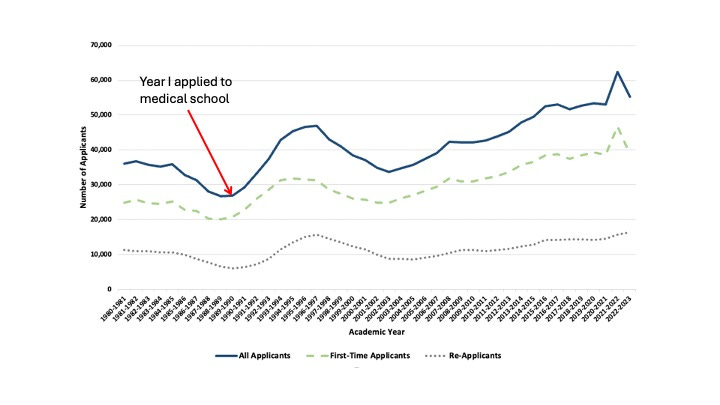
A graph…
And last, a two-star review of Ending Medical Reversal on Amazon:
This book is as scary as the medical reversals outlined but for no good point
The authors are so opinionated that I doubt they could make a diagnosis or treat a patient. The most interesting part of the book is the index showing recalled treatments. I especially found troubling claims such as the one that stenting does not improve mortality and that it is really ok not to be scanned for cancers. If you read this book too carefully you will refuse any medical treatment that makes you feel better but may not increase your life span. We all know that medicine is an art rather than a science. The information about trials governing treatment plans are well known at this point. I think this book is quite scary and does no objective good.
(I still love that review.)
I originally published these in the medical literature and then repackaged them (links) for Sensible Medicine.
Oh, Dr Cifu, I LOVE your posts! As a RN I would have been proud to work alongside you. I enjoy your thoughtful care of your patients. Your sense of humor is welcomed. Thank you!
I find this wildly encouraging, even beyond the field of medicine to all the many things that we try and fail at, and yet we grow along the way.