


We recently published an article titled Ferritin Levels – Redefining Normality in Women. Sensible Medicine articles often open rich veins of comments and emails; this one exceeded most. The comments were particularly interesting because they suggested that people were looking at similar data and reacting very differently. Some worried that embracing ferritin screening and the diagnosis “iron deficiency without anemia” risks turning many asymptomatic people (mostly women) into patients while essentially medicalizing womanhood. Others argued that we are currently leaving an enormous proportion of the population with unrecognized and treatable symptoms. Both sides saw misogyny in the other’s view.
In my review of the literature, I do think quite a bit is settled. First, primary care doctors — internists, family medicine doctors, pediatricians, gynecologists —underdiagnose symptomatic iron deficiency. There are patients who go to doctors with symptoms that could be due to iron deficiency, with or without anemia, who are not tested. I don’t think there is much of an argument against better education of patients and doctors about the symptoms and prevalence of iron deficiency.
Second, observational data suggest that iron deficiency during pregnancy is associated with worse birth outcomes. For me, this observation pretty much mandates that we conduct an RCT to determine whether screening pregnant women for asymptomatic iron deficiency and treating it, if present, improves outcomes.
I do not think we have evidence that supports population-level screening.
Drs. Auerbach, DeLoughery, Lim, and Rodgers have done extensive work in this area. They come to very different conclusions from the article we published. They also disagree with me on the screening issue. I wanted to let them have a say here about screening for iron deficiency because, as our about page says:
We feature contrasting ideas and opinions. Once upon a time, that was how progress occurred, through dialogue. We work to nurture a home for this type of engagement.
Adam Cifu
In the past two decades, a substantial body of literature has documented the clinical impact of non-anemic iron deficiency, even among individuals described as “asymptomatic.” Despite this evidence, non-anemic iron deficiency remains under-recognized or normalized in clinical practice. The suggestion that a subset of women with low iron levels represents a normal physiological state risks overlooking a highly prevalent condition, which affects up to 84% of females when pregnant populations are included. This perspective also contributes to disparities in the recognition and management of iron deficiency, a condition that disproportionately affects women.
Before we address the above further, we would like to clarify several inaccuracies regarding serum ferritin and its clinical interpretation. First, classifying a ferritin level of 9 µg/L as normal, based on bone marrow data, is not supported by existing evidence. Prior studies have demonstrated that a ferritin threshold of approximately 30 µg/L has high specificity (98%) and sensitivity (92%) for absent bone marrow iron. Physiologic data also support a higher ferritin threshold as early indicators of iron deficiency, where changes in hematologic indices, red cell morphology, and increased iron absorption are observed at ferritin levels around 50 µg/L.
Second, while it has been suggested that normal ferritin values should reflect the statistical distribution observed in a general, “otherwise healthy” population, this approach assumes that the reference population is free of underlying pathology. The current derivation of normal ferritin reference ranges relied on cohorts of “apparently healthy” individuals, without adequately accounting for the presence of iron deficiency within this population. As a result, the inclusion of individuals with unrecognized iron deficiency shifted the ferritin lower limits downward, resulting in a methodologically flawed normal ferritin reference range.
Globally, iron deficiency remains the most prevalent micronutrient deficiency, yet it continues to be underrecognized, underdiagnosed, and undertreated, particularly among women (see Figure). A key contributor to underrecognition is the reliance on normal hemoglobin levels as evidence of adequate iron status, an approach that inherently fails to detect earlier stages of iron deficiency. Iron plays essential roles beyond hemoglobin synthesis, including mitochondrial energy metabolism, skeletal and cardiac muscle function, neurotransmitter production, and immune regulation. Accordingly, non-anemic iron deficiency can manifest with a range of symptoms, including fatigue, pica (such as ice craving), restless legs syndrome, cognitive impairment (often described as “brain fog”), and reduced work productivity. Iron deficiency anemia, therefore, represents a late manifestation along the spectrum of iron deficiency. Underdiagnosis is further compounded by the use of methodologically flawed ferritin reference ranges, as discussed above. Individuals with ferritin levels near the lower limit of normal (e.g., 15 µg/L) are being misclassified as normal despite evidence of depleted iron stores.
Figure: Key contributors to underrecognition, underdiagnosis, and undertreatment of iron deficiency
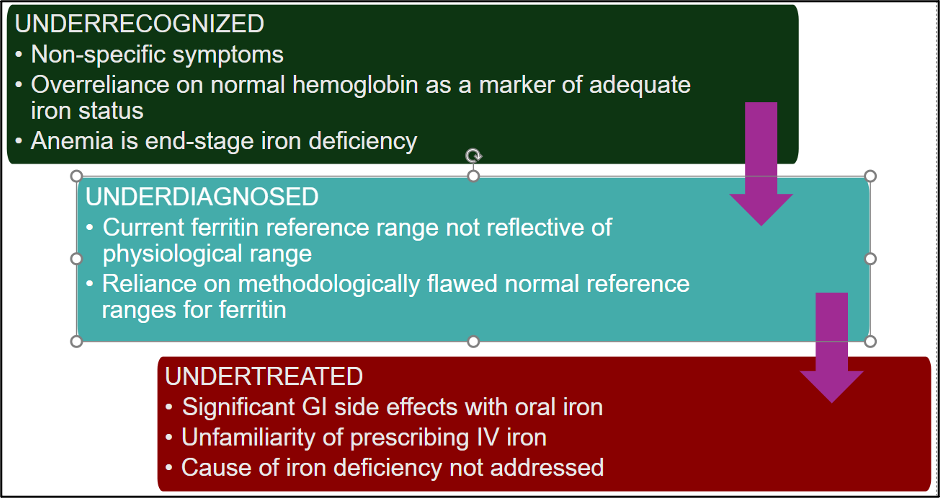
Treatment gaps also contribute significantly to the overall burden of disease. Oral iron supplementation is commonly used as first-line therapy. However, it is associated with a significant increase in gastrointestinal side-effects, leading to treatment discontinuation or non-adherence in up to 50% of individuals. In addition, patients prescribed oral iron are often not closely followed, despite the need to reassess response within 2 to 4 weeks. Those who do not tolerate oral iron or who have an inadequate response should be transitioned to intravenous iron therapy. However, provider unfamiliarity with contemporary intravenous iron formulations and their safety profiles remains an important barrier to optimal care. Importantly, iron repletion represents only the initial step in management. Identifying and addressing the underlying cause is essential to achieving sustained resolution. One study found that only 40% of individuals with iron deficiency achieved resolution within three years of diagnosis. These factors contribute to the persistent undertreatment of iron deficiency.
Hence, we advocate for earlier recognition, accurate diagnosis, and appropriate treatment of non-anemic iron deficiency to prevent progression and associated clinical consequences.
Achieving this goal requires proactive screening for iron deficiency rather than deferring evaluation until symptoms emerge, an approach that is particularly important during pregnancy. Several international guidelines, including those from the International Federation of Gynecology and Obstetrics, the European Hematology Association, and the Australian Women’s Health Collaborative, recommend routine screening for iron deficiency throughout reproductive life and during pregnancy. In contrast, national guidelines such as those from the U.S. Preventive Services Task Force (USPSTF) conclude that there is insufficient evidence to support routine screening for iron deficiency in pregnant individuals, whereas the American College of Obstetricians and Gynecologists (ACOG) only recommends evaluating for iron deficiency when anemia is present during pregnancy.
We advocate for screening for iron deficiency in pregnancy based on emerging evidence from two large studies. In a longitudinal, prospective study of a high-resource, largely iron-supplemented cohort of asymptomatic, non-anemic primigravid individuals, iron status was assessed at 15, 20, and 33 weeks’ gestation. The prevalence of iron deficiency (defined as ferritin <30 ug/L) was 21%, 44%, and 84% across these time points, respectively. In a subsequent analysis, maternal non-anemic iron deficiency in early pregnancy (15–20 weeks’ gestation) was associated with poorer language and motor outcomes in infants at 2 years of age. Collectively, these findings underscore the importance of early screening for iron deficiency in pregnancy, regardless of hemoglobin levels.
We conclude by emphasizing the following. The evidence presented above supports routine screening for iron deficiency, especially in pregnant individuals, and the use of a ferritin threshold of 30 ug/dL for diagnosing iron deficiency, with or without anemia. Even with residual uncertainty, the balance of the data favors early identification of this highly prevalent condition across a spectrum of severity using a readily available, low-cost test, with safe and effective treatment options. In contrast, deferring evaluation in asymptomatic, non-anemic individuals and relying on methodologically flawed ferritin thresholds risks missed diagnoses and progression to clinically significant disease.
Michael Auerbach is Clinical Professor of Medicine at Georgetown University School of Medicine, Thomas DeLoughery is Professor of Medicine at Oregon Health and Science University, and Ming Y. Lim and George M. Rodgers are Professors of Medicine at the University of Utah. The views expressed above are solely those of the authors and do not necessarily reflect the views, policies, or positions of their respective employers, affiliated institutions, or professional organizations. The authors present these perspectives in an independent capacity.


Thank you, Drs. Auerbach, DeLoughery, Lim, Rodgers, and Dr. Cifu. I appreciate the opportunity to engage in a collegial exchange on topics such as this.
I am always taken aback when recommendations based on low-level evidence such as these make it into clinical guidelines. Observational studies and surrogate measures, taken out of clinically meaningful context, often lead to correlations that are inconsistent with the principles of evidence-based medicine. To me, high-quality guideline recommendations should imply that we can identify, with an acceptable level of uncertainty, a target population in which implementing a treatment is expected to achieve a desired clinical outcome that exceeds the placebo effect while maintaining an acceptable risk-benefit balance. This should be the foundation of guideline recommendations.
Instead, I see low-level correlations being incorporated into guidelines and subsequently becoming the new standard of care. I would argue that, for a condition as prevalent as iron deficiency in women, it should be easy to demonstrate a clinically meaningful benefit in an adequately powered randomized controlled trial (RCT). If observational studies suggest an impact after only three years in pregnancies complicated by iron deficiency, I would gladly wait three years for a more robust recommendation. Why isn't this being done?
What we are seeing instead is that a low-level recommendation becomes the standard of care, making it virtually impossible to disentangle evidence from correlation. By endorsing such recommendations, we risk ensuring that, as a scientific profession, we will never know whether our interventions truly improved outcomes.
The downside of identifying iron deficiency is that it often triggers a cascade of additional tests and investigations to determine the underlying cause. What is the plan once the cause is identified? Lifelong iron replacement? Oral or intravenous iron? Hormonal therapy? Myomectomy? Hysterectomy? Upper and lower gastrointestinal endoscopy? What are the downstream risks of pursuing this diagnostic pathway?
I believe epidemiologists and population health experts should play a much larger role in developing population-level clinical guidelines precisely because they are trained to address these questions. Yet they are underrepresented.
"Both sides saw misogyny in the other’s view."
For God's sake, people. Get over yourselves.