


Adam Cifu
John landed himself in a little hot water last week with this Monday essay. I was surprised since John is not the Sensible Medicine editor known for angering people, and when I read his post, it didn’t seem the least bit controversial. I could see how the doctor named might have wished he had considered John’s points, but I didn’t think anyone would find the essay inappropriate. People, or at least a person, did.
The first point John made in his essay is that a case series providing safety and effectiveness data of a new left atrial appendage device tells us little. It is hard to argue this point. Any first-year medical student will tell you that a study of an intervention without a control is uninformative.
His second point is that researchers should not act as cheerleaders for a study’s results, especially one this meaningless. I agree with John completely. Researchers should be unbiased arbiters. They should ask interesting questions, design studies to answer them, and report the data. They may sense what the results will be. They might even root for one outcome over another (one which will make patients’ lives better). But cheerleaders have no place in medicine.
This might sound like an unimportant call for old-fashioned, WASP-y civility. It is not (and I am not a WASP). Doctors and researchers need to earn trust. They do not do this by touting their own results. If a study has an important finding, people will recognize it.
One could argue that there are times that we need cheerleaders. What if there is a clearly beneficial treatment that is underused; don’t we need cheerleaders to drive adoption? I don’t think we do. With journals and social media to alert practitioners to the benefit, and companies motivated to sell their product through detailing and advertising, physician cheerleaders only sully the field.
There are proven, underused medical therapies; I point you to the current measles epidemic. But we have learned nothing in the last six years if we think cheerleaders will encourage parents to make the right decisions.
On the other hand, faced with a medical literature that is systematically biased toward positive findings and industry that depends on ever-expanding markets, we need skeptics. Of course, skepticism can go too far. Skeptics need to be intellectually honest. They cannot make unreasonable demands for unnecessary data. They must not feel that their brand is threatened by medical breakthroughs. They especially need to accept advances where they have expressed doubt in the past.
Vinay Prasad
I picked 4 medical oncology departments randomly from the top 10 Cancer centers, and I randomly assembled 100 oncologists. I put them in three buckets. People who are cheerleaders, people who are thoughtful skeptics, and Non-playable characters AKA people who don't really put themselves out there. The breakdown was 37, 4, and 59.
Then I looked through esmo abstracts for 10 novel drugs. Two were good, 6 were marginal or useless, 1 didn't have enough information.
Another way you could look at it is what percent of drugs entering phase 1 receive usfda approval and it's maybe 8%. And yet a third way is among drugs approved by the FDA what percent improve overall survival… here is our paper. Ruh roh.
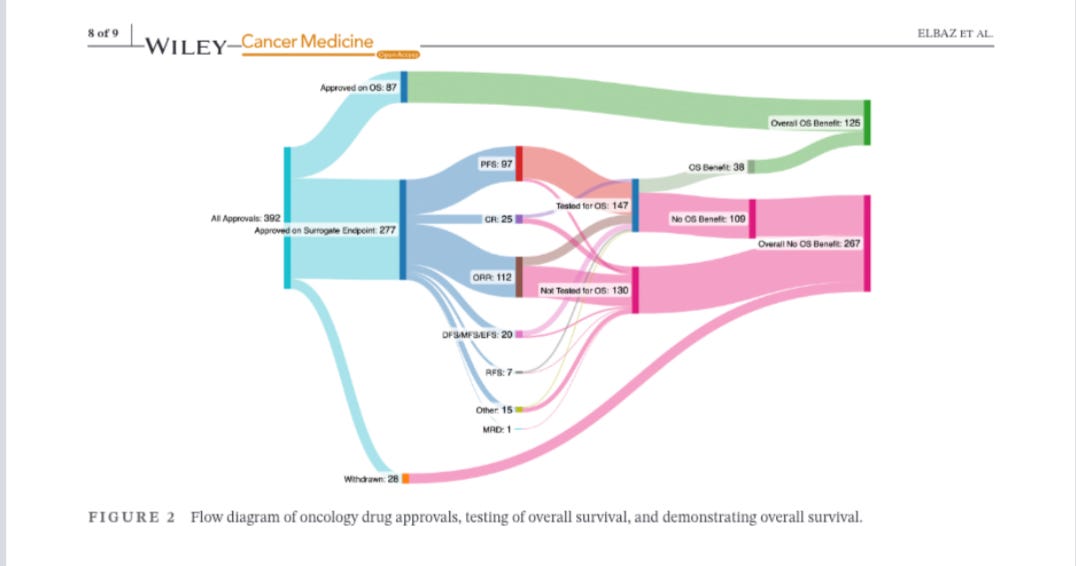
My point is two things are true
There are numerically more cheerleaders than skeptics in medicine, particularly among top centers.
Novel products are much more likely to be disappointing than transformative.
Medicine benefits from vigorous debate. We need cheerleaders, and we need skeptics, and we need non-playable characters to cast votes. The reason cheerleaders outnumber skeptics while the facts go the other direction is simple: money.
If you made a non-profit organization called medical skeptics r us and gave it the lobbying budgets of all the major biopharmaceutical firms to this group and had this group host dinners, conferences, and distribute grant money and spread the message that skepticism is important, all of medicine would look different. Skeptics would probably exist in equal proportion to the probability that novel drugs don’t work.
But, skeptics have a budget pretty close to zero, while cheerleaders have deep pockets. Taking a drug or device that doesn't work and getting it approved, and then bribing key opinion leaders to say it's great based on non-randomized evidence or other flawed evidence, and then bribing politicians to ensure it's covered by Medicare or insurance, is a popular business model. (Not the only type in medicine because we also have good products, but this is one type)
I smiled when I saw John Mandrola had gotten in trouble. Now he'll know what it tastes like, I thought smugly.
The essay rebutting John was entitled debate ideas, not people and it conceded that everything John said about the watchman device was more or less true and the evidence presented was poor. Then it went on to argue how John is doing it all for clicks, and the audience piled on, contradicting the very title of the article. The author writes:
“commentary like this stops being about debating the science and starts being about building an audience. A subscriber-driven platform rewards provocation, and provocation is easiest when there is a name attached” — and references multiple essays by Jonathan ‘doing it for the clicks ‘ Mandrola— a 60 year old grandfather who spent decades doing EP just to, in his twilight years, become a cynical shock jock. Nailed it.
As did this commenter
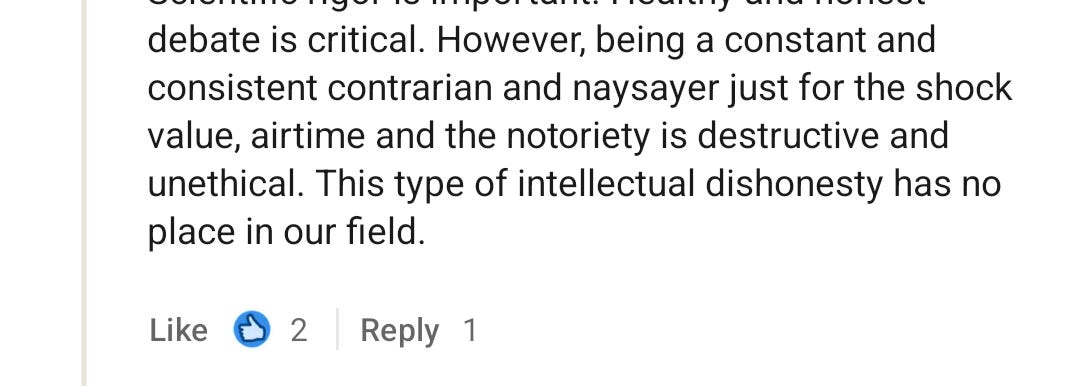
In my opinion, the biggest problem in medicine are the utterly incompetent people who are frequently quoted in the media as medical experts. These people forced us to put cloth masks on our 2-year-olds and they somehow pretended evidence justified this. These are really dangerous people because their delusional disorder is so big it has subsumes common sense. They are on to new topics like how hantavirus will kill us all, how the Russians really released drug resistant plague, etc.
I gave up worrying about the everyday sell out kol who works at a university who stumps for some company making some borderline useless product that costs half a million dollars or something like that. These people are a dime a dozen.
True believer cheerleaders. I don't mind at all. We need you. And the true believer skeptics, I don't mind at all.
One last point that I can't resist making. In 2026 America, you can definitely make a lot of money by driving internet traffic. You could make memes, politically charged videos, cat videos, videos for kids, videos about finance, there are lots of ways you could grab a large audience. If anyone thinks that writing a series of critical posts about esoteric cardiac electrophysiology randomized control trials is the way to profit by driving clicks that person should be committed to a mental institution. John Mandrola would make more money on only fans. In contrast, if you are practicing EP doctor and you start cheerleading for useless medical products, you can make a massive amount of cash from the sponsors of those products that you cannot make in any other way.
Medicine needs innovators, medicine needs skeptics, cheerleading is fine, trashing studies is fine, and I'm more worried about the lack of common sense and inability to understand medical evidence. But don't get me wrong. I love when cheerleaders come up with a new arguments that I hadn't thought of, and the same for skeptics. At least that gives me something to think about.
John Mandola
Allow me to use some numbers and real examples.
Doctors have implanted around 600,000 left atrial appendage devices worldwide. The popularity of this procedure has largely stemmed from enthusiasm from key opinion leaders, most of whom have dualities of interest with the companies that make these devices. (Ref: Google it). Ten years after approval new trials have come out showing a higher ischemic stroke rate and no differences in major bleeding compared to standard anticoagulation. I was part of a meta-analysis of LAAC vs anticoagulation trials that found a hazard ratio of 1.48 for ischemic stroke. That translates to ≈5,800 extra ischemic strokes. Using the upper bound of the confidence interval would be nearly 13,000 extra ischemic strokes. That might be acceptable if there were other benefits of the device, but alas, there are not, as major bleeding rates are similar in the two strategies.
Another example of cheerleading leading directly to harm: the absorbable stent was called the fourth revolution of coronary stenting. The idea was that the stent would prop open the stenosis but then slowly dissolve so as not to leave any metal that platelets could stick to. The FDA advisory committee enthusiastically embraced the new stent. Multiple key opinion leaders acted as cheerleaders. At the time, one skeptical doctor—with no academic credentials—looked at the data and wrote a piece called: Dissolving Coronary Stents: The Fog of Hype, where he laid out the numerous lines of evidence showing worrying issues with the new stent, including but not limited to higher rates of stent thrombosis. A broken clock is right twice daily, but the skeptic was right as not long after FDA approval, new data came out confirming the skeptic’s worries and the new stent was removed from the market.
Medicine is replete with such stories. Antiarrhythmic drugs after MI, IV magnesium for MI, Swan-Ganz catheters in the ICU, etc etc. Skepticism without nihilism forms the foundation of medical science. Most things don’t work; that should be our baseline.
Medicine as practiced today has done much more good than harm; no one wants to go back to the 1960s. Yet, a proper dose of skepticism can balance the human tendency to be over-enthusiastic.
I will close with a nod to those who would argue that there are unknown downsides to a heavy focus on skepticism and less-is-more thinking in Medicine. My friend Lisa Rosenbaum, writing, elegantly, in the New England Journal of Medicine, has warned about the unknown harm from what is not discovered when science is not bold enough or when doctors are discouraged from working with industry. I see this point and acknowledge it. Indeed, we want physician-innovators, I would just like them to be a lot less enthusiastic about their work. Since they are human, the job of neutral judging remains that of the users of evidence—me and you. So I remain skeptical and not nihilistic.
Photo by Rojan Maharjan on Unsplash
Great discussion. We need far more healthy skepticism. Therapeutic bias in medicine is very strong. We tend to naturally disregard and minimize evidence of harms. Need more trials to look at net clinical benefit.
What are the chances that medical schools would include in their curricula a lecture or mini-course on the importance of skepticism in medicine using published studies and practices as discussed here? I think that this would be hugely important and augment the importance of the public responsibility of having a medical license.