

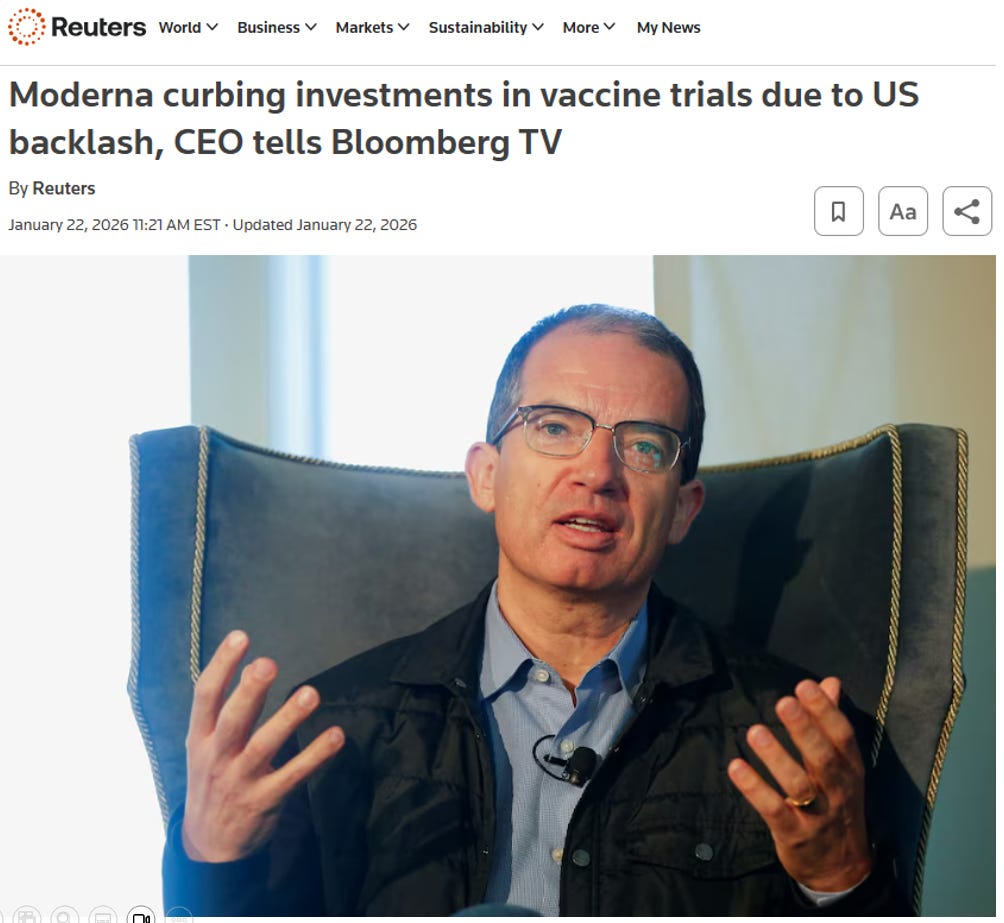
Lost in the latest news cycle was a stunning report from Reuters that has generated some buzz on X. Speaking from the World Economic Forum in Davos on January 22, CEO Stephane Bancel told Bloomberg TV that “Moderna does not plan to invest in new late-stage vaccine trials because of growing opposition to immunizations from U.S. officials.”
This is a shocking reversal for the once high-flying company and a modified RNA (modRNA) technology that many had predicted would revolutionize biomedicine. What happened?
I wrote in a previous piece in Sensible Medicine about a Pfizer trial for a modRNA influenza vaccine in 18-64 year olds reported as “positive” in the NEJM and lay press, but which had many limitations that negated this conclusion. In addition, the clearly negative trial in subjects over 65 years old was (deceptively) buried in a clinicaltrials.gov website and not published or even mentioned in the NEJM report of the younger cohort.
Moderna trumpeted results of a “successful” trial of its modRNA flu vaccine product in the lay press, but a review of published report of the findings in JAMA showed that the only “efficacy” was in antibody production - no clinical efficacy outcomes at all. The FDA was not impressed.
Moderna had previously developed and begun clinical trials of an RSV vaccine, but that did not go well, according to this report in Science from December 2024:
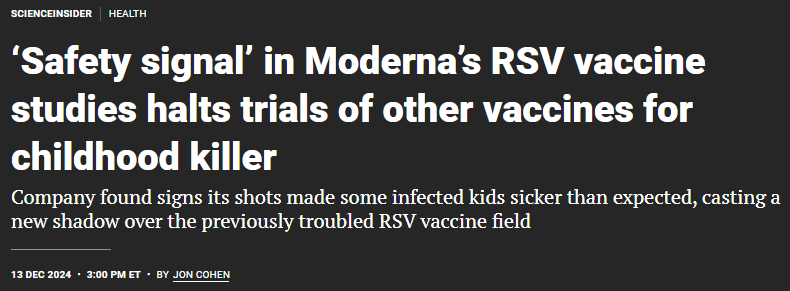
“Safety signal” is a code phrase for “kids were harmed” by the shots. According to the Science report:
“In a trial in Panama that enrolled children ages 5 months to 7 months old, five of 40 who received either RSV vaccine and later became infected with RSV developed severe or very severe cases of lower respiratory tract infections, compared with one of 20 children in the placebo group. Among the 27 infants who got the combo vaccine, three later became seriously ill from human metapneumovirus infections versus none in the placebo group.”
The phenomenon of vaccine-associated enhanced respiratory disease had been seen in previous RSV trials from the 1960s in which 2 children died.
Some commentators on X used the announcement to criticize RFK, Jr. for cancelling a $500 million contract to Pfizer and Moderna to support its trials of novel modRNA products and for perceived “anti-vax” statements made prior to his appointment as HHS Secretary. Yet a sensible observer should ask why any government support for these companies is needed or warranted.
The federal government has already paid for much of the basic science that led to creation of the modRNA technology. It supported the trials of modRNA Covid vaccines through Operation Warp Speed. It then paid the lion’s share of the cost of acquiring, distributing, and marketing the shots, resulting in enormous revenue and profits for the companies. Why should this mature technology require any further corporate welfare? In my view, the US would be better served funding 500 one million-dollar basic science RO1 grants.
Mr. Bancel also implies that modRNA vaccine are facing heightened regulatory scrutiny and a less favorable public reception owing to change in HHS leadership. This is likely true. The previous FDA policies of fawning over these products, fast-tracking their approval based on minimal clinical data, and promoting them in glowing terms to the public are over. They will be treated like other pharmaceutical products and more rigorously scrutinized for efficacy and safety. It is telling that Mr. Bancel seems to believe that Moderna’s modRNA lineup will not be able to survive such evaluation.
There are also risks of the technology which have been noted by critics but minimized or ignored by the FDA in the previous administration. modRNA shots are known to be highly reactogenic – they actually cause an “influenza-like illness” (ILI) in a high percentage of users. This alone makes them questionable as preventive therapies against influenza-like illnesses such as influenza and RSV.
The story of the minimization of risk of myocarditis from covid shots in young males is well known. Thousands of deaths associated with the shots were reported to VAERS, and a rigorous vetting of these reports has not been published, leaving questions in the minds of critics. Other unknowns include how widely the lipid nanoparticles disseminate the modRNA to other organs, and how much antigen is produced. Concerns about DNA contamination have also been raised along with potential for mutagenicity.
Perhaps Mr. Bancel has realized that the current FDA is going to ask them to address these concerns more rigorously. Finally, the modRNA brand was badly damaged during the pandemic by the vaccine mandates and the failure of the shots to deliver the expected herd immunity and long-term protection from severe illness and death. The NIH also failed to disclose the fact that it had a multi-million dollar royalty agreement with Moderna, even as its leaders were heavily promoting their covid shots.
Another point that Mr. Bancel makes in the Reuters interview is worthy of comment: “You cannot make a return on investment if you don’t have access to the U.S. market.” The US constitutes only 4% of the global population.
Why can’t Moderna make an adequate ROI from the 96% of people in the rest of the world, including 500 million Europeans? Mr. Bancel is saying the quiet part out loud: The US public pays nearly all of the profit margin and R+D budget for the global pharmaceutical industry. The Trump administration has declared its intention to level the playing field for the American pharmaceutical consumer. It remains to see how well this initiative will succeed.
What is next for modRNA technology? Time will tell. A recent press release reported that a modRNA cancer treatment given along with pembrolizumab immunotherapy increased the response rate in melanoma patients. Perhaps cancer therapy will prove to be a valuable approach for modRNA, and Moderna has pledged to continue research and trials in oncology.
Safety is a relative phenomenon, and an adverse event profile and unknown risks that would be unacceptable for mass vaccination of healthy young people might be entirely acceptable for patients with metastatic cancer. It might even be useful for vaccination in high-risk populations against high-risk diseases, like Ebola.
But for mass vaccination in healthy populations against relatively low-risk diseases like influenza and RSV, modRNA appears to be at a “dead-end.”’

Facts don’t care about your feelings ? Just the facts mom. We need to be protected from bad science. Glad we can have conversations now without fear of losing our jobs
Excellent article, Dr. Marine. These genetic drugs never passed the test of the “three D’s” that are known for all other pharmaceuticals, including vaccines: DOSE - DISTRIBUTION - DURATION of action. The DOSE isn’t how much they put in your shoulder; it is the amount of spike protein produced by your cells under the direction of the mRNA. That dose is unpredictable. DISTRIBUTION? The mRNA goes everywhere in the body including brain, ovaries, myocardium. DURATION? Not just a few days but reports of 2 years and counting. I agree mRNA might be of value in cancer where potential benefit could outweigh the risk. But as a “vaccine”? No way!