

Most studies published in medical journals investigate whether doing something helps. Does this drug, device, or procedure make people better? Vinay and I spent a little over a decade publishing on a less common study type: those testing an accepted practice against the practice it supplanted, or against doing nothing. An even less common study type tests whether indicated therapies can be stopped.
There is no question that, at some point, most medical interventions are no longer warranted. Whether we are talking about screening tests (mammograms, PSA, colonoscopy), risk factor modification (statins, smoking cessation), or treatment of common diseases (hypertension), there comes a time when competing health threats make it unlikely that interventions will pay dividends. Sometimes the ratio of benefits to harms flips from favorable at a young age to unfavorable later in life.
When it comes to therapy discontinuation — deprescribing — doctors practice in a data-free zone. We estimate a patient’s individual life expectancy — not every American man will live 76.5 years; we guess at the continued benefit of therapy and weigh that against the harm of 1-5 more pills a day.
It is worth celebrating that we are seeing more studies that address therapy discontinuation:
In July, the NEJM published an article asking whether it is OK to stop lenalidomide in patients with myeloma: Continuous or Fixed-Duration Maintenance Therapy in Multiple Myeloma.
John posted a great article discussing an observational study published in JAMA, "Colorectal Cancer and Mortality Risk Among Older Adults With vs Without Adenoma on Prior Colonoscopy," whose goal was to tell us when enough is enough with colon cancer screening.
The last few weeks have brought us studies in The Lancet (SAGA/SITE) and the NEJM (STAREE) that shed light on when we should stop starting or start stopping statins. (I deeply love that sentence.)
Andrew, John, and I discussed SAGA/SITE on Fortnight; Vinay wrote about STAREE; and STAREE will likely appear on a future Fortnight, so I am not going to rehash the critical appraisal here. But since, of the four of us, I am probably faced with these decisions most, I wanted my uninterrupted say.
Atorvastatin is the most prescribed medication in America. Rosuvastatin comes in at number 9. They are spectacularly effective in people with vascular disease. They have a role in primary prevention, but the new lipid guidelines seem to have been written with the sole purpose of getting more people on statins at a younger age. Even though we don’t have strong data to support this ramping up of primary prevention, it makes some mechanistic sense: stop the early deposition of plaque.
It also makes sense that we should stop them at some point. Why? Because as you get older, targeting one disease, even if it is the most common killer, does not make a difference in the face of everything else conspiring to kill you. We do have vaguely related data from 2004 that starting statins in people (in their mid-60s) who are at high risk for all-cause mortality (those on hemodialysis) provides no benefit.
Takeaways from STAREE
STAREE studied a group of patients that I don’t see — I’m not even sure they exist in the US — people over 70, about half with hypertension, with “average” cholesterol levels, who are not already on a statin. To be part of this patient population, you also needed to be willing to start a statin and demonstrate adherence during a month-long run-in.
(Vinay commented on the irritating nature of this run-in period. The inclusion of a run-in period in STAREE means that any efficacy demonstrated will exceed the effectiveness in a real population.)
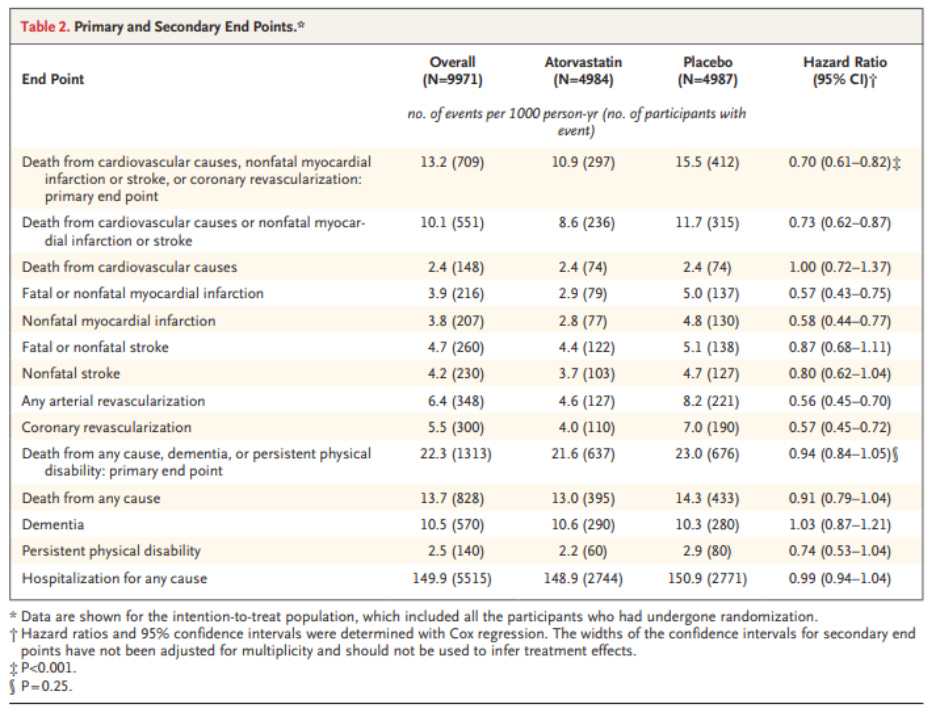
In the results table, with all the slicing, dicing, coupling, and uncoupling of endpoints, the only results that I think are independently important are that there was a decreased rate of nonfatal MI in the statin group (HR 0.58, 0.44-0.77, ARR 2%, NNT 50) and no difference in overall mortality (HR 0.91, 0.79-1.04).
How will STAREE affect my practice?
If I ever see a patient who looked like this, I would tell them I don’t really see a reason for them to start a statin. If they thought they’d definitely adhere, and decreasing the risk of MI a bit is important to them, and they wanted to start a statin, I’d write the prescription.
Takeaways from SAGA/SITE
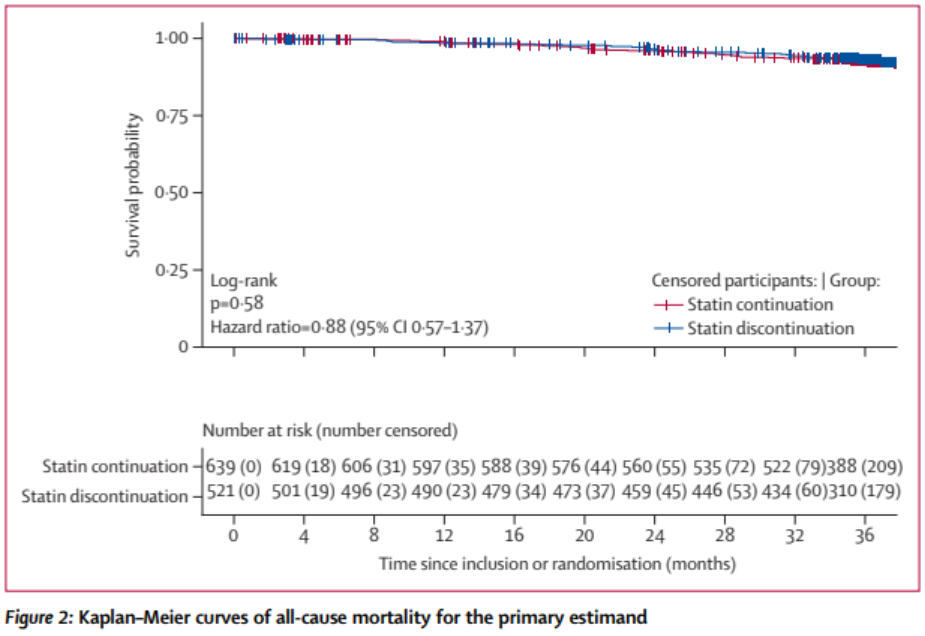
SAGA/SITE looked at a population that I see EVERY SINGLE DAY: People in their late 70s and early 80s who are on a statin for primary prevention and would like to be on fewer medications. On the Fortnight podcast, we discussed the issues with this trial, mostly related to its power. All that aside, the results of the trial are clear and in line with my priors. If you look at a population of generally healthy older people, whether or not you continue a preventive medication makes no real difference.
It is worth considering the characteristics of the patients in this trial. The median age was 80; about 2/3 were women; 29·5% had DM; and 77·2% had hypertension. The mean BMI was 27·3 kg/m2, and 61·7% had been on statins for more than 10 years. You can also bet that the 80-something-year-old patients participating in this trial were healthier than your average. Here is the survival curve for overall mortality.
How does SAGA/SITE affect my practice?
If a patient, similar to the ones in this trial, asked me if they could stop their statin, I’d say, “Absolutely!”
Whether I am going to start deprescribing statins in the 40% of my practice who are 75 and older gets to what we deprescribe, why we deprescribe, and the barriers to deprescribing. I always work to deprescribe unnecessary medications and those with toxicities that likely exceed their benefits. Benzodiazepines, aspirin, sleep aids, gabapentin, chronic NSAIDs, and PPIs probably lead the list.
I am also inspired to deprescribe medications when people are burdened by polypharmacy. I do this because there is a chance of unknown interactions and because I am obsessed with “cleaning up” medication lists and problem lists.
If we paid for our healthcare differently, cost would be a reason to deprescribe. This seldom comes up.
What undermines my deprescribing efforts? Often, my patients are more apt to continue a medication than to do an “N of 1” trial to see if they are getting any benefit from their PPI, gabapentin, or montelukast. Sometimes there is resistance to admitting the reality of one’s mortality. Accepting that there is not enough time left to benefit from a medication whose effect is measured over decades is not something everyone is willing to do.
Conclusion
In the end, STAREE will have little effect on my initiation of statins in older patients. SAGA/SITE will modestly increase my rate of statin deprescribing.
I loved "Because as you get older, targeting one disease, even if it is the most common killer, does not make a difference in the face of everything else conspiring to kill you."
Comes an age where just breathing might conspire to kill you.
In 2002, my 82-year-old grandmother laid in a hospice bed 2 weeks away from passing away. She had survived breast, colon, and endometrial cancer, but her heart was fine, short of being 82 years old. She was having difficulty swallowing anything, especially pills. The hospice nurses (on orders written by her doctor) were still giving her atorvastatin. Needless to say, I deprescribed it myself by washing them down the sink through the disposal. I know, we are not supposed to do that, but someone somewhere said they should be in the water supply anyway, and it's what I had on hand that I knew would make sure she never got forced to take another one. I started deprescribing them routinely in my elderly patients who were taking them for primary prevention after that (after a conversation with said patient). I finally feel vindicated with this study. To me, it was just logical.