

About 10 years ago, I built a website called Flawed Science Times. I spent way too much time building it so that it would be nearly indistinguishable from the actual, weekly New York Times’ Science Times section.1 I imagined that every week I’d write articles about what was wrong with that week’s health science coverage. I never published the site, which is probably for the best since I expect I would have ended up depressed and litigated.
In the early days of Sensible Medicine, we published a whole series on churnalism. We defined churnalism as the careless, incurious reporting of poorly conducted biomedical research. We argued that churnalism trades the real story — why a study is unimportant or proves something other than it contends — for the easy headline. We publish articles about churnalism from time to time. John’s article about the latest coffee research is an example, though he thankfully stayed away from the Times’ coverage.
What brings me back to churnalism today is some particularly egregious exercise churnalism recently.
Before going any further, I must reiterate that exercise is good for you. We have pretty robust evidence that exercise prevents more diseases than most people can name. It fights obesity, coronary artery disease, diabetes, dementia, cancer, and depression. And it is cheaper than a GLP-1! Here is one of a million references you could use. Everybody should find a way to exercise safely and as much as possible, every day.
There is also some good journalism on exercise. 5 Science-Backed Longevity ‘Hacks’ That Don’t Cost a Fortune, is pretty good (as long as I stay away from the “Train your brain to be more optimistic” recommendation). There are also some pretty good Substacks. Michael Easter always does a nice job.
Most articles that are published, however, answer a question that nearly nobody needs to ask: If I am already maximally exercising, is there something I can do to make my exercise more beneficial?2
Recently, the New York Times published an article titled, The Best Sports for Longevity. This article restated a claim that just won’t die: Tennis is the best sport for longevity. This claim was made by a Danish study in 2018. And it has haunted me ever since. A few years ago, I was at the US Open and started ranting like a psychopath when I saw this sign:3
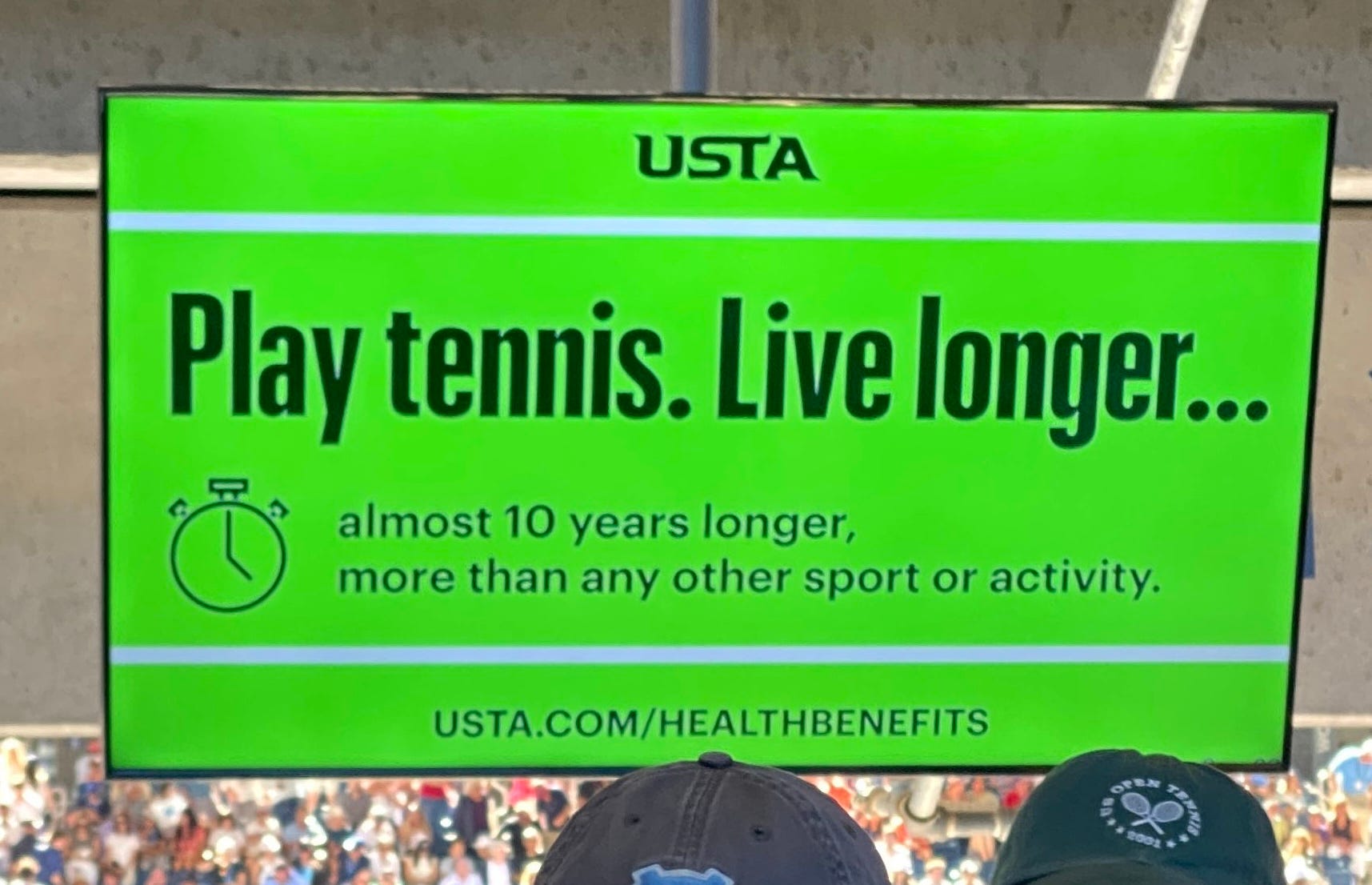
There have been a few equally poor, similarly designed studies since. I’ll argue the failings of the original study, as reported in the recent Times’ article, in terms of our deadly sins of churnalism:4
Sin #4: Neglecting Plausibility
In the Danish study, participants were surveyed about their exercise habits and then followed for 25 years. It turns out that most of the active people in this study were bikers, and most bikers also did other sports. If biking was your most common activity, you were considered a biker. Because almost everyone was a biker, you were considered a jogger, for instance, if, after biking, jogging was the sport you did most commonly. Thus, the same person was often included in multiple categories.
The researchers found that playing tennis was associated with the longest survival; tennis players lived over 10 years longer than sedentary people. Following tennis, badminton, soccer, jogging, cycling, and swimming, in that order, benefited longevity. The magnitude of the differences was huge. If you swim, you will live 3 years longer than if you sit around, but if you play tennis, you will live 9 years longer. The benefit of playing tennis over swimming is twice as big as the benefit of swimming over doing nothing.
This is an implausible finding. Tennis might be a little better than swimming, but six years is preposterous. It seems even more preposterous when you remember that people do more than one activity. Tennis players also play soccer. Soccer players also swim. Swimmers also go to the gym. What makes someone a “tennis player” in this study is that tennis is the second most common activity he or she does.
Sin #3: Confounding
What is the explanation for this finding? It is likely confounding. People who choose one sport are different from those who choose another. Tennis players in this population tended to be younger than others, and a higher proportion had high household incomes. The authors adjusted for factors they inquired about and that differed between the groups. They adjusted for age, sex, and the number of hours people exercised per week.
But think about the residual confounders, all those differences that were not measured. To play tennis, you must have access to a court. Copenhagen has a yearly average daytime high of 52 degrees and fewer hours of sunshine per year than Anchorage, Alaska. To maintain a tennis habit, a person probably needs access to an indoor court. That takes a certain level of resources. That person also needs someone to hit the ball back, a colleague or a friend who is free at the same time, or maybe a professional whom you pay. This further selects for people who are economically well off and socially connected.
Sin #5: The Disclaim and Pivot Maneuver
Churnalists employ the disclaim and pivot maneuver so they can sleep at night. The maneuver enables them to publish worthless and misleading articles while still calling themselves journalists. The Times article provides a beautiful example about which nothing needs to be said:
These findings don’t prove that tennis causes people to live longer, said Emmanuel Stamatakis…
Still, experts believe that tennis’s unique blend of physical, cognitive and social challenges contribute to healthy aging.
Sin #7: Being Incurious
Lastly, churnalists are just not sufficiently curious. There is so much more to make of this research. The implausibility is interesting. A journalist could analyze the impact of the things we know prolong life and consider how unbelievable the tennis effect is. The story of confounding is also interesting. The impact of wealth, social connectedness, and health/luck (it takes a lot of musculoskeletal fortune to keep playing tennis) are truly remarkable. A curious journalist could make a great read out of these topics.
Ok. I got this out of my system for a bit. If you want another piece of churnalism to sink your teeth into, here is a gift: Walking Longer, Not Necessarily More, Shows Big Health Benefits. If you’d rather just be happy and embrace the things you like that churnalism supports, I give you this wonderful article by Paul Sax.
I was inspired by Not The New York Times, a parody newspaper published during the 1978 New York City newspaper strike.
Most of the articles fail even to answer this question.
Yes, I did take a picture of it.
For a deep dive into this article, Vinay and I made relentless fun of this study in one of your first churnalism posts.
Not sure whether you guys have ever addressed the demand side .I think we are primarily dealing with ‘clickbaiting’ rather than churnalisim, Clickbait works for the journalists and publishers because the fish are attracted to particular sorts of bait - or fly. So the bait or fly that is most effective in hooking the fish is the one that is selected/constructed and used. Healthbait is particularly effective in landing lots of fish. I’m not ot all denying the media have enormous power but they are usually exploiting some basic human limitations in information processing and bS detection, which the current education system (deliberately) avoids tackling. Without addressing this, hoping for more ‘ethical’ and ‘responsible’ journalism is likely to be futile.
Adding to the implausibility—how could tennis be that good for you when pickleball is so dangerous??? 🤨