


Last week, Vinay Prasad posted a “Frequently Asked Questions” article. I was tempted to respond with my answers to the questions that Vinay is frequently asked. David Rind acted on my temptation and wrote about one of the questions that Vinay answered:
Do you think a healthy pregnant woman in 2026 should get a COVID-19 shot?
Because our goal here is to “showcase a range of ideas and opinions about all things bio-medicine”, we thought it would be informative to post Dr. Rind’s answer and give Dr. Prasad the chance to expand his answer. This piece ended up being even more of a back-and-forth than we expected.
If you finish this and think, “I don’t get to see this sort of agreeable disagreement anywhere these days,” subscribe!
Adam Cifu
David Rind
I agree with many of Dr. Prasad’s answers in his article, but there was one that I disagreed enough to respond to: his conclusion that a healthy pregnant woman in 2026 should “absolutely not” get a Covid-19 vaccination. This is a fraught topic, and it is one my organization, The Institute for Clinical and Economic Review (ICER), tackled in its July 2026 report on Covid vaccination. The evidentiary support for any unreferenced sentences in this piece can be found in that Report.
I want to start by asserting two truths. First, the mRNA vaccines rolled out in the US as a result of Operation Warp Speed were lifesaving in 2021. If you do not agree with this, it is pointless to continue reading what I have to say. The second is that, in 2026, any benefits of COVID vaccination are much, much smaller. This is because the population is no longer immunologically naïve. Even if you believe universal vaccination should be required, you should agree that the absolute benefits today are much smaller than they were five years ago.
For most people, getting a COVID vaccine reduces an already very small risk of serious disease while carrying a relatively high risk of side effects severe enough to interfere with work or activities for a couple of days. This is a tradeoff, and reasonable people can choose to get vaccinated or not. The evidence that vaccination reduces transmission at the population level is relatively unconvincing. Vaccinated individuals can transmit COVID even if they are asymptomatic, and being vaccinated may increase the likelihood of COVID infection being asymptomatic. Better evidence is needed before vaccination can be claimed to protect others in society against COVID in 2026.
In the 2024-2025 season, younger adults in the US were hospitalized with Covid-19 at a rate of about 20-40 hospitalizations per 100,000 people. ICER estimated that vaccination might reduce this by about 6 hospitalizations per 100,000.
Some groups, though, are at much higher risk. The rate of hospitalization for those 85 and older is 1200 per 100,000 people. Vaccination in those over age 65 is likely less effective than in younger people on a relative basis, but the best recent evidence that ICER found strongly suggests that vaccination would reduce hospitalizations by 75 per 100,000 and deaths by 22 per 100,000 older adults. Older adults often have fewer side effects with COVID vaccination and might well choose to be vaccinated for these risk reductions.
Pregnant women have consistently been found to have higher risks of severe Covid-19 than non-pregnant women. However, the risk of severe Covid-19 has been decreasing in all groups year over year, so the absolute benefit of vaccination is uncertain and quite possibly small. The American College of Obstetricians and Gynecologists (ACOG) continues to strongly recommend COVID vaccination for all pregnant individuals during any trimester at the earliest opportunity.
ICER’s conclusions about the evidence lead me to question both the ACOG recommendation and Dr. Prasad. Infants less than 6 months of age are at higher risk of hospitalization for COVID than any other age group until people reach the age of 75. Do we know if maternal vaccination is beneficial?
On this question, ICER concluded we needed to look to biologic plausibility – typically a form of evidence low on the evidentiary hierarchy. Early third-trimester vaccination for COVID has been demonstrated to optimize cord blood antibodies. Higher levels of antibodies are associated with greater protection in infants; this is a type of “dose response”, which increases the likelihood that this association is causal. Additionally, observational data show that influenza and pertussis vaccines in pregnant women can protect young infants against those diseases.
What about harms? There have been many studies of COVID vaccination in pregnant women that have found it to be safe. However, fever during embryogenesis has been shown to be teratogenic in animals; the evidence in humans has been somewhat inconsistent. Given this concern, the frequency of fevers after COVID vaccination, and the desire to optimize placental antibody transfer, vaccination early in the first trimester seems riskier than other options and may offer fewer benefits. In contrast, early third-trimester vaccination is unlikely to be harmful even if it results in fever, and it optimizes cord blood antibody levels.
Since COVID itself results in fevers, women contemplating pregnancy may want to try to have had the most up-to-date vaccine prior to pregnancy and then get revaccinated early in the third trimester. We currently have limited evidence and biologic plausibility to support this approach, but it is what I tell my patients, my friends, and my family members. ICER’s report explicitly called out the need for randomized trials of third-trimester vaccination for COVID to definitively answer questions about safety and efficacy.
I think ACOG should have made more targeted recommendations, but while we wait for better evidence, I think Dr. Prasad is wrong to say that in 2026 a healthy pregnant woman should “absolutely not” get a COVID vaccine.
Vinay Prasad
I appreciate Dr. Rind, and ICER in general, but on this issue, I maintain that a pregnant woman in 2026 should “absolutely not” get a COVID-19 shot.
What is our core disagreement? People who choose to get COVID shots differ from those who don’t in ways that go beyond the vaccine. If you believe this – which I do – you cannot use observational data to make your argument. Not for efficacy, nor safety. Proof they differ comes from studies that compare the two and find ludicrous differences: different rates of car accidents or all-cause mortality. If healthier, richer, better educated people get (more) shots, even safety risks can be hidden.
Dr. Rind cites a rate of 20/100k hospitalizations among young people in 2024-25. The CDC tracker he links to tracks “COVID-associated hospitalization.” This is technically not the same as tracking kids who are hospitalized because they can’t breathe because of COVID in the lungs. It includes kids who are hospitalized for all sorts of reasons (broken bone) who incidentally have COVID (when swabbed on intake). Second, his numbers are out of date. 2025-26 is down to 8 per 100,000 among kids 0-4 (presumably the target of passive maternal antibodies) at its peak.
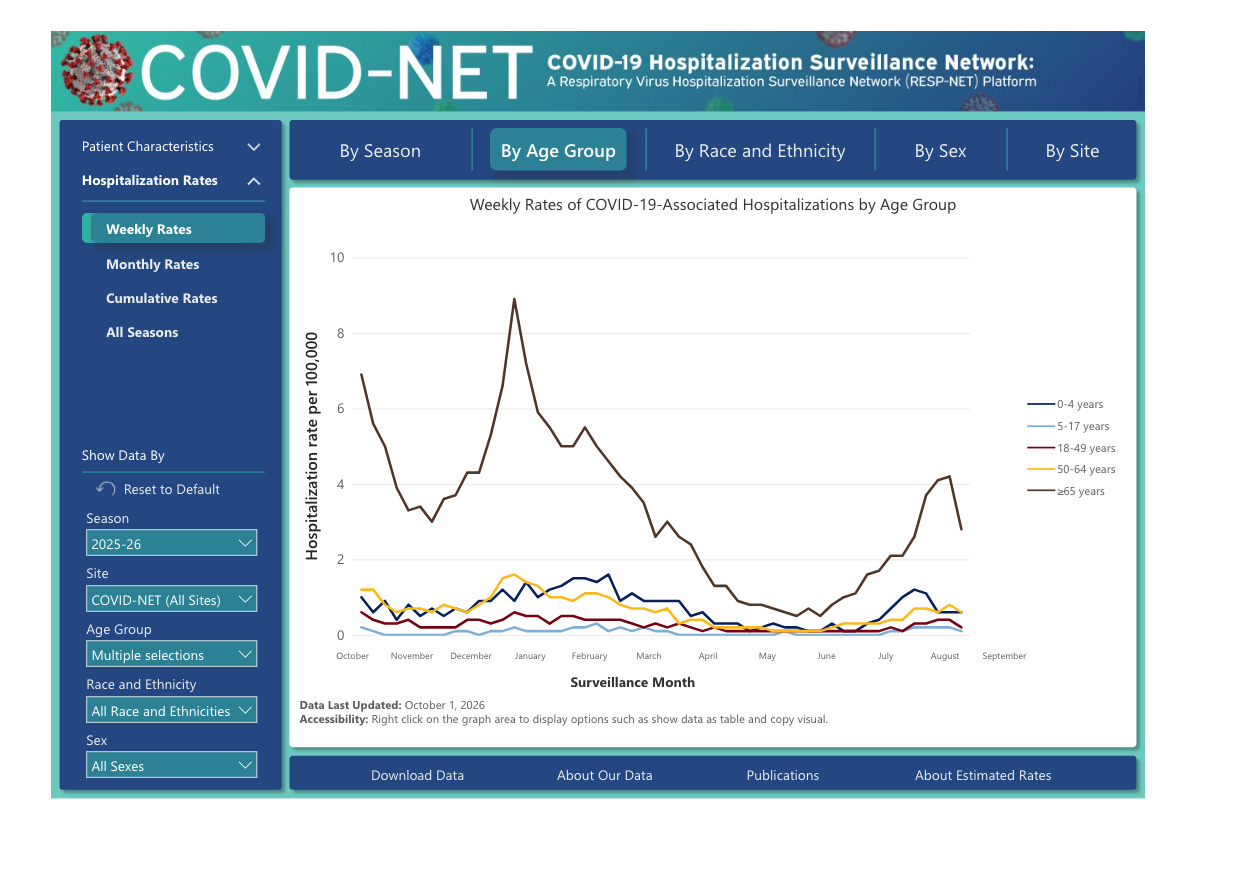
These data don’t separate healthy kids from kids with comorbidities. A child with in utero birth defects has a much higher chance of hospitalization (with or from) COVID than a perfectly healthy, morphologically normal baby on a 20-week ultrasound.
Dr. Rind says that ICER estimates COVID boosters reduce the rate of hospitalization in young adults from 20 to 14 per 100,000 (6 per 100,000). The 6 per 100k, or 30% RRR, is an imaginary number. Dr. Rind has no randomized evidence to support this number. He is citing a target trial from the VA. Target trials are unreliable; they showed Paxlovid saved lives, glp1s reduced Alzheimer’s, and other claims that were debunked with randomized studies. In this case, the fundamental challenge is that people who receive both vaccines are still different than those who get flu only. The authors are familiar characters to those of us in COVID debates, and to be blunt, I don’t trust them. Their falsification tests vary from publication to publication and often exclude the greatest falsification test. Ask them to publish a Kaplan-Meier curve of all-cause mortality for the matched cohorts, which is the ultimate falsification test to exclude healthy user bias. Extrapolating this relative risk reduction to maternal antibody transfer to babies is dubious. Finally, even assuming his RRR, Maternal antibodies last at most 3-9 months, conferring even smaller benefits.
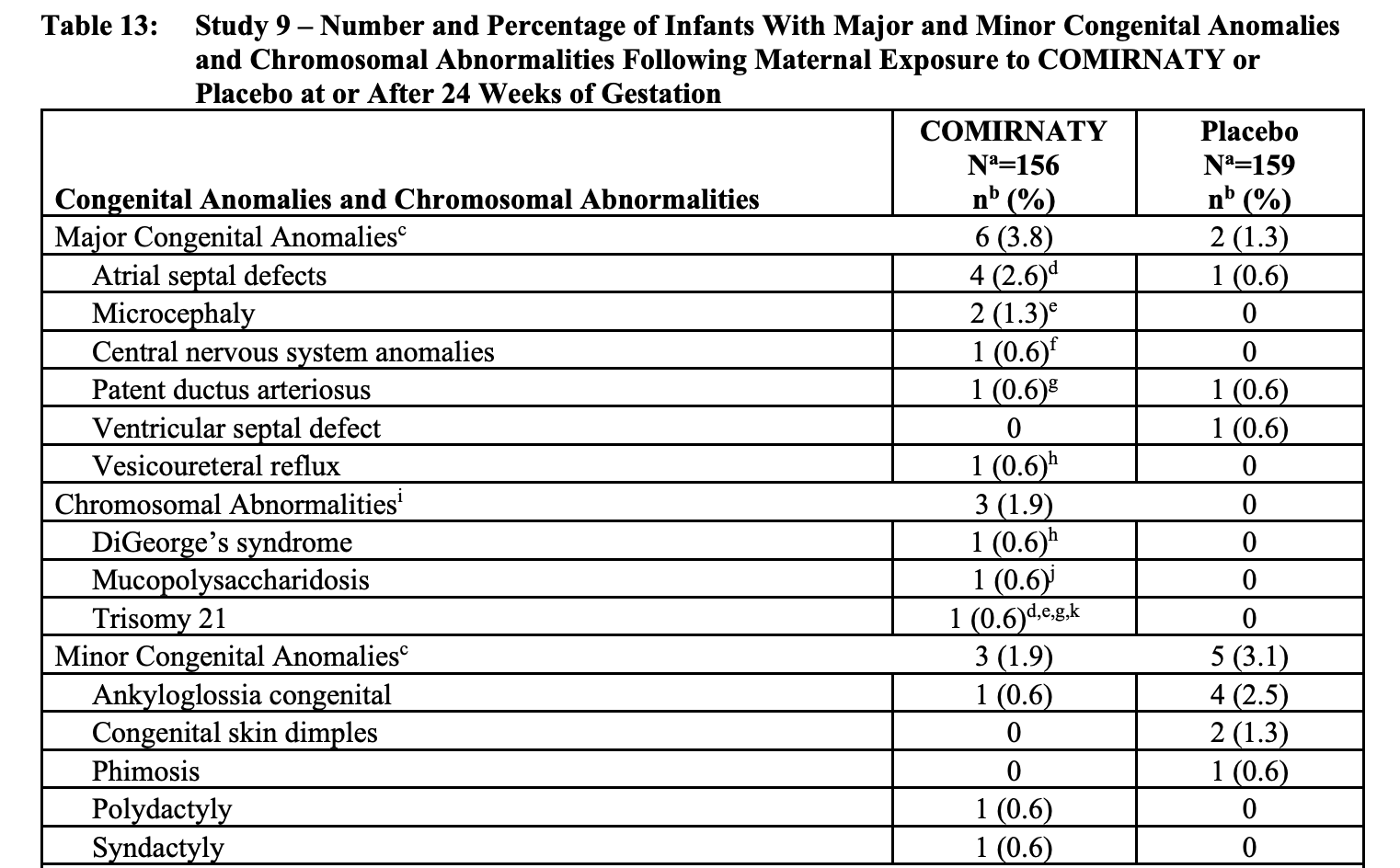
Dr. Rind says many studies show vaccinating pregnant women is safe – again citing observational data. In my opinion, we have no idea what the true safety profile is in pregnant women. There was a randomized controlled trial that was going to answer this question, but it was aborted (conveniently for the manufacturer). Those truncated RCT data are on the package leaflet, and they allow no strong conclusion to be drawn. We don’t know if the product increases birth defects; we don’t know if the product increases maternal hypertension. Pregnant women deserve better than this limited table.
Every year the covid-19 vaccine is different. It is possible that a future antigen will stimulate the immune system in a more problematic way. With pregnancy, the priority of safety and no one knows the safety of the next vaccine.
Dr. Rind admits that his level of evidence is biologic plausibility. If you can take healthy people and administer medical interventions based on biologic plausibility, why should that not extend to other situations in medicine? Should I be able to give a fat 8-year-old a glp1 agonist because of biological plausibility? How about a PCSK9? You can construct similar chains of logic here.
I believe in a simple rule. Do not inject pregnant women with anything unless you have robust randomized evidence that there is a net clinical benefit to mother and child. That standard is not met here. Not even close. In the meantime, not only do I think pregnant women absolutely should not get a COVID shot – I think it is negligent to give it.
Final point: if you powered an RCT of pregnant women getting a COVID booster starting in 2027 (the first year we could run it), following neonatal outcomes, the sample size would be so astronomical that this might be one of those rare situations where I would argue that randomization is unethical due to futility. Maybe it is time to forget about COVID.
David Rind
Pregnant women need to make a choice in the face of inadequate data. I think the evidence points in a direction opposite that of Dr. Prasad’s FAQ answer but, to be clear, I am less certain in my conclusions than he is in his.
Dr. Prasad is clearly not a fan of the VA study or its authors. When it was published, I was startled that the NEJM would publish an observational study and skeptical that it could improve our understanding of COVID vaccine efficacy; then I read the article. I would encourage everyone interested in this question to do the same.
David Rind is an academic primary care physician at Beth Israel Deaconess Medical Center and Chief Medical Officer of the Institute for Clinical and Economic Review. He was previously Vice President, Editorial and Evidence-Based Medicine at UpToDate.
Vinay Prasad is, never mind, you know him.
Vinay brought the receipts
I enjoyed reading this debate about Covid vaccinations. Thank you SM.