


I was shocked at the comments on this post.
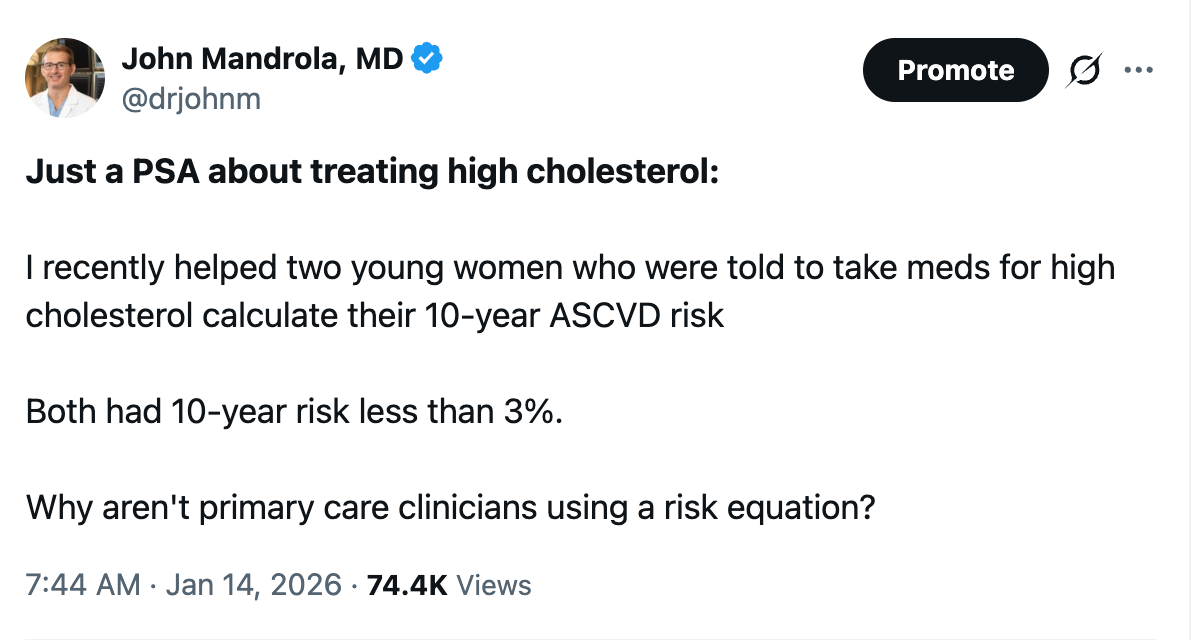
Many people, some of them I know to be smart, thought I was nuts for suggesting two middle-aged women who had isolated high LDL-C needn’t take meds because their calculated 10-year risk was less than 3%
What shocked me is that our guidelines suggest treatment with statins when 10-year risk is ≥ 7.5%. You may not know this but clinicians are supposed to consider cholesterol (and BP) based on overall risk, which include things like age, blood pressure, smoking status as well as HDL. Here is a link to the PCE. It drives me bananas that clinicians don’t go over this with patients. They just look at LDL-c in isolation.
Experts chose this a 7.5% threshold because they felt it was the point where the absolute risk reduction from statins (about 20-25% relative risk reduction) for nonfatal cardiac events outweighed any potential downsides of statins. It is an arbitrary threshold.
The thinking: We know from many RCTs that statins reduce future risk by about 20-25% over 5 years. So .25 x the estimated risk outputs the absolute risk reduction. Let’s say a person has a calculated risk of 10%. They can expect a 2.5% risk reduction (.25 x 10% = 2.5%) over 10 years. But .25 x 3% = .75, so a person with an estimated risk of 3% who takes a daily pill for 10 years goes to 2.25%. That’s not much.
Here are some pics of the pushback I recieved:
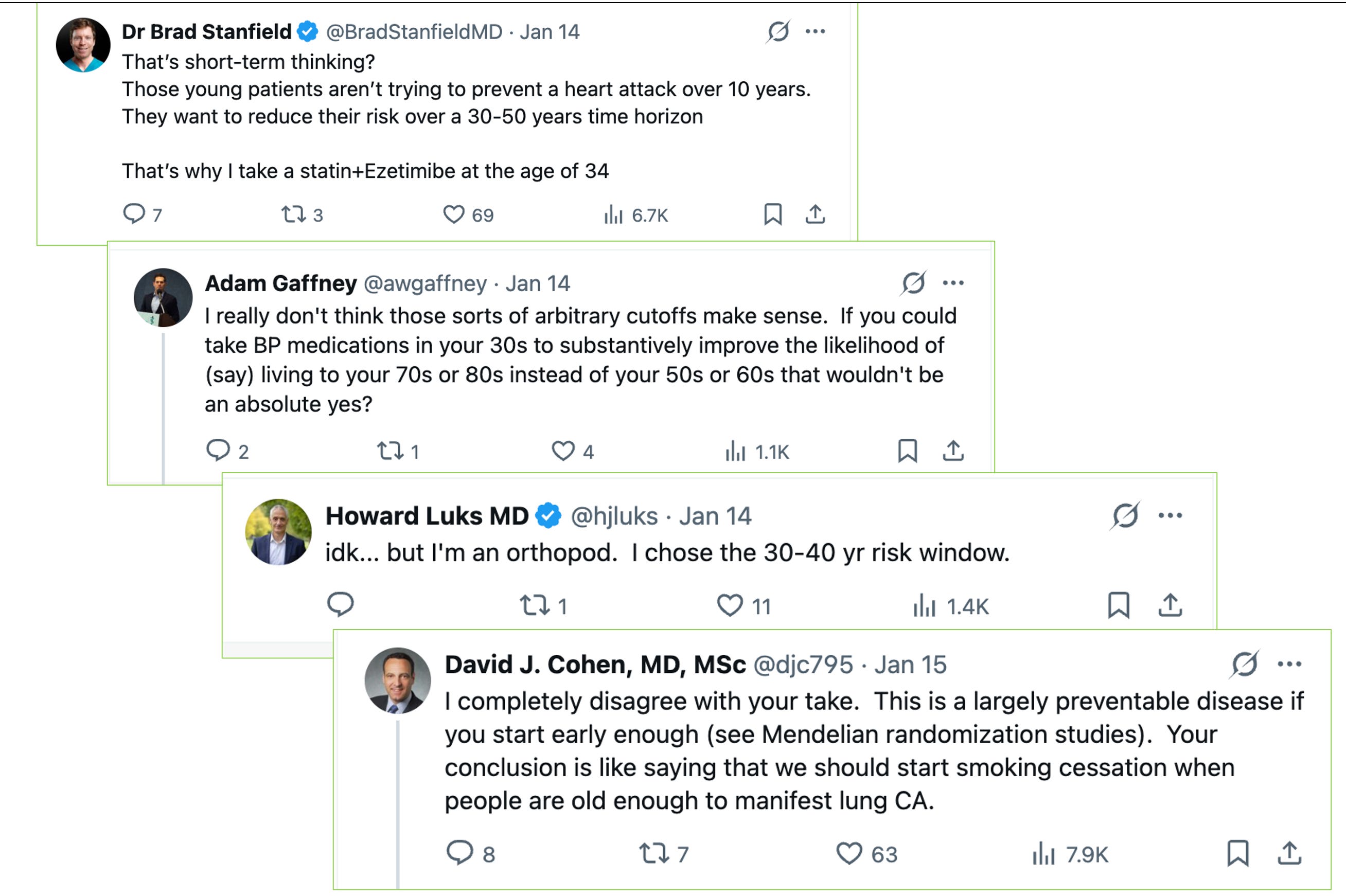
My colleagues rightly point out that atherosclerosis of the coronary arteries is a slow process and longer exposure to lower LDL-c is beneficial. They feel that the 10-year horizon is too short. They cite something called Mendelian randomization studies which find that people who were born with genetic profiles that cause low cholesterol also have low rates of heart attacks.
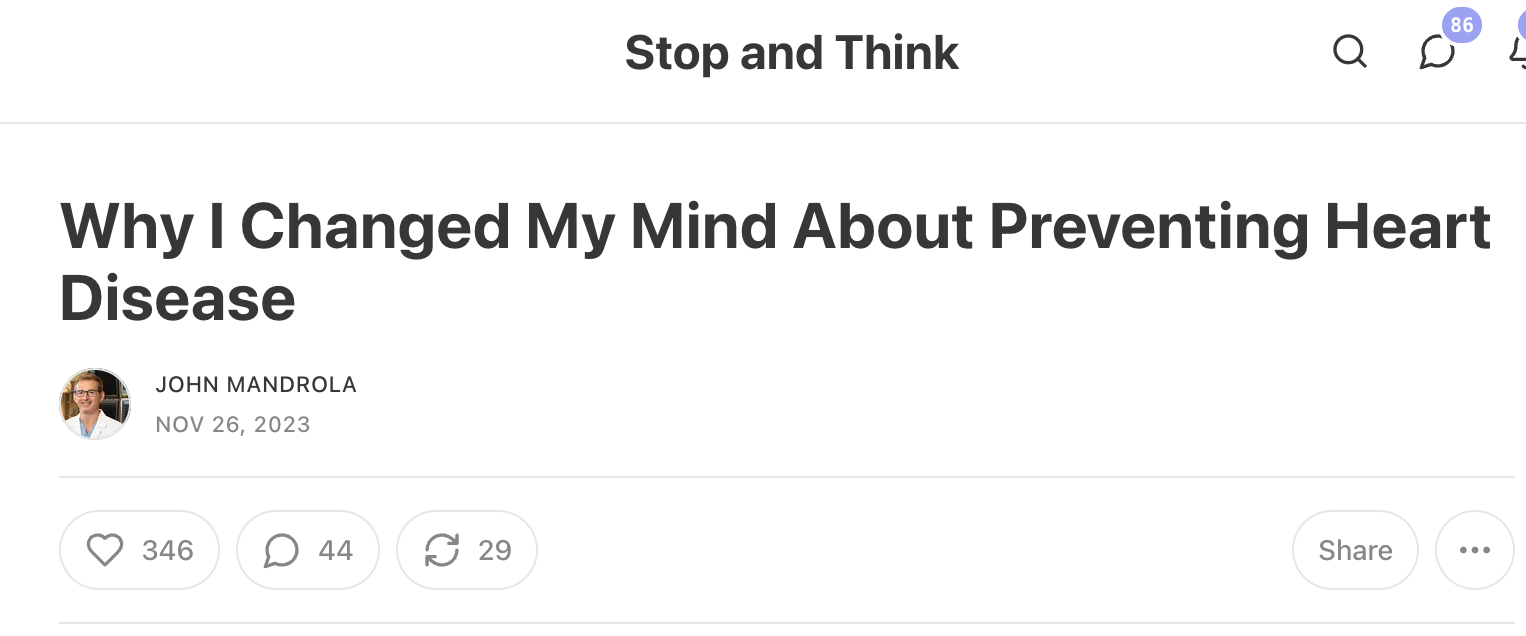
I wrote a post about this. I actually think that statins and blood pressure drugs may have greater effects in younger people who are at lower risk.
But come on. Both individuals who I helped calculate risk were below 3%. That’s too low to worry about.
Further, if you think we treat people with elevated LDL levels who have this low of a risk, why do we need risk calculators? Or…why don’t we just treat everyone above a certain age, since age is the largest driver in the calculators?
These are issues I spoke with Drs Foy and Murthy about. I learned a ton. I hope you will too.
Topics include:
The value of risk calculators
The uncertainty of prediction
The best time window to consider (statin trials were for 5 years; can we assume effect sizes over 5 years are similar at 30 years?)
The causal role of LDL-c vs “metabolic health”
The value of coronary artery calcium testing
Lipoprotein (a)
Academic people like to make fun of podcasts, but I can’t imagine a more educational 40 minutes. Andrew and Venk are two of the most thoughtful people in cardiology today.
Enjoy and consider supporting Sensible Medicine


